Uncategorized
How to Bleed Brakes Alone: Skip Repeated Pedal Pumping

September 27, 2026
Share:
 autoolstore.com
Repair testing / 8 sub-categories
Diagnostic tools for leak tracing, visual inspection, battery health, circuits, pressure, spark, oil, and electrical readings.
Repair maintenance / 6 sub-categories
Service equipment for fluid exchange, A/C diagnostics, refrigerant recovery, oil handling, and cooling-system work.
Carbon cleaning / 3 sub-categories
Carbon-removal equipment for injectors, intake valves, components, and workshop cleaning jobs.
Wheel tire / 3 sub-categories
Equipment for alignment, lifting, tire repair, tire mounting, and service-bay workflows.
Tool storage / 1 sub-category
Storage products for keeping workshop tools, test equipment, and accessories organized.
EV charging / 1 sub-category
EV charging products for new-energy vehicle service, workshop use, and installation scenarios.
OBD diagnosis / 5 sub-categories
OBD-related testers, ECU programming power supplies, cable products, used-car inspection tools, and key frequency diagnostics.
Accessories / 8 sub-categories
Replacement parts, adapters, consumables, cables, and add-ons for major diagnostic and service equipment.
What is one of the most frightening things that can happen while driving? You press the brake pedal, but it feels soft and spongy—and the vehicle does not slow down as expected.
A soft brake pedal can indicate air in the hydraulic braking system. Unlike brake fluid, air can be compressed. When air bubbles enter the brake lines, part of the force applied to the pedal compresses the air instead of being transferred directly to the brake calipers. This can reduce braking performance and, in serious cases, create a significant safety risk.
Brake bleeding removes trapped air from the hydraulic system and restores consistent pedal pressure. With the right pressure brake bleeder, one trained person can perform a brake fluid change without repeatedly pumping the pedal or relying on a second person.
Brake systems are safety-critical. Always follow the vehicle manufacturer’s service procedure, pressure limits, fluid specification, and bleeding sequence. If you are uncertain about any step, have the work performed by a qualified technician.
There is no single replacement interval that applies to every vehicle. Some manufacturers recommend a time-based interval—often around two years—while others specify an inspection or replacement schedule based on mileage, operating conditions, or measured moisture content.
Always consult the owner’s manual or service information for the correct interval. Most glycol-based DOT 3, DOT 4, and DOT 5.1 fluids are hygroscopic, meaning they absorb moisture over time. As moisture content rises, the fluid’s boiling point falls. Under heavy braking, the fluid may become hot enough to form vapor, contributing to a soft pedal or reduced braking response. A proper brake fluid change replaces aged, contaminated fluid while helping remove trapped air from the hydraulic system.
The conventional method usually requires one person inside the vehicle to operate the brake pedal while another opens and closes the bleeder screw at each wheel.
Although this method can work when performed correctly, it has several disadvantages:
It requires two people. The timing between pedal operation and opening or closing the bleeder screw must be coordinated carefully.
It is repetitive and time-consuming. Pumping the pedal, opening the bleeder, closing it, checking the reservoir, and repeating the process can take considerable time.
The reservoir can run dry. If the fluid level drops below the reservoir outlet, air may enter the master cylinder or other parts of the system, making the bleeding process more complicated.
Brake fluid may also damage painted surfaces. An uncontrolled manual process can lead to spills around the reservoir, wheels, or work area.
For workshops and experienced DIY users, a brake fluid exchanger offers a cleaner and more efficient approach to one-person brake service.
The principle behind brake bleeding is straightforward: remove old fluid and air through the bleeder screws while continuously supplying fresh fluid without allowing new air to enter the system.
Three common one-person methods are available:
| Method | How it works | One-person convenience |
|---|---|---|
| Vacuum bleeding | A vacuum pump draws fluid and air through the bleeder screw | Moderate; leaks around the screw threads can resemble air bubbles |
| Pressure bleeding | A pressure brake bleeder supplies fresh fluid through the reservoir | High; pressure and adapter sealing must be monitored |
| Pulsating fluid exchange | A machine supplies fluid with controlled pressure pulses while collecting the old fluid | Very high; designed for efficient one-person service |
A pulsating AUTOOL brake fluid exchanger can combine controlled fluid delivery, pressure monitoring, and waste-fluid collection. This reduces repeated pedal pumping and helps technicians complete the job with fewer interruptions.
A standard pressure brake bleeder maintains positive pressure at the brake fluid reservoir, pushing fresh fluid through the hydraulic system as old fluid exits through the bleeder screws.
A pulsating exchanger varies the pressure output during the process. According to AUTOOL, this controlled pulsing helps move old fluid and contaminants through the brake lines while reducing bubble formation during filling.
Depending on the model, an AUTOOL machine may also include:
These features make a pulsating brake fluid exchanger useful for workshops that perform brake maintenance regularly.
The following overview explains the general process for using a pulsating exchanger. It does not replace the instructions for your vehicle or machine.
You will typically need:
Do not select fluid based only on a general DOT label. Use the precise specification listed by the vehicle manufacturer. Never mix DOT 5 silicone fluid with glycol-based DOT 3, DOT 4, or DOT 5.1 fluid unless the vehicle manufacturer expressly permits it.
Park the vehicle on a firm, level surface. Apply appropriate wheel chocks and follow the manufacturer’s lifting instructions.
If the vehicle must be raised, support it with properly rated safety stands at the approved lifting points. Never work beneath a vehicle supported only by a jack.
Before beginning the brake fluid change, inspect the reservoir, hoses, brake lines, calipers, wheel cylinders, and bleeder screws for damage or leakage.
A bleeding machine cannot repair a leaking hydraulic component. Any known leak or mechanical fault should be corrected before the vehicle returns to service.
Add the specified new brake fluid to the machine’s supply container. If required by the device instructions, prime the filling hose until it contains clean fluid without visible air bubbles.
Choose the correct reservoir adapter and secure it firmly. A poor seal can prevent pressure from building or allow fluid to leak.
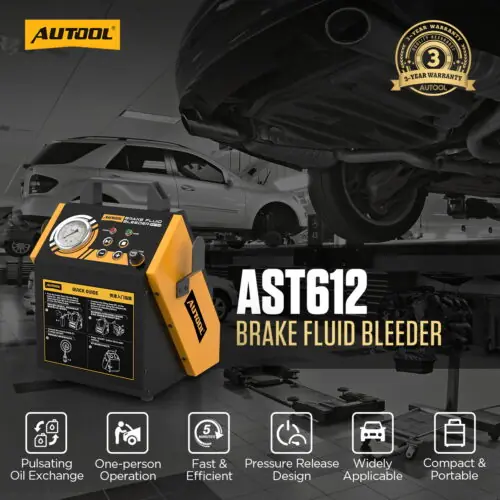
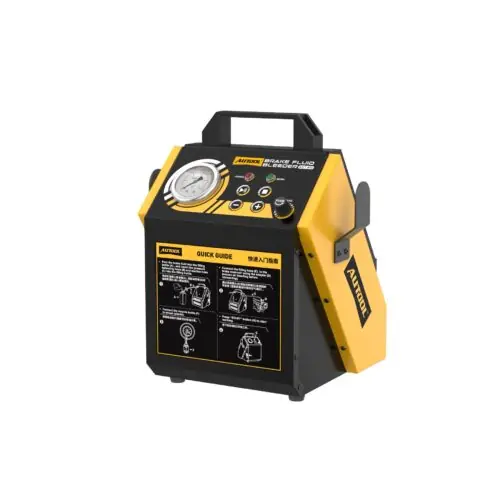
Connect the machine to its specified power source. For example, the AUTOOL AST612 operates from a 12V DC supply, which makes it suitable for mobile service and workshops without convenient access to an AC outlet.
Do not assume that one pressure setting is safe for every vehicle. Check the vehicle manufacturer’s maximum filling pressure and follow the instructions supplied with the exchanger.
Excessive pressure can damage the reservoir or other hydraulic components. If the machine cannot build pressure, stop and inspect the fluid level, adapter seal, hoses, and connections.
Connect a transparent recovery hose and waste-fluid bottle to the selected bleeder screw. Start the machine, carefully open the bleeder, and monitor the discharged fluid.
Continue until clean fluid flows without visible air bubbles, then close the bleeder to the manufacturer’s specified torque before disconnecting the hose.
Many older vehicles are bled from the hydraulic circuit farthest from the master cylinder toward the nearest one. However, this is not a universal rule. Diagonal-split systems, ABS modules, brake-by-wire systems, and manufacturer-specific hydraulic layouts may require a different sequence or a scan-tool-assisted procedure.
Always use the bleeding order specified in the vehicle’s service manual.
After completing all required circuits:
A cautious low-speed brake test should only be performed in a controlled area after the system passes a stationary inspection.
An AUTOOL brake fluid exchanger is designed to make professional brake maintenance more efficient, particularly when only one technician is available.
Maintaining a controlled supply of fresh fluid helps prevent the reservoir from running dry. Certain models also monitor pressure or fluid supply and stop the pump when normal operating conditions cannot be maintained.
AUTOOL’s pulsating systems use controlled pressure pulses during fluid delivery. This is intended to improve fluid exchange efficiency and help move contaminants through the hydraulic lines.
Once the machine, adapter, and recovery bottles are connected correctly, one technician can service the system without asking another person to repeatedly pump the brake pedal.
Recovery hoses and bottles collect discharged fluid, helping keep the work area cleaner while reducing the risk of brake fluid contacting paint or wheels.
Different vehicles use different reservoir openings. AUTOOL offers models with adapter sets intended for a variety of European, American, and Asian vehicles. Compatibility should still be confirmed before purchase and use.
AUTOOL offers several pulsating exchangers for different workloads. The specifications below are based on the manufacturer’s published product information and may vary by region or product revision.
| Model | Recommended application | Selected features |
|---|---|---|
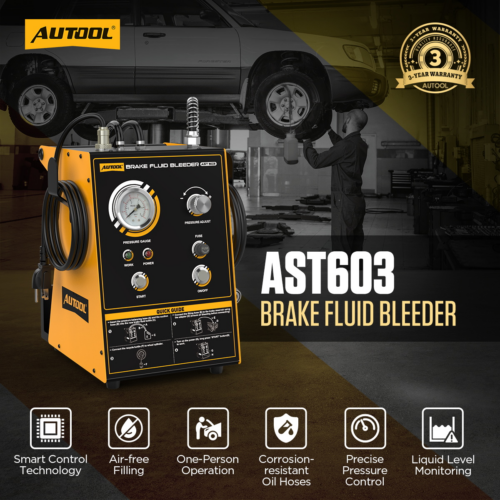
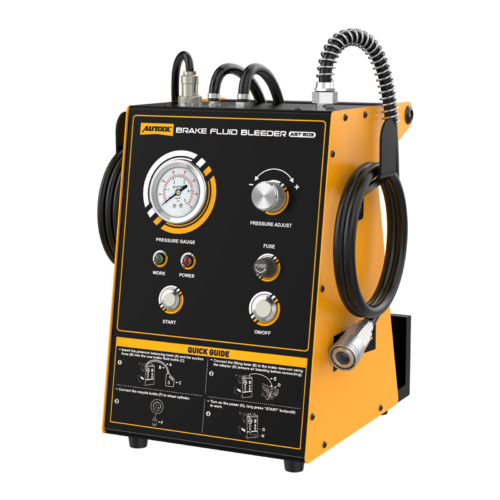
| AUTOOL AST603 | Mobile service and general workshop use | One-person pulsed exchange, AC or 12V DC power, 0.5–2.5 bar working-pressure range, low-fluid protection and two-wheel service support |
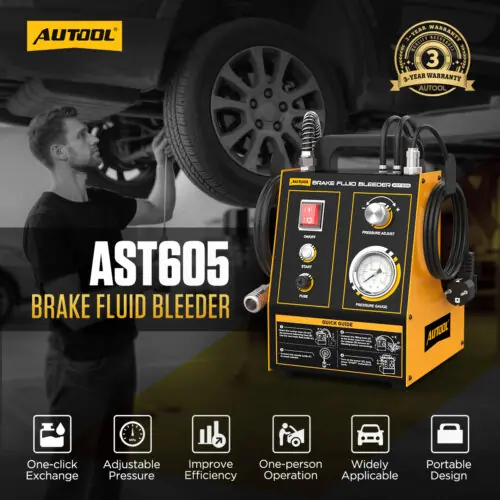
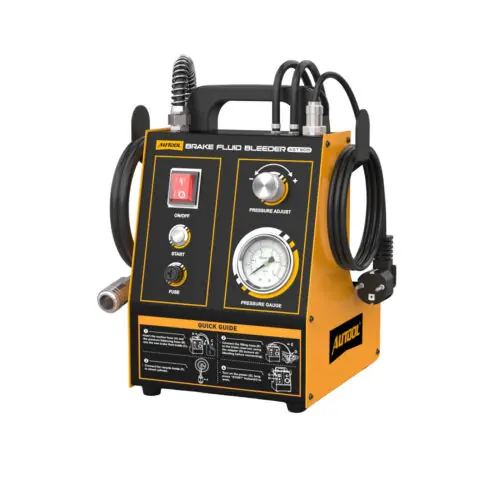
| AUTOOL AST605 | Workshop use with access to compressed air and AC power | 0.7–2.5 bar adjustable pressure, moisture-separating air filter, waste-fluid recovery and simultaneous multi-wheel service |
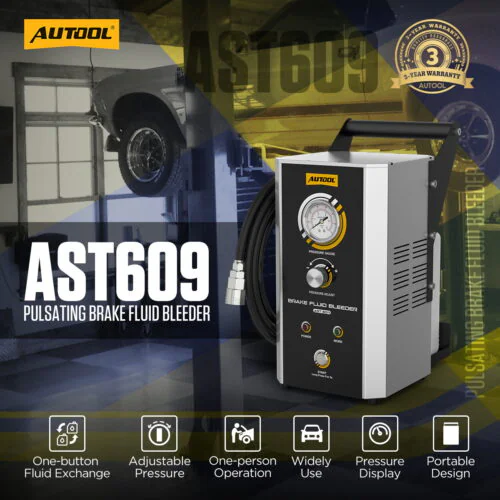
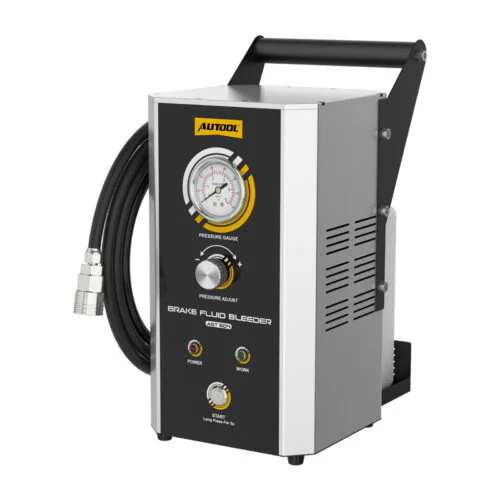
| AUTOOL AST609 | Portable professional use | AC or 12V DC power, two pressure modes, seven adapters, low-fluid protection and 3.5 m filling hose |
| AUTOOL AST612 | Mobile technicians and repair shops | 12V DC power, two waste-fluid bottles, nine adapter types, two-wheel exchange and automatic pressure release |
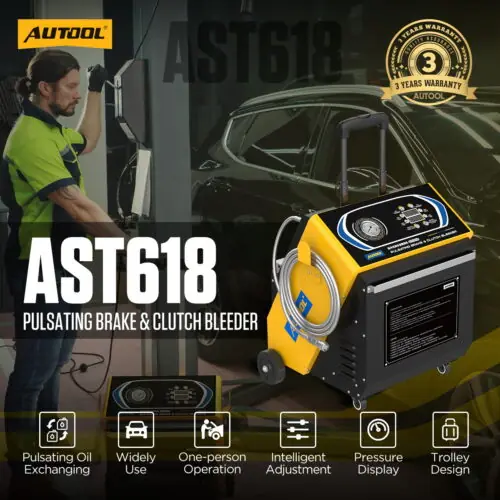
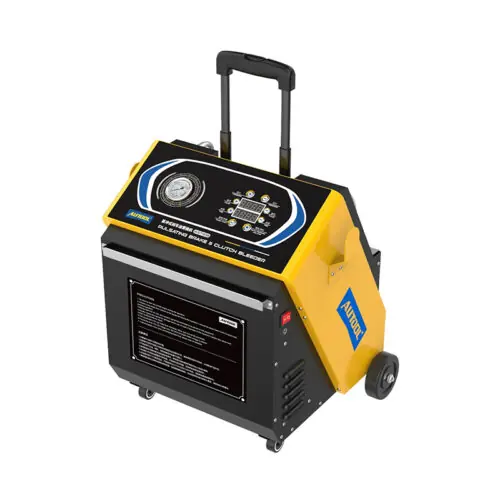
| AUTOOL AST618 | High-volume commercial workshops | Four-wheel simultaneous service, digital controls, 17 adapters, 3 L fluid reservoir and mobile cabinet design |
For occasional or mobile service, the AST603, AST609, or AST612 may provide a practical balance of portability and automation. The AST605 is suited to workshops with the required air and electrical supplies, while the AST618 is intended for higher-volume professional environments.
Before purchasing, confirm the local voltage, power requirements, included adapters, vehicle compatibility, and package contents. See the official product information for the AST603, AST605, AST609, AST612, and AST618.
Brake bleeding does not always need to involve two people repeatedly pumping the pedal. With a compatible pressure brake bleeder, the correct brake fluid, and a manufacturer-approved procedure, one trained technician can complete the work more consistently and efficiently.
A pulsating AUTOOL brake fluid exchanger adds controlled fluid delivery, waste-fluid recovery, pressure monitoring, and model-dependent automation. These features make AUTOOL products worth considering for repair shops, mobile technicians, and experienced users who regularly perform a brake fluid change.
The machine does not replace technical knowledge or vehicle-specific service information. The safest process is to select the correct fluid, use the specified pressure and bleeding sequence, inspect the entire hydraulic system, and verify brake operation before driving.
Contact us to learn more about selecting an AUTOOL brake fluid exchanger and available purchase offers.
WhatsApp: +86 189 2647 7404
Email: [email protected]