Uncategorized
BT10 EPB Emergency Release Tool: A Fast Solution for EPB Lockup and Brake Service

September 27, 2026
Share:
 autoolstore.com
Repair testing / 8 sub-categories
Diagnostic tools for leak tracing, visual inspection, battery health, circuits, pressure, spark, oil, and electrical readings.
Repair maintenance / 6 sub-categories
Service equipment for fluid exchange, A/C diagnostics, refrigerant recovery, oil handling, and cooling-system work.
Carbon cleaning / 3 sub-categories
Carbon-removal equipment for injectors, intake valves, components, and workshop cleaning jobs.
Wheel tire / 3 sub-categories
Equipment for alignment, lifting, tire repair, tire mounting, and service-bay workflows.
Tool storage / 1 sub-category
Storage products for keeping workshop tools, test equipment, and accessories organized.
EV charging / 1 sub-category
EV charging products for new-energy vehicle service, workshop use, and installation scenarios.
OBD diagnosis / 5 sub-categories
OBD-related testers, ECU programming power supplies, cable products, used-car inspection tools, and key frequency diagnostics.
Accessories / 8 sub-categories
Replacement parts, adapters, consumables, cables, and add-ons for major diagnostic and service equipment.
As vehicle technology continues to advance, the Electronic Parking Brake (EPB) has gradually replaced the traditional mechanical handbrake. With the press of a button, drivers can engage or release the parking brake, making parking more convenient while also saving space inside the vehicle.
However, an electrical failure, a discharged battery, a faulty control module, or accident-related damage can cause the electronic parking brake to remain locked. When this happens, the vehicle may be impossible to move. Forcefully towing the vehicle or dismantling the brake assembly may damage the tires, brake calipers, EPB motor, or other braking components.
The AUTOOL BT10 EPB emergency release tool is designed to address these repair and roadside assistance challenges. As a professional electronic parking brake release tool, it helps technicians temporarily release or engage an EPB actuator when the vehicle’s conventional control system cannot complete the operation.
An electronic parking brake system consists of switches, sensors, wiring, control modules, actuator motors, and mechanical braking components.
When the driver activates the EPB switch, the vehicle’s control system sends a command to the parking brake actuator. The electric motor then operates the braking mechanism to engage or release the parking brake.
If any part of this process fails, the EPB may not release normally. Common causes of an electronic parking brake failure include:
When the electronic parking brake remains locked, the vehicle may be difficult to push, tow, or move into a repair bay. Dragging the vehicle with its wheels locked can cause excessive tire wear, while forcing the brake assembly apart may damage the motor gears or deform the brake caliper piston.
An appropriate EPB release tool can provide a safer temporary solution when conventional electronic release procedures are unavailable.
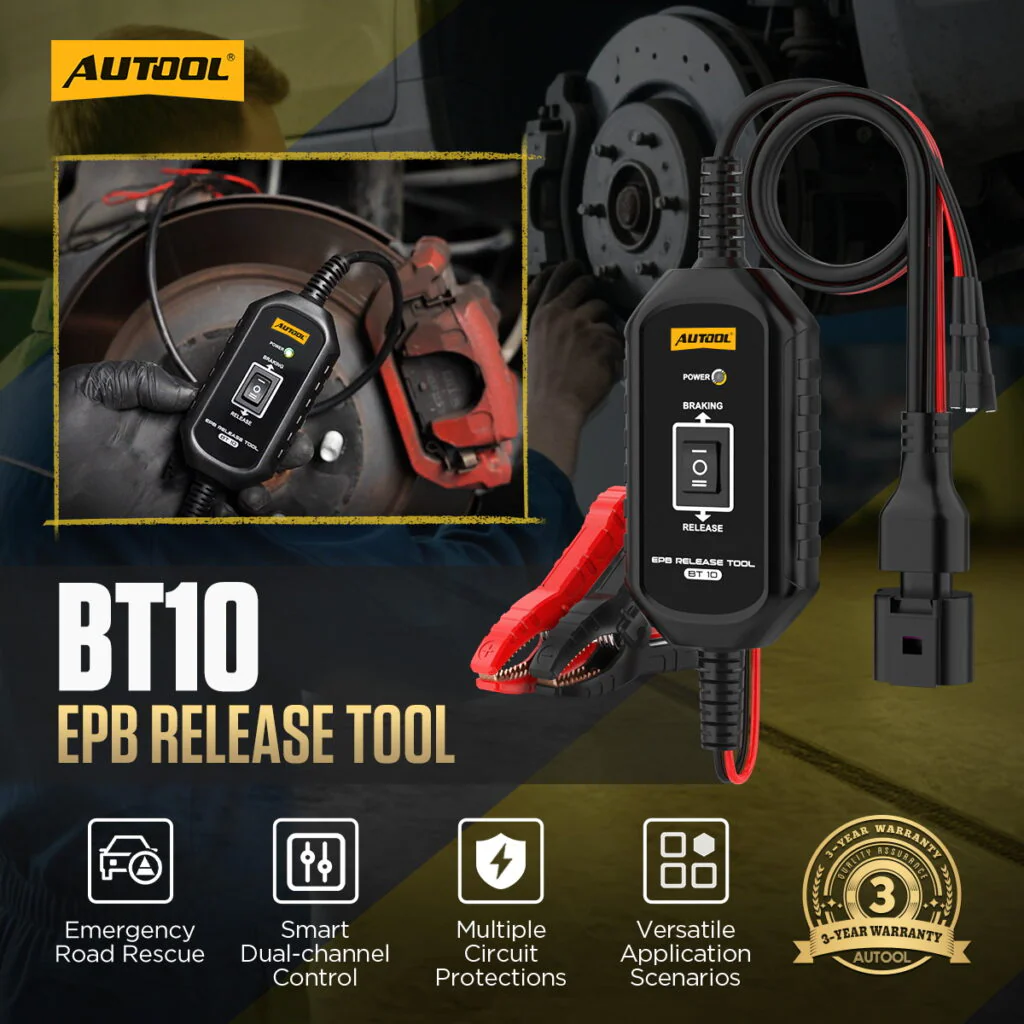
The AUTOOL BT10 is a professional EPB emergency release tool developed for automotive repair, roadside assistance, towing, and brake system maintenance.
Under suitable service conditions, it directly controls the EPB actuator motor. Its forward and reverse control modes allow technicians to temporarily release or re-engage the electronic parking brake.
The purpose of the BT10 is not to repair the underlying vehicle fault. Instead, it helps technicians release the brake so that the vehicle can be moved, inspected, recovered, or prepared for further repairs.
The AUTOOL BT10 can be used in situations such as:
The BT10 is a temporary electronic parking brake service tool, not a permanent repair solution. After releasing the brake, technicians should still inspect the vehicle’s battery, wiring, sensors, control modules, actuator motors, and mechanical brake components.
The AUTOOL BT10 provides forward and reverse motor control, allowing technicians to temporarily release or engage the electronic parking brake according to the service requirement.
The release mode is useful for moving disabled vehicles, roadside rescue, emergency towing, and brake system maintenance. The engagement mode can operate the actuator in the opposite direction after the vehicle has been moved or serviced.
Motor polarity, connector design, and actuator direction may vary between vehicles. If the EPB responds differently from the expected operation, stop immediately and check the vehicle’s service information, connector arrangement, and operating direction.
The BT10 features dual-channel control for operating electronic parking brake actuators in either direction. This design can reduce the need to repeatedly change connections during service.
It is especially useful on vehicles equipped with separate electronic parking brake motors on the left and right rear brake calipers. By supporting efficient motor control, this electronic parking brake release tool can save time during roadside rescue and workshop maintenance.
When the BT10 performs a release or engagement operation, its voltage output stops automatically after approximately one second—even if the switch remains pressed.
This short-duration output helps reduce the risk of overloading the actuator motor. It also helps protect the brake caliper and related EPB components from damage caused by continuous power.
However, the automatic stop function does not replace proper operating procedures. Technicians must still monitor the actuator, caliper, wiring, and overall system response during every operation.
The AUTOOL BT10 incorporates several electrical protection features, including:
After the device is connected to power, it performs a self-check. A green indicator light shows that the tool is receiving power normally.
If the fuse blows, the indicator behaves abnormally, or the tool does not respond, stop the operation and inspect the power supply, fuse, and connections. Never bypass the fuse or other safety protection to continue operating the tool.
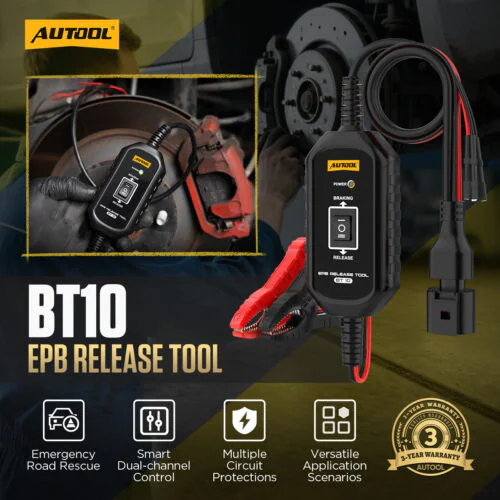
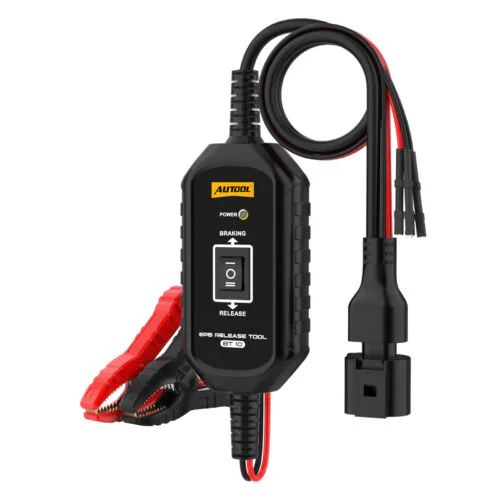
A collision, damaged wiring, a discharged battery, or an electronic parking brake failure may prevent the EPB from releasing. If the vehicle is dragged while the wheels remain locked, the tires and related chassis components may be damaged.
After securing the vehicle against unintended movement and confirming that the tool is suitable for the application, a trained roadside assistance technician can use the BT10 to temporarily release the parking brake. The vehicle can then be moved using appropriate towing or recovery equipment.
In this situation, the AUTOOL BT10 serves as a practical EPB emergency release tool for professional recovery teams.
When a vehicle arrives at a repair shop with its EPB locked, technicians may be unable to push it onto a lift or move it between service bays.
The BT10 can assist with temporary vehicle movement, reducing the need for additional lifting equipment or premature brake system disassembly.
This makes the device particularly useful for repair shops, dealerships, collision repair centers, and other facilities that regularly handle disabled vehicles.
Technicians may need to release the braking mechanism before inspecting the EPB motor, wiring, sensor, or control module.
The BT10 can support this process, but it cannot replace a diagnostic scanner. Reading fault codes, viewing live data, performing component tests, coding control modules, or completing system calibration still requires a compatible diagnostic tool.
The BT10 should therefore be viewed as a specialized electronic parking brake service tool, not a complete EPB diagnostic system.
Many vehicles equipped with an electronic parking brake must be placed into a dedicated service or maintenance mode before the rear brake pads are replaced.
Attempting to force the caliper piston backward while the EPB actuator is still engaged may damage the caliper, motor, gears, or internal mechanism.
On compatible systems and within an approved repair procedure, the BT10 may help release the electronic parking brake. However, technicians should always follow the vehicle manufacturer’s specified service-mode and brake maintenance instructions first.
The AUTOOL BT10 and an EPB-compatible diagnostic scanner can both support electronic parking brake service, but they perform different functions.
A diagnostic scanner communicates with the vehicle’s control modules through the diagnostic port. Depending on the vehicle and the scanner, it may be able to:
These functions generally require the vehicle’s power supply, communication network, and related control modules to remain operational.
The BT10 is designed for situations in which the EPB cannot be released through the conventional electronic control process. It temporarily controls the actuator motor to help technicians move or service the vehicle.
In simple terms:
An EPB release tool and a diagnostic scanner should therefore be considered complementary tools rather than interchangeable products.
The electronic parking brake is a safety-critical vehicle system. The AUTOOL BT10 should only be used by trained technicians who understand automotive electrical systems and braking components.
Before releasing the electronic parking brake, place the vehicle on a stable and level surface whenever possible. Use wheel chocks or another reliable method to prevent unintended movement. Never rely solely on the parking brake to secure a vehicle when preparing to release it, especially on a slope or while the vehicle is raised.
The AUTOOL BT10 requires a DC 10V–14V power supply. Before operation, verify that the power source is stable, the 5A fuse is intact, and all electrical connections follow the instructions in the product manual.
EPB designs, connectors, motor polarity, and maintenance procedures vary between vehicle manufacturers and models. Before connecting the electronic parking brake release tool, confirm the type of EPB system installed on the vehicle and consult the appropriate manufacturer repair information.
Stop the operation immediately if you notice:
Repeatedly applying power to a seized or damaged mechanism may make the original problem worse.
The ability to move the vehicle does not mean that the EPB fault has been repaired.
After the emergency operation, technicians should diagnose the electronic system, inspect the mechanical brake components, and perform the appropriate functional safety tests. Some vehicles may also require EPB initialization, calibration, matching, or fault-code clearing.
The AUTOOL BT10 is mainly intended for professional users, including:
If a vehicle owner experiences an electronic parking brake that will not release, contacting a dealership, professional repair shop, or qualified roadside assistance provider is usually the safest option. Untrained operation can create risks such as unintended vehicle movement, electrical short circuits, EPB motor damage, or incorrect brake operation.
For workshops and roadside assistance providers that regularly handle locked electronic parking brakes, accident-damaged vehicles, or rear brake repairs, the AUTOOL BT10 offers practical value.
Its main advantages include:
However, buyers should also understand its limitations:
The BT10 is most valuable when used as a specialized EPB emergency release tool alongside a diagnostic scanner, proper workshop equipment, and reliable vehicle service information.