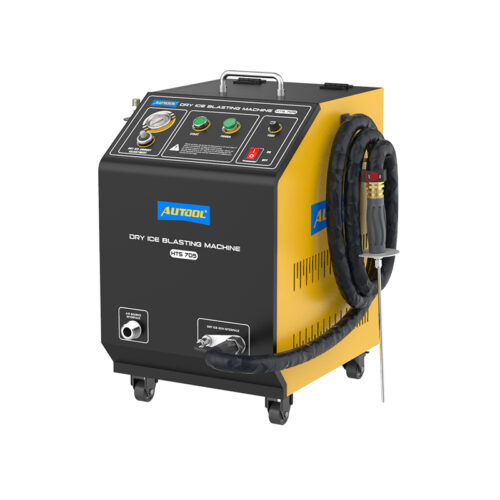
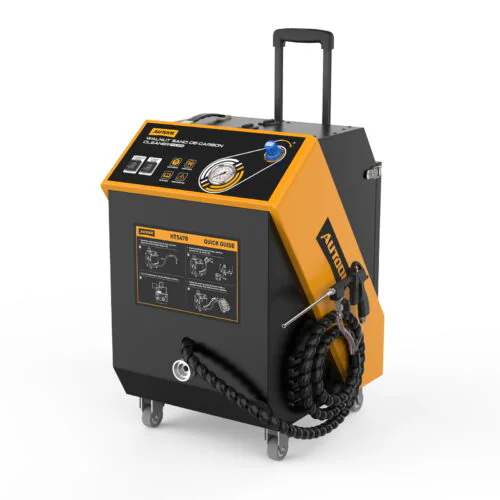
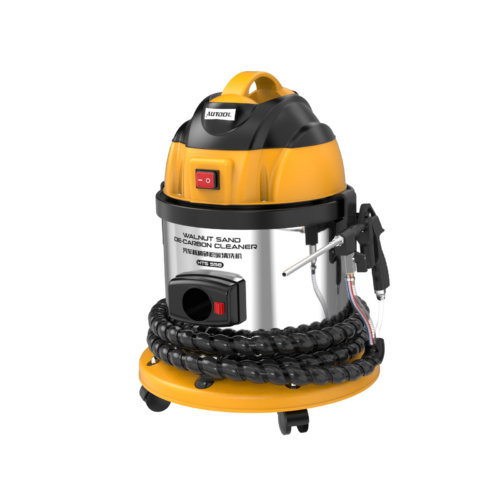
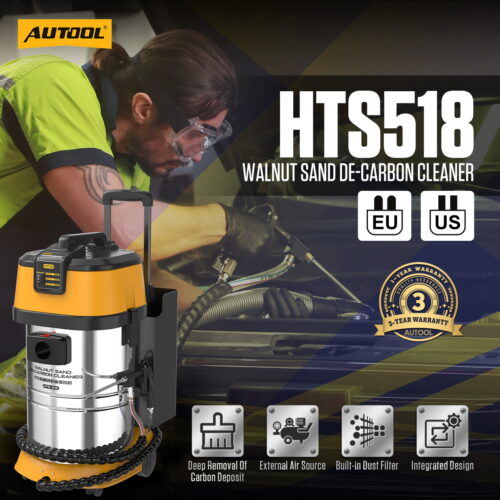
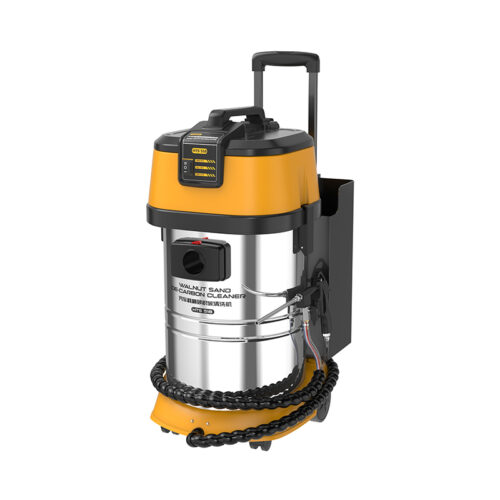
A walnut shell blasting machine uses crushed walnut shell particles as the cleaning media.Compressed air accelerates the walnut shell media at high speed, allowing it to remove carbon deposits through controlled impact and abrasion. During the cleaning process, the machine’s vacuum recovery system collects the walnut media and loosened carbon deposits for filtration and recovery. Depending on the equipment and condition of the media, the walnut shell particles can be reused.The entire process is mechanical and does not require chemical cleaning agents.Because walnut shell media is softer than metal, it can remove carbon deposits from intake valves without damaging metal surfaces when the correct procedure and equipment are used.
Dry Ice Blasting
A dry ice blasting machine uses solid carbon dioxide (CO₂) pellets at approximately –78.5°C as the cleaning media.Compressed air accelerates the dry ice particles toward the target surface. The cleaning process combines three effects:
Low-temperature effect: Rapid cooling can make carbon deposits brittle and easier to break apart.
Kinetic impact: High-speed dry ice particles strike the surface and help dislodge contaminants.
Rapid sublimation: Upon impact, the dry ice converts directly from solid CO₂ into gas, creating a rapid expansion effect that helps lift contaminants from the surface.
After impact, the dry ice sublimates into CO₂ gas. No solid blasting media is left behind, so there is no need to recover the dry ice itself.
2. Which One Fits Your Work?
When to Choose Walnut Shell Blasting
Best for cleaning heavy, hardened carbon on intake valves and ports — especially on German direct-injection engines. Walnut shell blasting removes thick valve deposits more effectively than dry ice and is the OEM-recommended method for intake valve cleaning.
Primary cleaning area: Intake ports and the back of intake valves.
Not suitable for:NEVER use walnut shell blasting on combustion chambers or piston tops. Walnut shells cannot be fully recovered from inside the cylinder. Any leftover media will cause scoring, piston wear, and major engine failure.
Best for: Shops focused on intake carbon cleaning for GDI engines — with budget constraints and high intake valve cleaning volume.
When to Choose Dry Ice Blasting
The go-to choice for cleaning combustion chambers and piston crowns. Dry ice sublimates completely — no residue risk inside the cylinder.
Also works on intake valves and ports — plus expands your service menu: engine bay cleaning, parts degreasing, industrial mold cleaning. One machine, more service offerings.
For narrow or complex intake passages where walnut shells are difficult to recover, dry ice is the better choice.
Best for: Shops with high volume, looking to add engine bay cleaning and parts cleaning services — need to handle both intake and combustion chamber carbon — with a higher budget.
3. Common Misconceptions
Misconception 1: Dry ice cleans better than walnut shell blasting.
The truth: For thick, hardened intake valve carbon, walnut shell blasting is more effective. For piston crown and combustion chamber carbon, dry ice is the better fit. Each has its strengths — neither is universally “better.” For a complete carbon service, you can use both: walnut for intake valves, dry ice for combustion chambers and pistons.
Misconception 2: walnut shell blasting works everywhere.
The truth: walnut shell blasting is only for intake ports and intake valves. Never use it in combustion chambers — leftover media means engine rebuild territory.
Misconception 3: Dry ice can completely replace walnut shell blasting.
The truth: On years-old, heavily baked-on valve carbon, dry ice alone sometimes struggles to remove it completely. Stubborn carbon needs the abrasion that only walnut shell blasting provides.
4. How to Choose – What's Best for Your Shop
Mainly doing intake valve carbon, with a limited budget – Start with a walnut shell blaster. Get multiple vehicle-specific adapters and make sure the vacuum recovery has enough suction.
Need to handle both intake valve AND combustion chamber carbon — plus engine bay cleaning – Go with a dry ice blaster. Make sure you have a stable, high-output air compressor to support it.
High-volume general repair shop – Run both machines. Choose the right tool for each job. Offer customers a complete carbon cleaning package covering every part of the engine.
Conclusion
Thick, baked‑on intake valve carbon → walnut shell. Combustion chamber and piston carbon → dry ice. For broader, multi‑purpose cleaning → dry ice is the winner.
There’s no “one tool does everything.” Understanding each method’s strengths and limits is the key to running a professional carbon cleaning service — the right equipment, the right technique, and zero comebacks.
Select options
This product has multiple variants. The options may be chosen on the product page