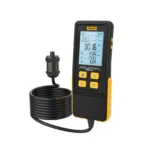






AUTOOL PT620 Digitales Motoröldruckprüfer-Set
US$169.00
Wichtigste Merkmale
- Den Druck im Motorölkreislauf über den angezeigten Bereich von 0–426,6 psi messen.
- Druckmesswerte mit einer Genauigkeit von 0,5 % FS und einer Anzeigeauflösung von 0,01 vergleichen.
- Aktuellen, maximalen, minimalen und Differenzdruck sowie die Messzeit ablesen.
- Mit 18 Anschlusstypen gängige Motoröldruck-Prüfanschlüsse verbinden.
- Gewindeadapter, einen abgewinkelten Schnellverbinder und einen ölbeständigen Schlauch an den Prüfstellen des Motors verwenden.
- Motoröldruckprüfung: Den Druck im Motorölkreislauf über den angezeigten Bereich von 0–426,6 psi messen.
- 0,5 % FS Genauigkeit / 0,01 Auflösung: Druckmesswerte mit einer Genauigkeit von 0,5 % FS und einer Anzeigeauflösung von 0,01 vergleichen.
- Maximum / Minimum / Differenz: Aktuellen, maximalen, minimalen und Differenzdruck sowie die Messzeit ablesen.
- 18 Adaptertypen: Mit 18 Anschlusstypen gängige Motoröldruck-Prüfanschlüsse verbinden.
- Anschlüsse bei engen Platzverhältnissen: Gewindeadapter, einen abgewinkelten Schnellverbinder und einen ölbeständigen Schlauch an den Prüfstellen des Motors verwenden.
- 3 Jahre Garantie Hauptgerät 3 Jahre · Zubehör 1 Jahr
- 90 Tage Rückgaberecht Berechtigte Rückgaben innerhalb von 90 Tagen
- Offizieller Shop Originalprodukte · Direkter Support
AUTOOL PT620 · Digitales Motoröldruckprüfer-Set
Motoröldruck am Sensoranschluss ablesen
Den Motoröldruck am richtigen Sensoranschluss messen und mit den Wartungsvorgaben des Fahrzeugs vergleichen. Der PT620 erfasst aktuellen, maximalen, minimalen und Differenzdruck. 18 Anschlusstypen und ein ölbeständiger Schlauch ermöglichen den Zugang zu verschiedenen Prüfstellen im Motorraum.
- Öldruckmessbereich 0–426,6 PSI
- Angegebene Genauigkeit: 0,5 % FS
- Aktuell / Maximum / Minimum / Differenz
- 18 Adaptertypen
- Ölbeständiger Schlauch
Wichtige Merkmale
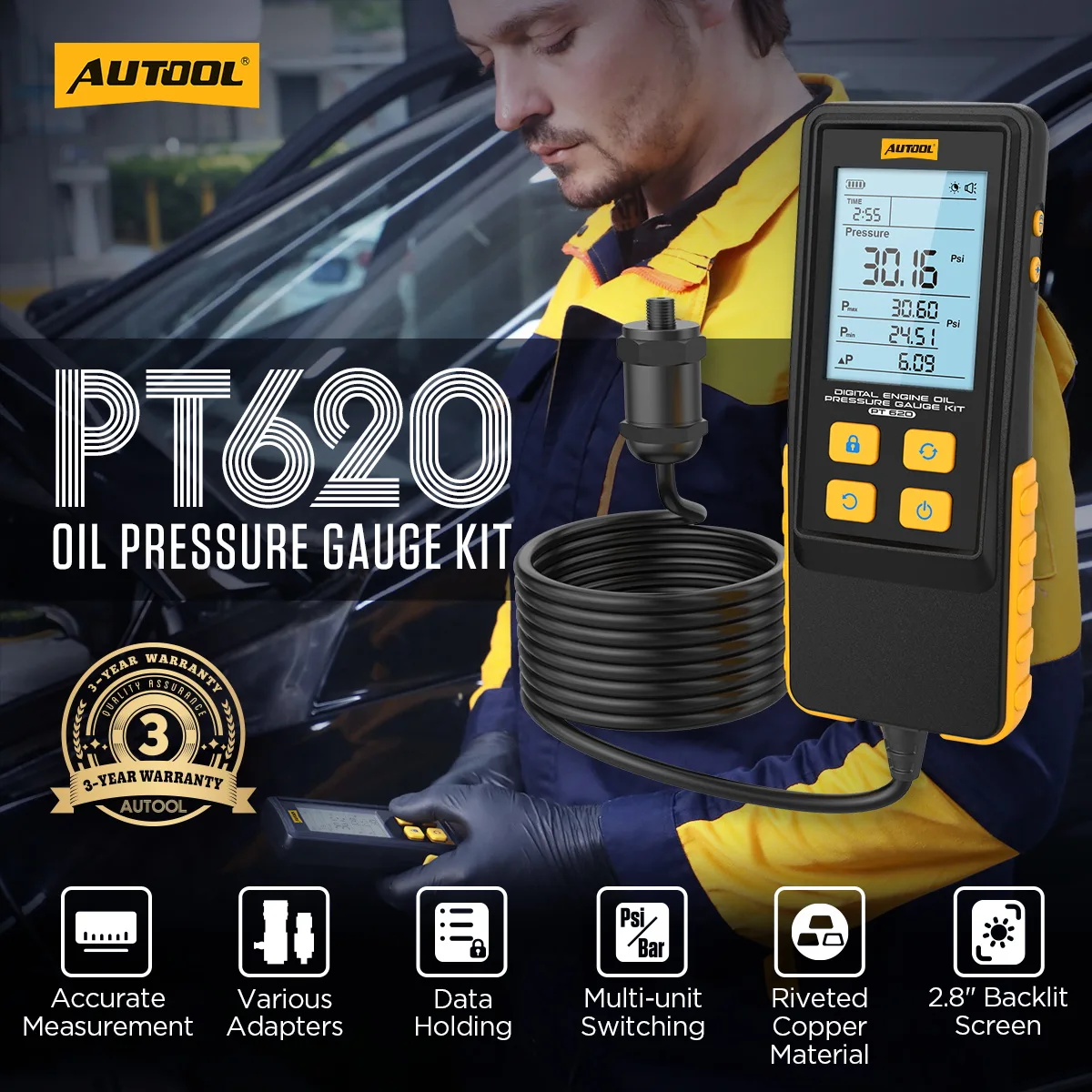
Aktueller, minimaler, maximaler und Differenzöldruck
Digitale Druckmessung
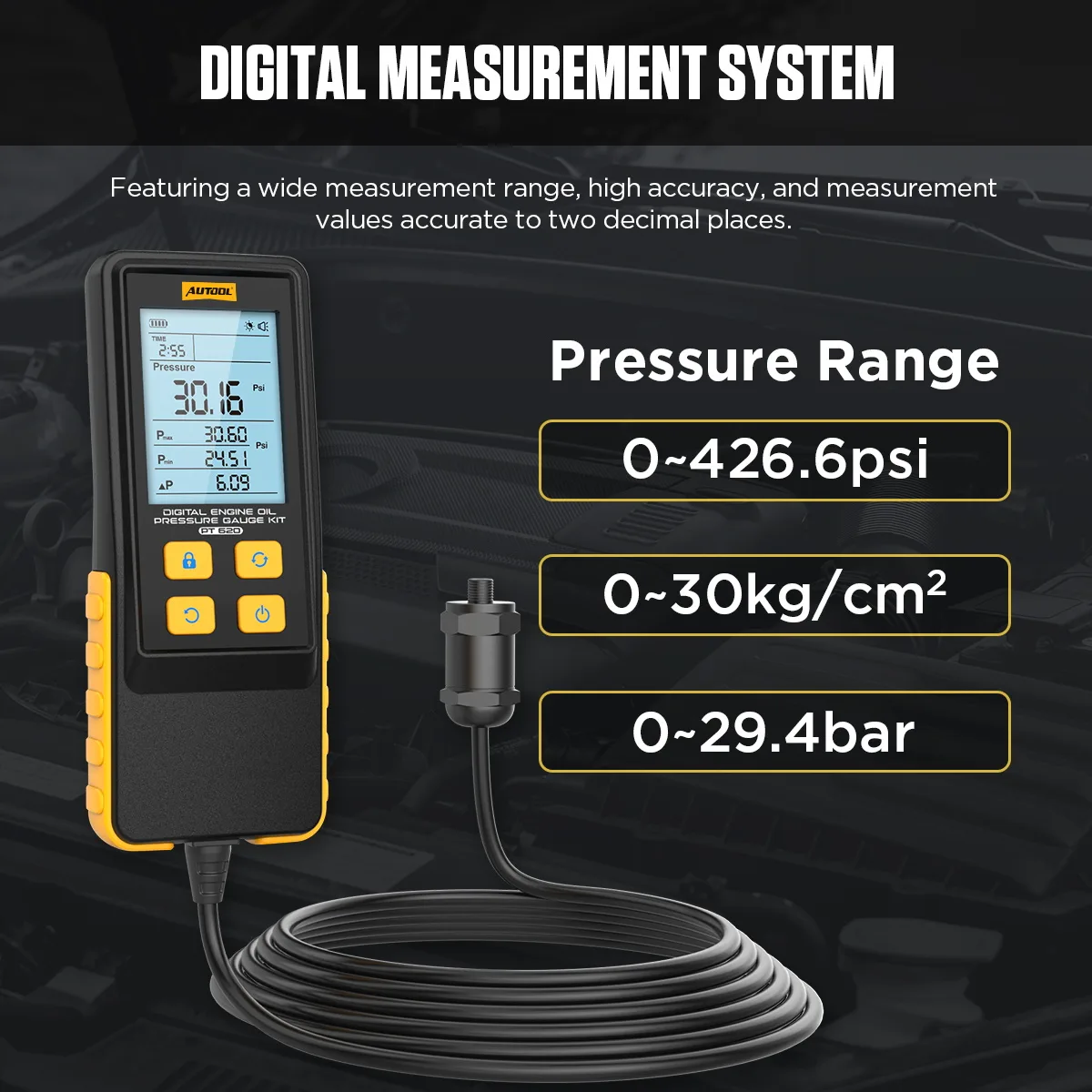
Misst den Motoröldruck mit einem digitalen Messsystem über den angezeigten Bereich bis 0–426,6 PSI bei einer Anzeigeauflösung von 0,01.
2,8-Zoll-Display mit Hintergrundbeleuchtung
Der beleuchtete 2,8-Zoll-Bildschirm zeigt die Druckinformationen deutlich an und erleichtert das Ablesen bei schwachem Licht in der Werkstatt oder im Motorraum.
Mehrere Einheiten zur Auswahl
Die Druckeinheit zwischen PSI, Bar und kg/cm² umschalten, um sie an unterschiedliche Wartungsgewohnheiten und Fahrzeugreferenzdaten anzupassen.
Maximum-, Minimum- und Differenzanzeige
Die Anzeige kann den aktuellen Druck, den aktuellen Maximal- und Minimaldruck, den Differenzdruck und die Messzeit darstellen.
Anzeige sperren, Daten löschen und nullstellen
Mit der Sperrtaste die aktuelle Anzeige halten, Prüfdaten bei Bedarf löschen und den Druckwert vor der Prüfung nullstellen.
Genietetes Kupferadapter-Set
Die mitgelieferten Kupferadapter ermöglichen den Anschluss an gängige Motoröldrucksensor-Anschlüsse und sind bei normalem Gebrauch verschleiß- und oxidationsbeständig.
Stromversorgung mit AAA-Batterien
Der PT620 benötigt vier AAA-Batterien mit je 1,5 V. Den Batteriefachdeckel auf der Geräterückseite öffnen, die Batterien mit der richtigen Polarität einsetzen und den Deckel vor der Verwendung sicher schließen.
Anschlüsse für die Öldruckprüfung
Gewindeadapter, ein abgewinkelter Schnellverbinder und ein ölbeständiger Schlauch ermöglichen den Anschluss an Motoröldruck-Prüfstellen.
18 Adaptertypen
Die Vergleichs- und Adapterabbildungen des PT620 zeigen 18 Zubehör-Anschlusstypen zur Vorbereitung der Motoröldruckprüfung.
Gängige Gewindegrößen
Die abgebildeten Adaptergrößen umfassen M10×1.0, M10×1.25, M12×1.25, M12×1.5, M12×1.75, M14×1.25, M14×1.5, M16×1.25, M16×1.5, M18×1.5, 3/8-24UNF, 1/2-20UNF, NPT-1/4-18, NPT-1/8-27, NPT-3/8-18, ZG1/8-28, ZG1/4-19 und ZG3/8-19. Vor dem Anschluss Gewinde und Abdichtungsart auf die Prüfstelle des Motors abstimmen.
Abgewinkelter Schnellverbinder
Der abgewinkelte Verbinder erleichtert den Anschluss bei engen Platzverhältnissen im Motorraum, wenn ein gerader Anschluss unpraktisch ist.
Ölbeständiger Schlauch
Der Verbindungsschlauch ist für den Anschluss bei Öldruckprüfungen ausgelegt. Schlauch und Anschlussstücke vor jeder Prüfung kontrollieren.
Automatische Abschaltung
Das Gerät schaltet sich nach 5 Minuten ohne Bedienung automatisch aus, wenn kein Druck anliegt.
Druckmessgenauigkeit
Genauigkeit: 0,5 % FS.
3 Jahre Garantieunterstützung
Hauptgerät: 3 Jahre Garantie. Standardzubehör: 1 Jahr Garantie. Garantiebedingungen.
Serviceablauf
Adapter anbringen und nach Vorgabe prüfen
Step 1
Sensor entfernen
Den Motoröldrucksensor gemäß der Wartungsanweisung des Fahrzeugherstellers entfernen.
Step 2
Adapter anschließen
Den zum Fahrzeugmodell passenden Adapter auswählen und mit der Messsonde verbinden.
Step 3
Manometer nullstellen
Die Ein-/Aus-Taste länger als 2 Sekunden gedrückt halten, um das Gerät einzuschalten. Anschließend den Druckwert vor der Prüfung auf null zurücksetzen.
Step 4
Am Motor anschließen
Die Messsonde sicher mit dem Motoröldruck-Prüfanschluss verbinden.
Step 5
Motor starten
Den Motor erst starten, wenn das Anschlussstück ordnungsgemäß verbunden und das Manometer bereit ist.
Step 6
Druck ablesen
Den aktuellen Druck und die zugehörigen Anzeigewerte auf dem Bildschirm des PT620 prüfen.
Step 7
Messung am Sensoranschluss
Den passenden Adapter für den Öldrucksensor-Anschluss auswählen und das Manometer vor der Messung nullstellen. Vor dem Motorstart und dem Ablesen des Drucks das vorgeschriebene Anschlussverfahren befolgen.
Sichere Verwendung
Heißes Öl, Schlauchführung und Druckrisiken beachten
Nicht überlasten
Das Manometer innerhalb des zulässigen Prüfbereichs verwenden und den angegebenen Überlastdruck nicht überschreiten.
Adapter auf den Anschluss abstimmen
Den zum Fahrzeug und zum Motoröldrucksensor-Anschluss passenden Adapter auswählen. Einen Adapter nicht mit Gewalt in einen inkompatiblen Anschluss einsetzen.
Verbindung vor dem Motorstart sichern
Die Messsonde sicher mit dem Motoröldruck-Prüfanschluss verbinden. Den Motor erst starten, wenn das Anschlussstück ordnungsgemäß verbunden und das Manometer bereit ist.
Vor dem Ausschalten Druck abbauen
Das Gerät nach der Messung bei Umgebungsdruck ausschalten.
Schlauch und Anschlussstücke prüfen
Schlauch und Anschlussstücke vor jeder Prüfung kontrollieren. Lose Anschlussstücke vor dem Betrieb festziehen.
Zuerst Anschlussstücke prüfen
Regelmäßig die Teile prüfen, die befestigt oder verbunden sein müssen. Lose Anschlussstücke vor dem Betrieb festziehen.
Korrosive Flüssigkeiten vermeiden
Kontakt mit korrosiven Flüssigkeiten vermeiden und Teile, die mit chemischen Medien in Berührung kommen, bei Bedarf nach dem Gebrauch reinigen.
Gehäuse schützen
Das Produkt bei Lagerung und Betrieb nicht an rauen Oberflächen reiben und das Gehäuse nicht beschädigen.
Trocken lagern
Das Produkt an einem trockenen Ort lagern. Nicht an heißen, feuchten oder schlecht belüfteten Orten aufbewahren.
Öldruck mit den Vorgaben vergleichen
Den für Öl geeigneten Schlauch und den passenden Motoradapter verwenden. Anschließend den Druck bei der vorgeschriebenen Temperatur und Motordrehzahl mit den Fahrzeugvorgaben vergleichen.
Modellvergleich
Wählen Sie das passende Druckprüfset
Modelle vergleichen
Choose one or more models. PT620 Oil Pressure Gauge Kit is selected by default.
| Product Name | ModellPT610 Cylinder Pressure Gauge | ModellPT620 Oil Pressure Gauge Kit | ModellPT630 Fuel Pressure Gauge | ModellPT635 Fuel Pressure Gauge(High-end version) | ModellPT640 GDI Fuel Pressure Gauge | ModellPT650 Transmission Oil Pressure Gauge | ModellPT660 Brake System Pressure Tester |
|---|---|---|---|---|---|---|---|
| Measurement & Readout | |||||||
| Display Screen | 2.8-inch | 2.8-inch | 2.8-inch | 2.8-inch | 2.8-inch | 2.8-inch | 3-inch |
| Data Storage | 6 Sets of Data | ×Nicht inklusive | ×Nicht inklusive | ×Nicht inklusive | ×Nicht inklusive | ×Nicht inklusive | Locks the current reading; check the current specification for multi-record storage. |
| Pressure Range | 0-426.6psi 0-30kg/cm² 0-29.4bar | 0-426.6psi 0-30kg/cm² 0-29.4bar | 0-426.6psi 0-30kg/cm² 0-29.4bar | 0-426.6psi 0-30kg/cm² 0-29.4bar | 0-5221.3psi 0-367kg/cm² 0-360bar | 0-426.6psi 0-30kg/cm² 0-29.4bar | 0–210 bar |
| Dual-Channel Pressure Testing | ×Nicht inklusive | ×Nicht inklusive | ×Nicht inklusive | ×Nicht inklusive | ×Nicht inklusive | ×Nicht inklusive | Two brake positions/calipers via L/R channels |
| Data Lock/Clear/Record | ✓Inklusive | ✓Inklusive | ✓Inklusive | ✓Inklusive | ✓Inklusive | ✓Inklusive | ✓Inklusive |
| Multi-Parameter Display | Current Temp Measurement Time Real-Time Pressure Value Average Pressure Value Pressure value of each cylinder | Measurement Time Pressure Maximum Pressure Minimum Pressure Differential | Maximum Value Minimum Value Differential Pressure Value Measurement Time Real-Time Pressure Value | Maximum Value Minimum Value Average Value Temperature Value Measurement Time Real-Time Pressure Value | Maximum Value Minimum Value Differential Pressure Value Measurement Time Real-Time Pressure Value | Maximum Value Minimum Value Differential Pressure Value Measurement Time Real-Time Pressure Value | Left/right real-time pressure, minimum, maximum, and front/rear pressure difference |
| Pressure Units | Psi Bar Kg/cm² | Psi Bar Kg/cm² | Psi Bar Kg/cm² | Psi Bar Kg/cm² | Psi Bar Kg/cm² | Psi Bar Kg/cm² | psi / bar / kg/cm² |
| Connections & Applications | |||||||
| Accessory Connectors | 10 Types | 18 Types | 17 Types | 31 Types | 3 Types | 12 Types | Check the selected package contents for included adapter types and quantities. |
| Equipped Toolbox | ✓Inklusive | ✓Inklusive | ✓Inklusive | ✓Inklusive | ✓Inklusive | ✓Inklusive | ✓Inklusive |
| Applicable Scenarios | Engine Cylinder | Engine Oil Circulation System | Automotive Fuel System | Automotive Fuel System | Fuel Injection Pump Pressure in the Automotive Direct Injection System | Automotive Transmission Pressure | Internal brake-system fluid pressure; two-position/caliper comparison |
Bedienungsanleitung und Support
Bedienungsanleitung und Hinweise zu Adaptern finden
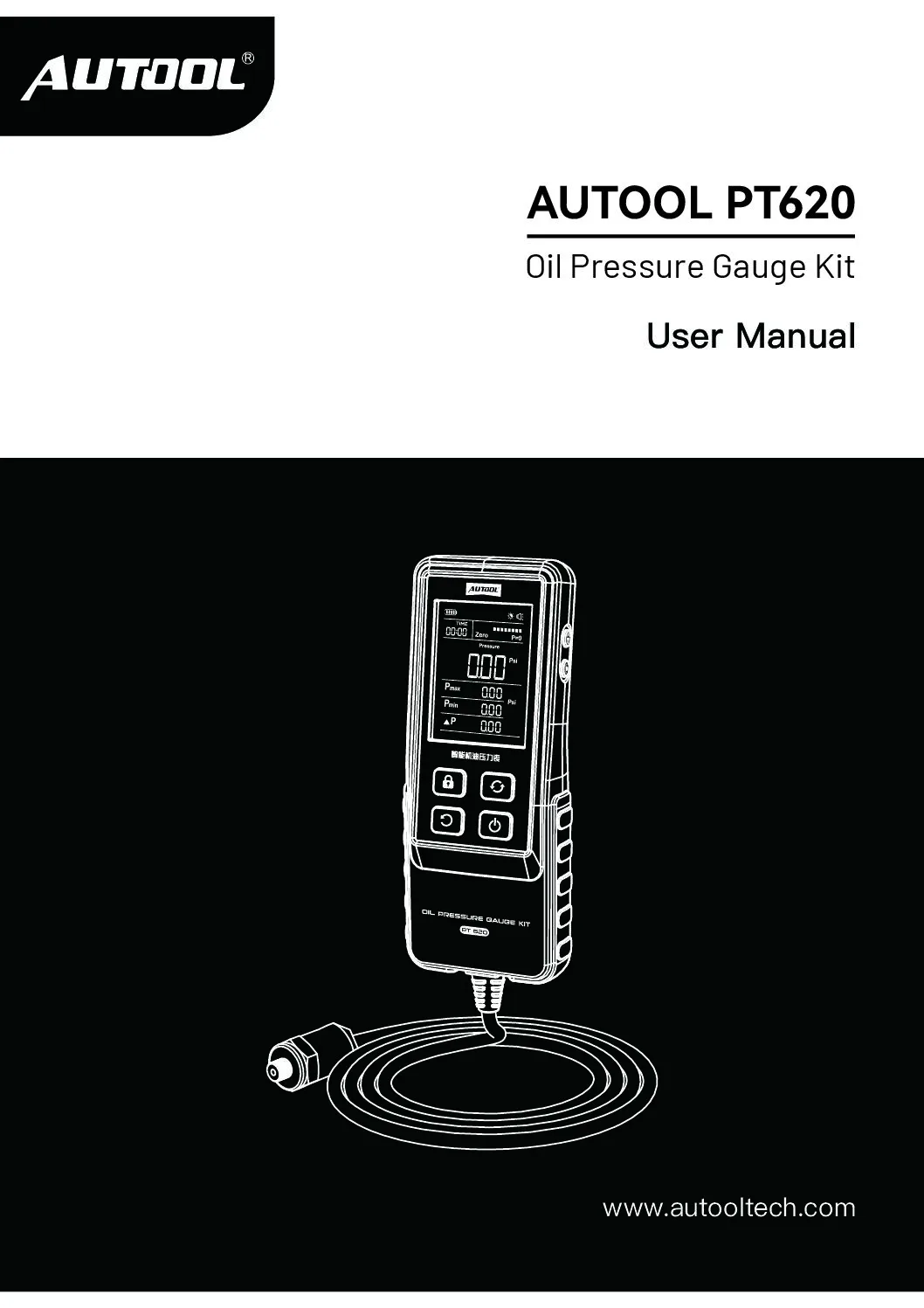
AUTOOL PT620 Bedienungsanleitung
Die PDF-Anleitung für den AUTOOL PT620 mit Informationen zu Öldruckprüfung, Einheitenwahl, Adapter- und Schlauchanschlüssen, Maximal- und Minimalwerten, Nullstellung, Sicherheit und Fehlerbehebung öffnen.
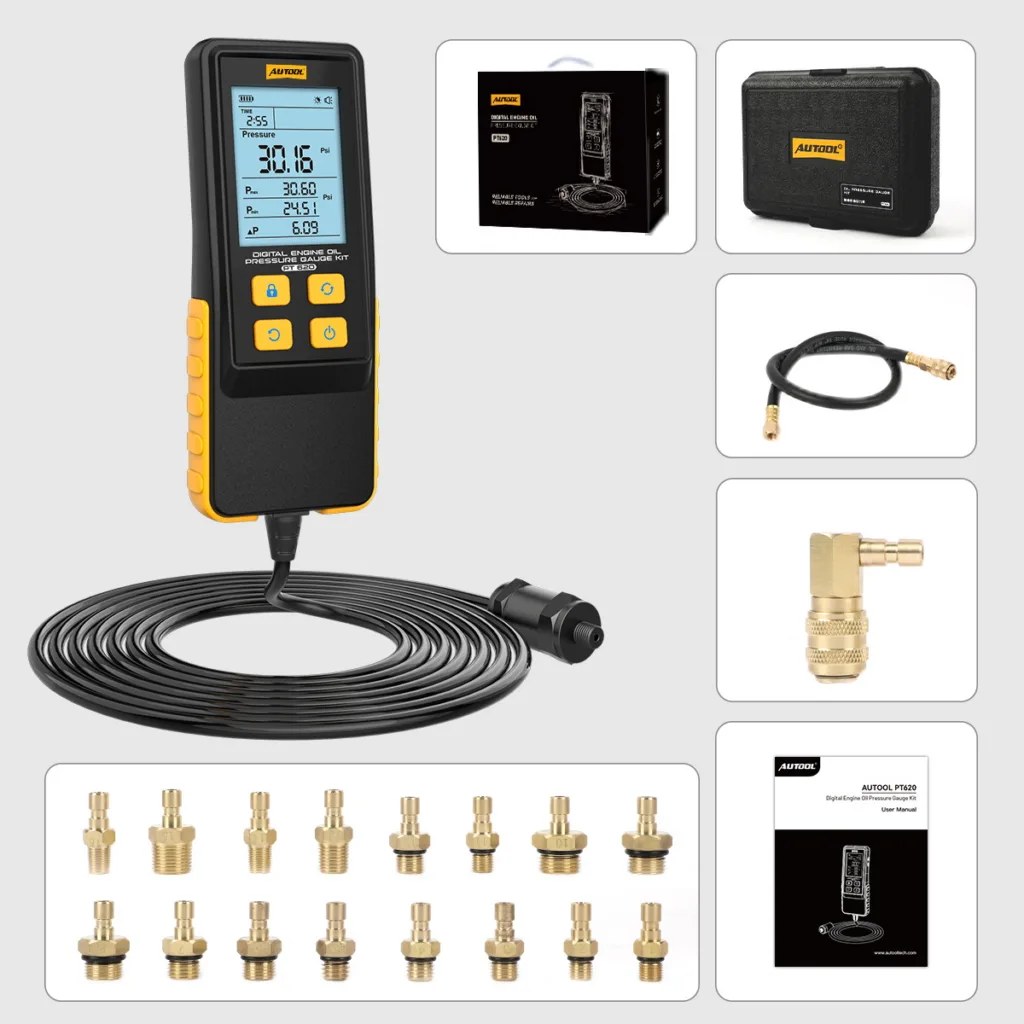
Lieferumfang
Lieferumfang ansehen
- HauptgerätAUTOOL PT620 Öldruckmanometer-Set
- AufbewahrungskofferSchützender Tragekoffer
- VerkaufskartonAUTOOL PT620 Produktverpackung
- ArtikelSchlauch: ölbeständiger Verbindungsschlauch
- ArtikelVerbinder: abgewinkelter Schnellverbinder
- AdapterAdapter-Set
- DokumentationBedienungsanleitung
Käuferfragen
Fragen zu Druckanschluss und Messwerten
Was prüft der AUTOOL PT620?
Der PT620 prüft den Druck im Motorölkreislauf kompatibler Pkw, Motorräder, Lkw und anderer Fahrzeuge, nachdem Sensoranschlussadapter und zulässiger Druck abgeglichen wurden. Er ist kein Prüfgerät für Kompressions-, Kraftstoff-, GDI-, Getriebeöl- oder Bremsdruck.
Welchen Druckmessbereich unterstützt der PT620?
Die Produktabbildungen zeigen einen Anzeigebereich von 0–426,6 PSI, 0–30 kg/cm² und 0–29,4 Bar. Die Bedienungsanleitung nennt einen Bereich von 0–30 Bar und einen Überlastdruck von 40 Bar.
Welche Druckeinheiten kann der PT620 anzeigen?
Der PT620 unterstützt PSI, Bar und kg/cm². Mit der Druckeinheitentaste die Einheit entsprechend den Prüfanforderungen umschalten.
Speichert der PT620 mehrere Prüfdaten-Sätze?
Der PT620 unterstützt das Halten von Daten, das Sperren der Anzeige, das Löschen von Daten und das Nullstellen des Drucks. Den PT620 nur dann als Modell mit Speicher für mehrere Datensätze betrachten, wenn dies für die aktuelle Produktversion vom Verkäufer-Support bestätigt wurde.
Welche Batterien benötigt der PT620?
Der PT620 benötigt vier AAA-Batterien mit je 1,5 V. Den Batteriefachdeckel auf der Geräterückseite öffnen, die Batterien mit der richtigen Polarität einsetzen und den Deckel vor der Verwendung sicher schließen.
Wie viele Adaptertypen sind enthalten?
Die Vergleichs- und Adapterabbildungen zeigen 18 Zubehör-Anschlusstypen für den PT620. Die Adapterabbildung zeigt metrische Gewinde sowie UNF-, NPT- und ZG-Gewinde, einen abgewinkelten Schnellverbinder und einen ölbeständigen Verbindungsschlauch. Die erforderliche Adaptergröße vor der Prüfung bestätigen.
Muss das Manometer vor der Prüfung nullgestellt werden?
Ja. Das Manometer einschalten und den Druckwert vor der Prüfung nullstellen. Die Anleitung weist außerdem darauf hin, das Gerät nach Abschluss der Messung bei Umgebungsdruck auszuschalten.
Kann der PT620 für Kraftstoff-, GDI-, Getriebeöl- oder Bremsdruckprüfungen verwendet werden?
Der PT620 dient zur Motoröldruckprüfung. Für Kraftstoffdruck den PT630 oder PT635 vergleichen, für GDI-Druck den PT640, für Getriebeöldruck den PT650 und für den inneren Flüssigkeitsdruck im Bremssystem den PT660.
Was gehört zum Lieferumfang des PT620?
Lieferumfang: PT620 Hauptgerät, Aufbewahrungskoffer, Verkaufskarton, Verbindungsschlauch, abgewinkelter Schnellverbinder, Adapter-Set und Bedienungsanleitung.
Wie lange gilt die Garantie?
Hauptgerät: 3 Jahre Garantie. Standardzubehör: 1 Jahr Garantie. Garantiebedingungen.
Kundenbewertungen 5
Easy to use, and the display is clear when checking engine oil pressure. A handy tool to have in the garage.
Good tool for Audi 2.0t diagnostics
This worked very well for trying to get a handle on the common Audi 2.0t low oil pressure issue (B8 series A5 in this case). Since these cars often develop low oil pressure warnings at low rpm with a warm engine, I thought I’d share our results.
I wanted a device that would log the lowest pressure while driving so we could see what happened to trigger these car warnings and see if the pressure was really low enough to be a major concern. These cars don’t have pressure sensors, only low pressure warning triggers for the alert, so no way to see pressures without an external gauge such as this.
I did not see many options for a reasonably priced alternative that was available fast so I rolled the dice and ordered this oil pressure test kit even though it had few reviews and most of them were Vine sponsored. The thing showed up less than 12 hours after ordering which was great. Always a little suspicious of Chinese goods I was pleasantly surprised to find the build quality of the device, packaging, and adapters all looked quite good. No rough threads or questionable milled bits. On mine the hose with quick coupler fitting and hose came screwed on black threaded sensor right out of the box. The quick coupler was well made and seemed secure enough when attached to an adapter to be ok taped to the engine while driving around a bit.
One thing to note, the adapter assortment is vast, but they are not labeled with the thread spec, so it’s necessary to verify what the car has. In our case I knew we needed an m10x1 thread, which turned out to be the #1 adapter and also the first on the printed list that came in that box. The adapters are numbered 1-16, but the printed list of sizes included is not numbered. It may be that the list is in numerical order that it matches the adapter numbers, but I can’t confirm. I included a picture of the list in my review.
We removed the upper oil pressure sensor from the car, screwed in the #1 adapter that matched its threads, and then connected the quick coupler. I just put a jumper wire in the cars sensor plug to ground so the car would not constantly beep at us during the test. A tee adapter would allow for use of both this and the car sensors at the same time, but we did not have one yet so we just went for it.
The wire from the unit’s sensor was long enough to run up across the engine, out under the rear edge of the hood, and into the passenger side window so we could monitor it in real time while driving.
Bottom line, once we figured out the interface buttons, it worked great and confirmed we did have adequate oil pressure at idle when warm, which we deemed sufficient for idle speed (though below audi specs) and immediately rises above idle, topping out at the car’s relief valve pressure of about 51-52 psi. There is about a second or so of latency between pressure changes and the display reading shift, but it’s a nice window into the engine pressure and range.
Worth noting it works a bit like a weight scale in that holding down one of the buttons recalibrates to zero, which you don’t want to do with it hooked up and car running or actual pressure becomes zero on the display. A short tap of the same button instead of long hold resets the high and low recording to zero without resetting the calibration. This is crucial for lowest pressure log since it will start at zero before you turn the car on! So after starting the engine you’ll want to tap that button to zero out the pressure high/low without changing the baseline calibration to zero. Took us a minute to figure that all out. It’s a good device which I can recommend.
The rest of this review only pertains to other Audi 2.0t engine owners in case they are in the same boat. We were dealing with this plus usual bad piston ring design oil consumption issue. We used this tester after tearing the engine down to replace pistons and timing chains. We removed all the stupid oil screens, decided the cam journals and balance shaft bearings were ok, and the oil pump had been replaced already so we kept it. We installed new Wossner pistons that use factory 21mm connecting rod pins and rods, but have proper wide waffle oil control rings. This totally solves the oil consumption and black oil too! We did leave the two stage oil pump in high pressure mode by not connecting the wire near the sump that allows it to shift into low pressure mode at lower revs. But we still get low pressure at warm idle, just not catastrophically low. Maybe 13-15 psi. It instantly jumps up above 20 psi above idle and is linear with revs up to 51 psi limit. Not sure where the oil pressure leakage is that is still haunting us, but seems fine to drive for now. Possibly intake cam phaser. I’ll try to post a YouTube video on this whole deal soon. Will update this review with what to look for if I do.
Good
Works well. Easy to use. Seems to be pretty accurate. Has multiple adapters for any situation. Large screen that's easy to see and read.