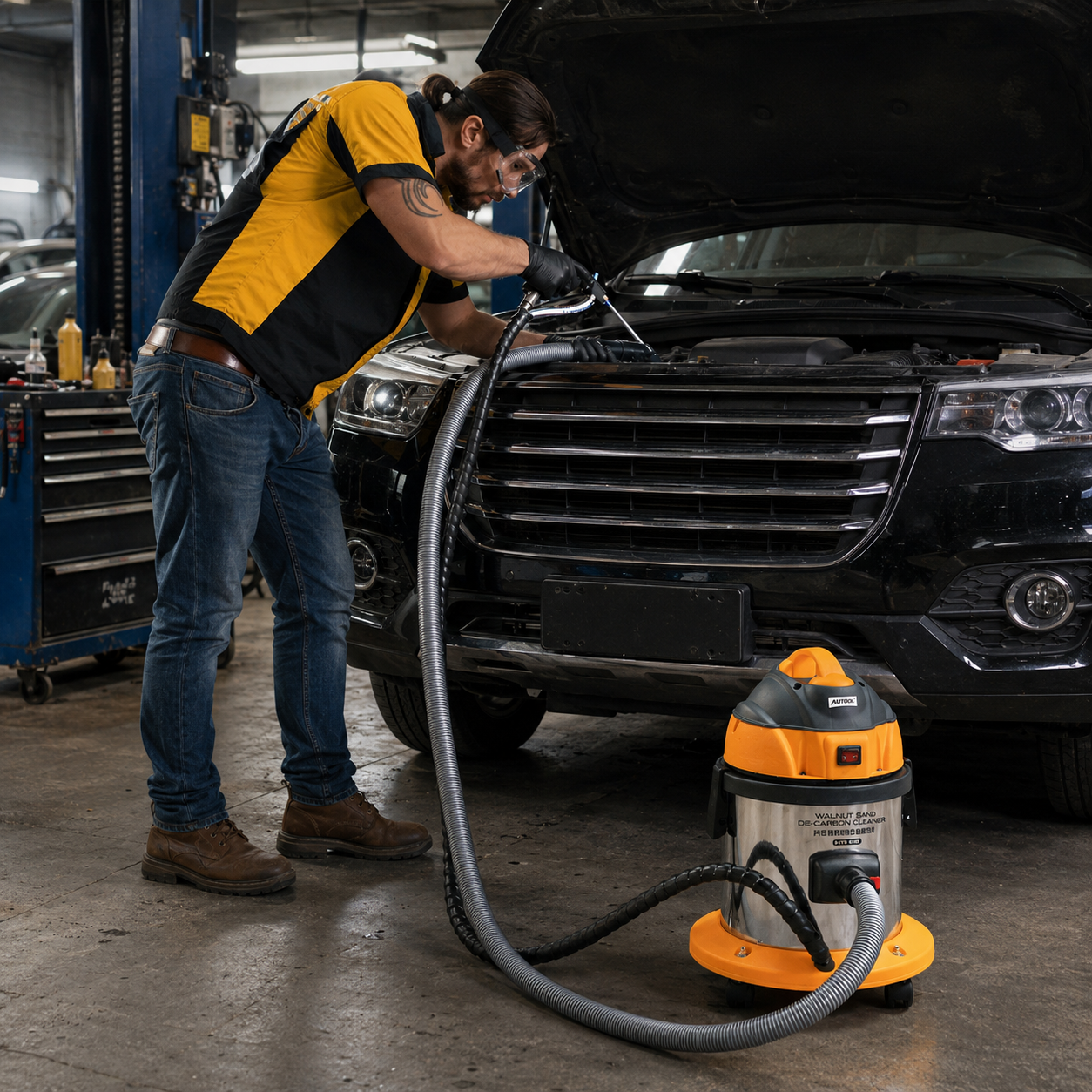
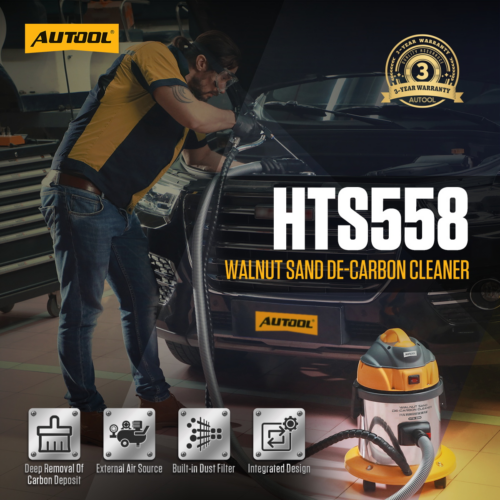
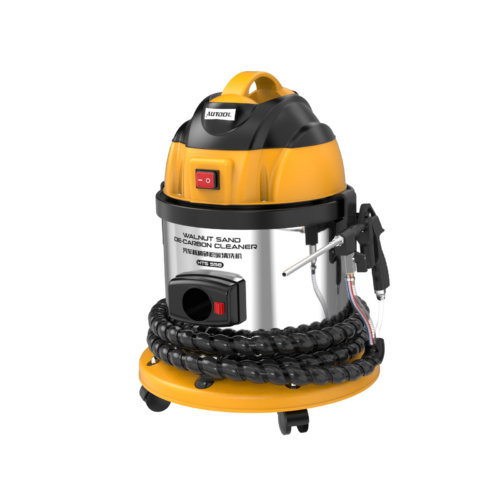
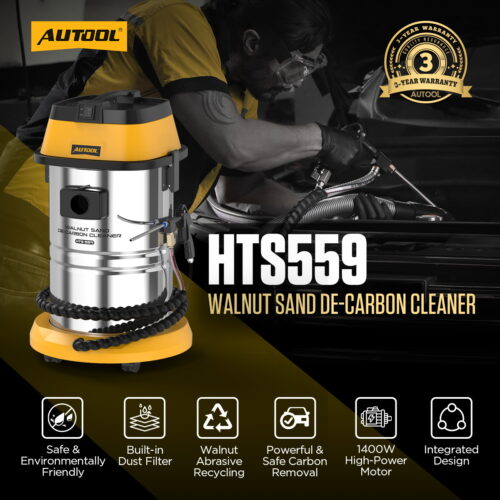
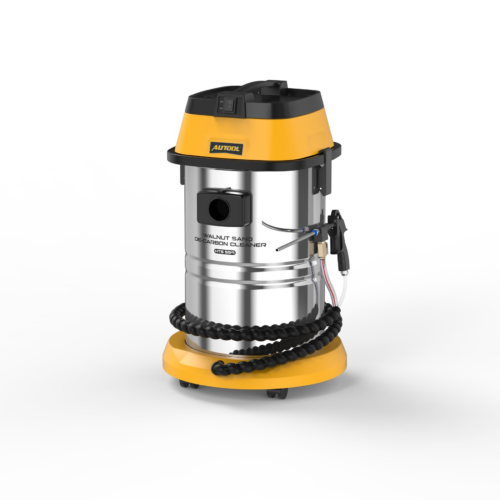
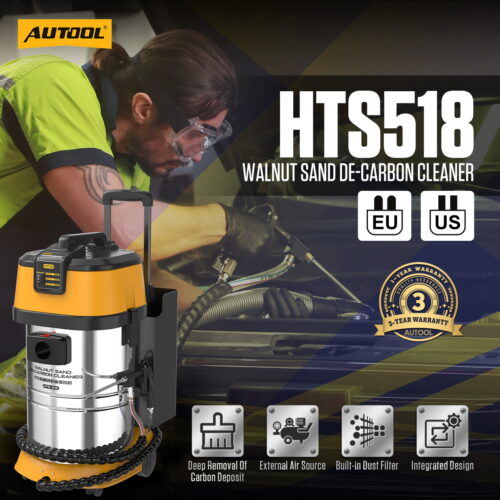
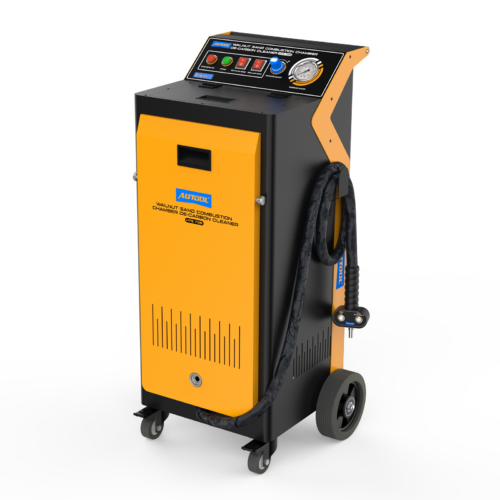
Over 55% of vehicles on the road today use direct injection — and every one of them builds carbon on intake valves that fuel can’t wash away. AUTOOL HTS walnut blasting machines and walnut blaster equipment are the physical solution professional shops trust.
Rough idle
Power loss
Misfires
Check engine light
Poor fuel economy
Sluggish throttle
4.91★
150 verified buyer reviews · 99% recommend
$300–$1,200
Per walnut blasting service job (market rate)
≈ 1 job
To break even on HTS558 at avg. service price
Before ordering:
External air compressor and dry walnut media are required and not included unless your selected package page states otherwise. Air pressure and airflow requirements differ by HTS model, so verify your selected model before purchase.
Sources: Global Growth Insights GDI System Market Report 2025 · Consumer Reports walnut blasting guide · AUTOOL service market analysis · Speed Logic / VAC Motorsports shop pricing data
Why It Matters
Your customer’s engine is slowly suffocating — and they don’t know it.
GDI engines inject fuel directly into the cylinder — bypassing the intake valves entirely. Without fuel washing them clean on every cycle, oil vapors bake into thick carbon deposits over 30,000–50,000 miles. The symptoms are easy to misdiagnose. The fix is physical.
01
Rough idle and engine vibration
Carbon restricts airflow to specific cylinders, causing uneven combustion at idle. The car shakes at a stoplight. Often misdiagnosed as spark plugs or coils before carbon is found.
Walnut blasting restores uniform airflow — idle smooths out within minutes of the first restart.
02
Power loss and sluggish acceleration
Studies show GDI engines can lose nearly 10% of wheel horsepower by 25,000 miles due to carbon alone. Throttle response feels delayed. Highway passing becomes hesitant.
Most owners report immediate and noticeable improvement in throttle response after cleaning.
03
Misfires and check engine light
Heavy deposits destabilize combustion, triggering misfire fault codes (P030x series). If left uncleaned, repeated misfires can stress catalytic converters — turning a $400 cleaning job into a $2,000+ repair.
Cleaning at first symptoms prevents secondary damage to ignition and exhaust components.
04
Worsening fuel economy
Engines work harder to produce the same power through restricted intake passages — burning more fuel per mile. The effect is gradual enough that most owners don’t connect it to carbon buildup.
Smooth combustion after cleaning typically restores 1–3 MPG on city driving cycles.
Chemical cleaners vs. walnut blasting:
Spray-in fuel system cleaners may soften light deposits, but Engine Builder Magazine confirms they “by no means solve the issue or completely rid the intake port of the buildup” once carbon has hardened onto valve surfaces. Walnut blasting physically abrades deposits away — it’s the method recommended by BMW, Audi, and VW independent specialists worldwide.
Find Your Setup
Who are you? Start here.
AUTOOL HTS walnut blasting equipment covers four buyer types. Your job type and service volume determine the right model — not just the budget.
01 / DIY Enthusiast
Cleaning your own GDI engine
You can remove an intake manifold, have access to a compressor, and want a proper intake valve carbon cleaning process rather than guess with chemicals.
You run a service bay and want to offer intake valve carbon cleaning and walnut blasting as a premium, high-margin service — across BMW, Audi, VW, Hyundai, and mixed makes.
One walnut blasting machine. One job to break even. Recurring revenue every month after.
Intake valve carbon cleaning with a walnut blasting machine has one of the highest gross margins of any mechanical service most shops offer. Consumable cost is under $15 per job. Every GDI vehicle your shop services is a repeat customer every 40,000–50,000 miles.
$
300–1,200
Per service job (market rate)
Independent shops in the US charge $300–$500 for 4-cylinder engines (BMW N20/N54, VW 2.0T). Specialist shops charge $700–$1,200 for V6/V8 and combustion chamber work. Dealer rates often run 20–40% higher.
~81
%
Gross margin per job
Variable cost is walnut shell media (~$5–15 per job) and compressor electricity. No chemical inventory. No hazardous waste. Media is reusable — the built-in filter separates carbon from clean shells after each use.
<1
Jobs to pay back HTS558
At $359 machine cost and a $400 average job, one completed service covers your equipment. Multiple Walmart buyers confirmed:
“pays for itself in the first use.”
Speed Logic has done 1,000+ jobs with a single setup.
Sample monthly revenue model — independent repair shop (conservative)
Machine cost (HTS558, one-time)
$359
Walnut media cost per job
~$10
Average service charge per vehicle
$500
Jobs per month (8 jobs — conservative for 1 tech)
8 × $500 = $4,000
Revenue estimates based on Speed Logic (SoCal BMW specialist, $300/job, 1,000+ jobs), VAC Motorsports, LA European Motors ($700–$1,200/job), Audi Forum community data, and AUTOOL operational data. Gross profit is before technician labor and fixed overhead. Actual results vary by market, vehicle mix, and service volume.
Independent Reviews
Mechanics who bought this walnut blaster — and filmed it.
Six independent buyer reviews — real-world cleaning results on BMW, Mazda, Hyundai, and VW platforms. Click any card to watch.
Verified Buyers
What mechanics and shop owners say about AUTOOL walnut blasting machines.
4.91
★★★★★
150 verified reviews
on autoolstore.com
99% recommend
5★
92%
4★
6%
3★
2%
2★
0%
1★
0%
Backed by 41,000+ units sold globally, a 99% eBay positive rating over 10 years, and consistent 5-star scores across independent YouTube buyer reviews.
★★★★★
It literally pays for itself in the first use. Did exactly what it was supposed to do. Well worth the money spent for this machine.
E
Verified Buyer · E.
Walmart · United States
★★★★★
Cleaned all eight intake ports on a diesel with severe carbon buildup in about an hour. Results are immediate — pays for itself after 2–3 vehicles. Highly recommended.
W
Workshop Technician
Verified buyer · EU Region
★★★★★
Worked great on an N14 MINI engine right out of the box. Easy to use. Does an amazing job in no time. I wish I’d bought it sooner.
J
Jozef B.
Verified buyer · autoolstore.com
★★★★★
Very nice tool, well built and worked very well. The vacuum is very powerful. Really easy to use and efficient for valve decarburizing.
V
Verified Buyer
Walmart · United States
★★★★★
Very fast shipping, complete package including everything you need for the first job. Did exactly what it was supposed to do — happy with the result.
V
Verified Buyer
Walmart · United States
★★★★★
Works perfect and very effective. Small shipping damage on one clip but the seller sent a replacement immediately — great after-sales support.
V
Verified Buyer
autoolstore.com · EU Warehouse
Why Buy Official
Direct means verifiable — order record, warranty path, and model guidance in one place.
Third-party listings may carry the same hardware. They won’t carry the same support, warranty documentation, or pre-purchase walnut blasting machine guidance from AUTOOL directly.
3-Year Warranty
Main-unit coverage
3-year limited warranty on eligible HTS main units. Accessories generally covered for 1 year. Coverage traceable to your official order record.
4 Warehouse Regions
DE · US · UK · CN routing
Orders can route from DE, US, UK, or CN warehouse options when available. Final shipping route depends on stock, destination, and item size.
90-Day Returns
Clear return path
Submit eligible return requests within 90 calendar days of delivery. Condition requirements apply — review autoolstore.com/return-refund-policy before purchase.
Direct Support
WhatsApp + email
+86 189-2647-7404 (WhatsApp) · [email protected]. Setup help, model guidance, troubleshooting, and after-delivery support.
Model Guidance
Right model for your job
AUTOOL can compare HTS558 through HTS728 by your cleaning area, job volume, adapter needs, and budget — before you commit.
Package Check
Confirm what’s included
Walnut media and external air compressor are NOT included unless your package page states otherwise. Voltage and adapter list vary by region — verify at checkout.
Official Resources
Manuals + video library
Access official HTS manuals and AUTOOL’s full YouTube tutorial library at youtube.com/autooltech after purchase.
B2B Pricing
Workshop & bulk support
Repair shops, mobile mechanics, fleets, and distributors can request bulk pricing and workshop-ready setup support for high-volume service operations.
HTS Model Comparison
Five AUTOOL walnut blasting machines. One right choice for your cleaning area and job volume.
Choose by cleaning area first — intake-side vs. combustion chamber. Then by job volume and adapter coverage. Intake valve carbon cleaning users start with HTS558 or HTS559. Shops doing 5+ jobs per week compare HTS518 and HTS678.
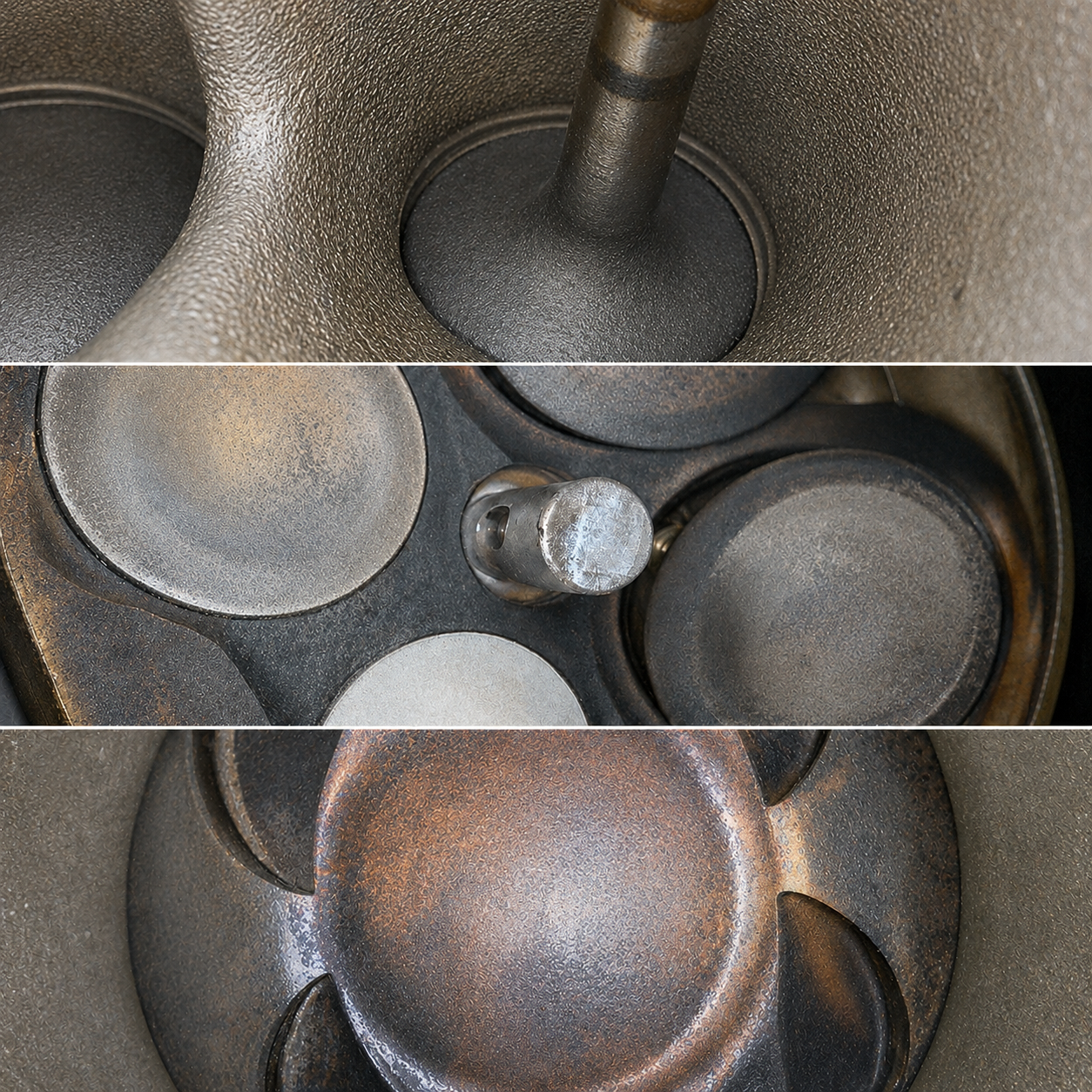
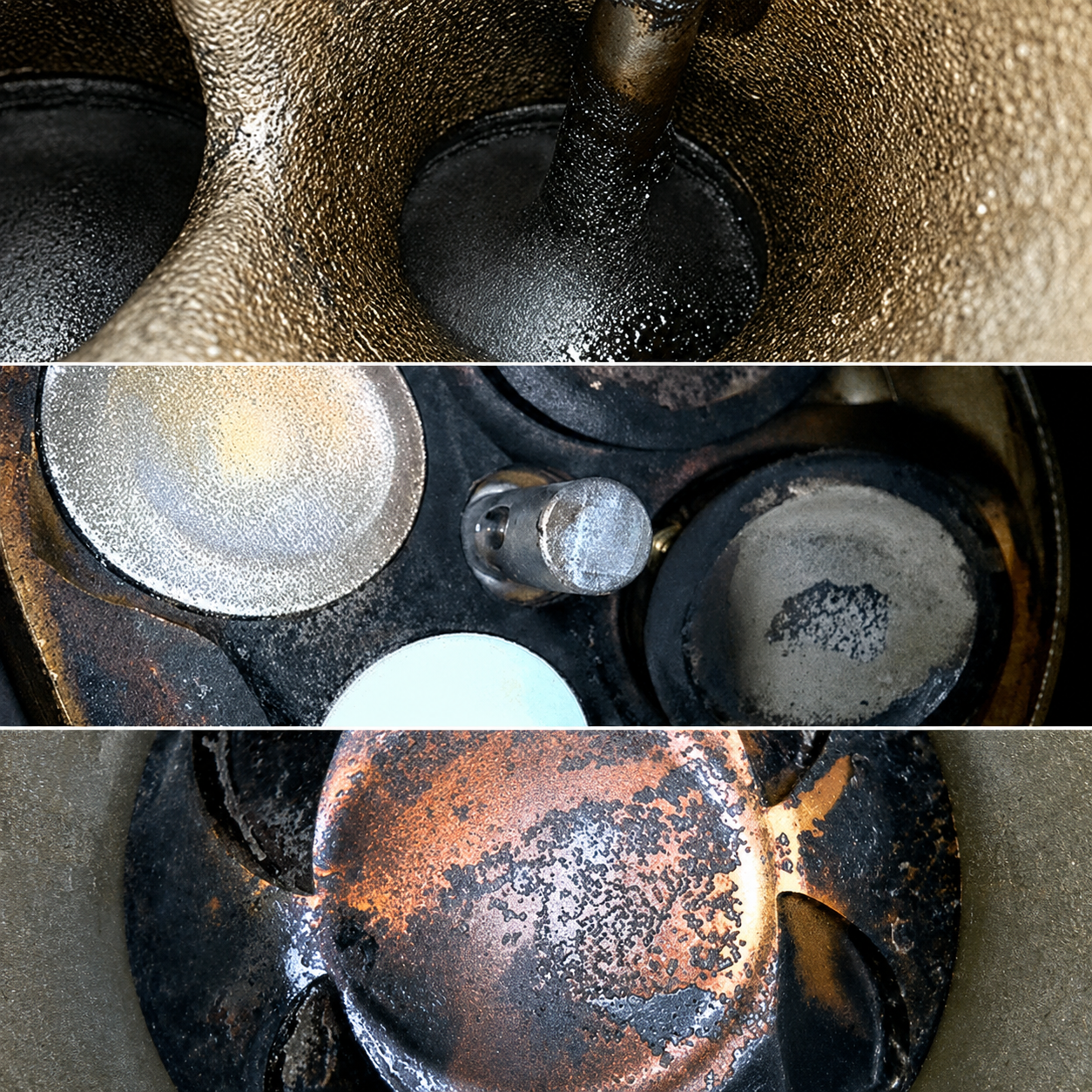
See the carbon. Verify the walnut blasting result. Show your customer.
Before/after documentation is part of the walnut blasting service — not just a quality check. Shops that show customers the before/after photos justify the service price without negotiation. The visual is the value.
Before — carbon buildup
After — cleaned
Drag handle to compare. Results vary by engine and deposit severity.
01
Inspect and document before cleaning
Confirm carbon buildup location and severity. A borescope photo before cleaning gives customers visual proof of why the service is needed — and justifies the price before any work begins.
02
Blast and recover in a closed loop
Walnut media blasts in via compressed air while vacuum recovery pulls out media and loosened carbon simultaneously. The built-in filter separates clean shells for reuse — cutting media cost per job to under $15.
03
Re-inspect and photograph after
Borescope check before reassembly confirms the cleaned area. Photo or video of the cleaned valve ports is your service record — and your marketing asset for future customer conversations.
04
Recommend the next interval
Set the expectation at delivery: stock engines need cleaning every 40,000–50,000 miles. Modified or tuned engines every 30,000–40,000. That’s a recurring service relationship — built from one job.
Before You Buy
What you need before your walnut blasting machine arrives.
The HTS walnut blasting machine handles blasting and vacuum recovery. But you need the air supply, walnut shell media, access, adapters, and safety gear sorted before your first job. Check this list before ordering.
Air supply note:
AUTOOL HTS walnut blasting machines require model-specific external air supply. HTS558: external compressor required. HTS559: 0.7MPa / 6bar or above. HTS518: generally 6bar or above. HTS678: 0.7MPa / 6bar or higher. HTS728: >0.7MPa with >0.4m³/min airflow. A compressor with a dryer/filter is strongly recommended to reduce moisture, walnut media clumping, weak blasting, and uneven cleaning.
Choose your walnut blasting equipment by cleaning area, job volume, adapter coverage, and service type. DIY → HTS558. Mobile repeated work → HTS559. Shop across BMW/Audi/VW/Hyundai → HTS518 or HTS678.
02
External air compressor (model-specific pressure / airflow)
Required — not included. Match the selected model before setup: HTS559 0.7MPa / 6bar or above; HTS518 generally 6bar or above; HTS678 0.7MPa / 6bar or higher; HTS728 >0.7MPa plus >0.4m³/min airflow; HTS558 requires an external compressor.
03
Dry walnut shell media for walnut blasting (correct size)
HTS558/559/518/678 use 0.6–1.2mm media. HTS728 uses finer 0.4–0.6mm. Not included unless package page states otherwise. Media is reusable — the dust filter separates it from carbon residue after each job.
04
Vacuum recovery path
Use the recovery hose and filter system required by your HTS model. Vacuum recovery must stay active throughout blasting — never blast without recovery running.
05
Correct adapter seal for your vehicle
Match the adapter to the intake port. A proper seal controls media spray pattern and maximises recovery efficiency. Check the adapter list for your specific engine before ordering.
06
Safety glasses, respirator mask, and gloves
Required before blasting begins. Walnut media, compressed air, and loosened carbon residue all require full eye, respiratory, and hand protection.
07
Intake manifold access tools
Most intake valve walnut blasting requires intake manifold removal. Follow the vehicle-specific service procedure. Access requirements vary significantly between BMW, Audi, VW, Hyundai, and Toyota platforms.
08
Closed-valve confirmation
Confirm the target intake valve is in the closed position before cleaning each port. Blasting an open valve risks media entering the cylinder — inspect with a borescope or light before starting.
09
Borescope or inspection light
Inspect carbon buildup severity before cleaning and re-check the cleaned port before reassembly. Borescope documentation before/after is standard shop practice for customer-facing service jobs.
10
Replacement gaskets (vehicle-dependent)
Intake manifold gaskets must be replaced on some platforms (common on BMW N54/N55 and VAG engines) during reassembly. Check your vehicle service manual and have gaskets ready before disassembly.
Safety & Correct Use
Six walnut blasting steps from access to reassembly.
Skip any step and you risk media entering cylinders, uneven cleaning, or adapter blowout. Follow this sequence on every job.
01 Prepare access
02 Inspect carbon
03 Close valves
04 Seal & connect
05 Blast controlled
06 Recover & inspect
01
Prepare intake-side access.
Follow the vehicle service procedure for your specific platform. Traditional intake valve walnut blasting and carbon cleaning require intake manifold removal on most engines. Required disassembly varies between BMW, VAG, Hyundai/Kia, and Toyota GDI platforms — check before starting.
Safety checks — before every job
Do not blast open valves under any circumstances
Keep vacuum recovery active throughout the entire blasting process
Use dry walnut shell media in the correct size for your HTS model
Use dry-filtered compressed air that matches your selected HTS model; HTS728 requires >0.7MPa and >0.4m³/min airflow
Confirm adapter is properly sealed before media flow begins
Keep walnut media out of open cylinders and unsealed areas
Re-inspect the cleaned area before reassembly — every time
Follow the vehicle-specific service procedure throughout
Wear safety glasses, mask, and gloves at all times while blasting
FAQ
Walnut blasting machine questions before you buy — answered directly.
What is walnut blasting and who needs a walnut blasting machine?
Walnut blasting, also called walnut shell blasting, uses crushed walnut shells propelled by compressed air to physically remove carbon deposits from intake pipes, intake manifolds, intake ports, and intake valve backside surfaces. It’s needed by owners of GDI (gasoline direct injection) engines — because fuel is injected directly into the combustion chamber, bypassing the intake valves entirely. Without fuel washing them, oil vapors bake onto valve surfaces over 30,000–50,000 miles. Chemical cleaners can’t reliably remove hardened deposits. Walnut blasting is the physical solution.
Do I need an external air compressor?
Yes. AUTOOL HTS walnut blasting machines require an external air compressor, but the pressure and airflow requirements differ by model. HTS558 requires an external compressor; HTS559 requires 0.7MPa / 6bar or above; HTS518 is generally 6bar or above; HTS678 requires 0.7MPa / 6bar or higher; HTS728 requires >0.7MPa plus >0.4m³/min airflow. A compressor with a dryer/filter is strongly recommended to prevent moisture from clumping the walnut media.
Is walnut media included?
Not unless your selected package page explicitly states otherwise. HTS558/559/518/678 use 0.6–1.2mm media. HTS728 uses finer 0.4–0.6mm media. Media is reusable — the built-in dust filter separates carbon residue from clean shells after each job. Typical media cost per intake cleaning is under $15 depending on engine cylinder count and deposit severity.
Which model is right for a repair shop with varied makes?
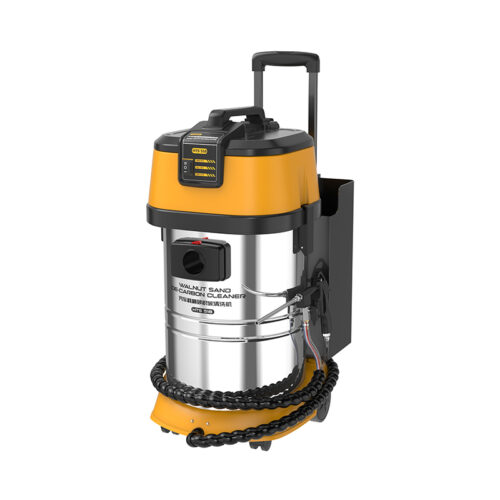
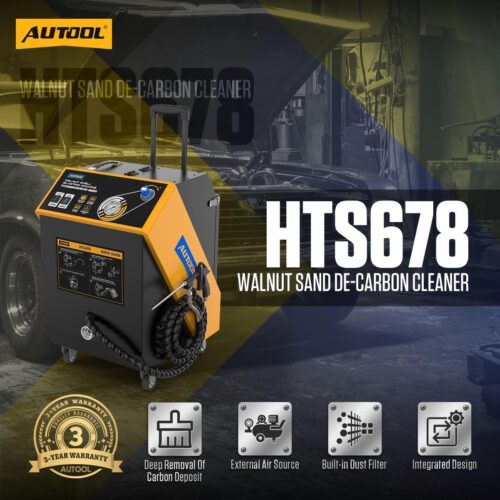
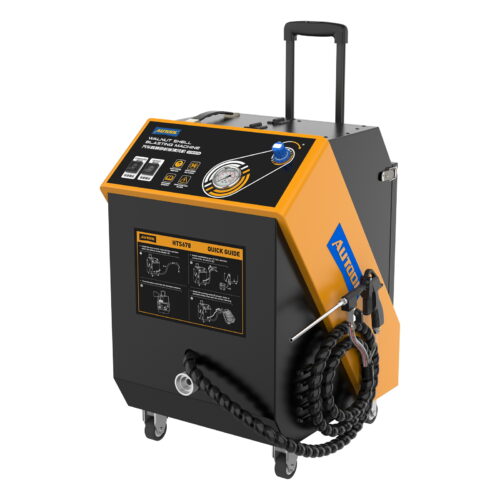
HTS518 is the practical repair-shop walnut blasting equipment entry point with 30L capacity and 23 adapters covering BMW, VAG, Hyundai/Kia, and other GDI platforms. HTS678 upgrades with adjustable pressure control, a pressure gauge, HEPA filtration, and Standard/Expert Mode — the professional-grade option for shops doing repeated high-volume intake cleaning across multiple engine families. Both models are intake-side only; HTS728 is reserved for combustion chamber work.
What’s the difference between HTS558, HTS559, and HTS518?
HTS558 is the starter walnut blaster: 1200W, 13L, 5 adapters. HTS559 upgrades power to 1400W, capacity to 30L, and adds 360° casters for easier movement — better for repeated mobile or small-shop jobs. HTS518 adds the full 23-adapter kit, three cleaning modes (High/Low/Low-Speed), and 30L capacity — the step into repair-shop service-grade. All three are intake-side machines.
How often does walnut blasting need to be done?
Industry consensus: stock GDI engines every 40,000–50,000 miles. Modified or tuned engines every 30,000–40,000 miles. BMW has included walnut blasting as scheduled maintenance on selected N20/N26/N54/N55 models. Driving patterns matter — frequent short trips, cold starts, and stop-and-go city driving accelerate carbon buildup and may warrant earlier service.
Can beginners use the HTS558?
HTS558 is designed for experienced DIY users, mobile mechanics, and small shops — not first-time tool users. Intake valve walnut blasting requires intake manifold access on most engines, adapter sealing, external air supply, closed-valve preparation, and post-cleaning inspection. If you’re not confident with those steps, a professional shop service is the safer choice.
Is walnut blasting safe for aluminum valve surfaces?
Yes, when correct preparation is followed. Walnut shells are harder than carbon deposits but softer than aluminum, steel, and cast-iron valve and port surfaces. The shells abrade carbon without scratching the underlying metal — it’s the same principle behind walnut shell tumbling used in precision parts cleaning. Always use the correct media size for your HTS model, confirm valves are closed before blasting, and keep vacuum recovery active throughout.
Will walnut blasting fix misfires or rough idle?
If carbon buildup on intake valves is the cause — yes, often immediately and noticeably. But misfires and rough idle also come from spark plugs, ignition coils, injectors, vacuum leaks, PCV valve issues, sensors, and other causes. Carbon buildup is frequently misdiagnosed as ignition failure. Confirm with a borescope inspection first. If visible deposits are on the valve backsides, walnut blasting is the correct fix.
Which AUTOOL model handles combustion chamber cleaning?
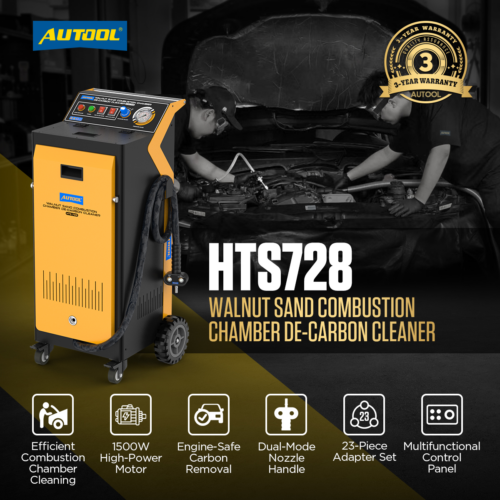
Only the HTS728. It uses finer 0.4–0.6mm walnut media and requires professional preparation. HTS558, HTS559, HTS518, and HTS678 are intake-side machines only — covering intake pipe, intake manifold, intake port, and intake valve backside carbon deposits.
Is walnut blasting better than chemical intake cleaner?
For hardened deposits on GDI intake valve backsides, walnut blasting is significantly more effective. Chemical sprays may soften light-stage deposits, but Engine Builder Magazine confirms they “by no means solve the issue or completely rid the intake port of the buildup” once carbon has baked onto valve surfaces. Walnut blasting is the method recommended by BMW, Audi, and VW independent specialists — and the method BMW included in factory maintenance schedules for N54/N55 engines.
Will residual walnut media damage the engine?
No. Any walnut shell fragments remaining in the intake manifold turn to ash under normal engine operating temperatures on first startup — this is not a concern. The vacuum recovery system captures the vast majority of media and carbon residue during cleaning. However: never allow media into open cylinders — only blast with target valves confirmed closed.
Which vehicles is this for?
For GDI intake valve carbon cleaning, this setup applies to any direct-injection (GDI/FSI/TSI/TFSI/EcoBoost/SKYACTIV-G) engine. Most commonly: BMW (N20, N26, N54, N55, B46, B58), MINI Cooper S/JCW, Audi (1.8T / 2.0T TFSI/FSI, 3.0T), Volkswagen (TSI, FSI, TFSI), Hyundai/Kia (GDI and T-GDI), Toyota (D-4S), Ford (EcoBoost), and others. Over 55% of new US light-duty vehicles use GDI. Always confirm adapter fitment for your specific engine configuration before ordering.
Repair Shop / Mobile Service
Add intake valve carbon cleaning and walnut blasting to your service menu.
Walnut blasting service is one of the highest-margin intake carbon cleaning services a shop can offer. Variable cost is under $15 per job. Service revenue is $300–$1,200. Every GDI vehicle you see is a candidate — and they come back every 40,000 miles.
Create walnut blasting service packages for BMW, MINI, Audi, VW, Hyundai, Kia, Toyota, Ford EcoBoost, and other GDI platforms
Use before/after borescope photos to document service value — customers who see the visual rarely question the price
Recommend cleaning intervals at delivery to build a recurring service cadence (every 40,000–50,000 miles for stock engines)
Bundle with intake manifold gasket replacement, PCV valve service, and spark plug change to maximise per-visit revenue
HTS559 suits mobile mechanics and small shops with 3–10 jobs per month
HTS518 / HTS678 suit busy service bays needing 23 adapters and pressure control across mixed makes
Workshop Quote
Request model advice, shop pricing, or bulk support
Share your setup so AUTOOL can recommend the right model for your cleaning volume, vehicle mix, and service plan.
Shop name and country / region
Main vehicle platforms you service (BMW, Audi, VW, etc.)
All five HTS models ship with a 3-year main-unit warranty. Choose by cleaning area, job volume, and adapter coverage — or contact AUTOOL for a direct recommendation.
SALE
Select options
This product has multiple variants. The options may be chosen on the product page