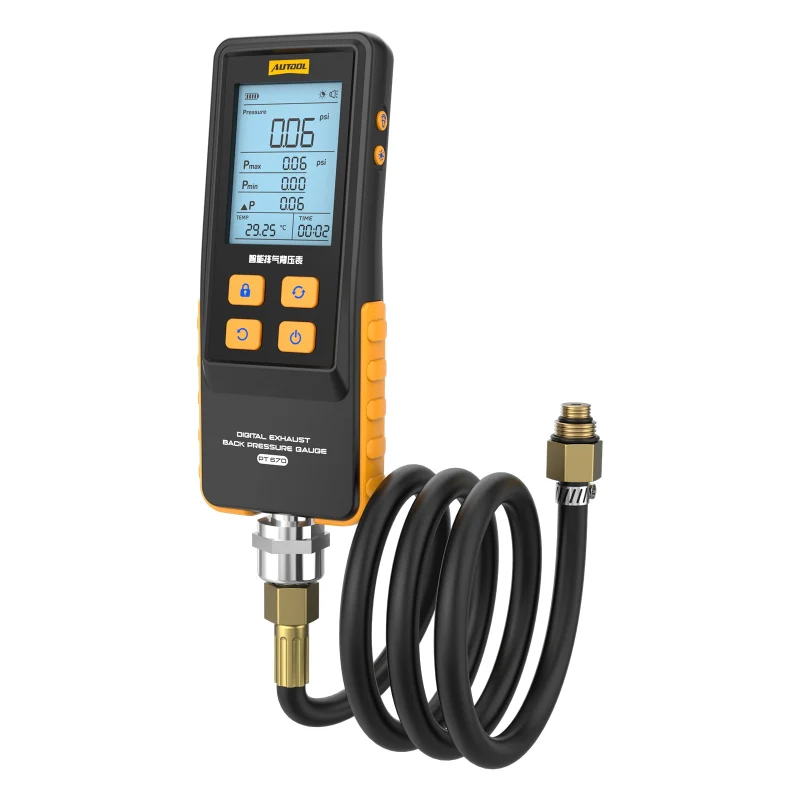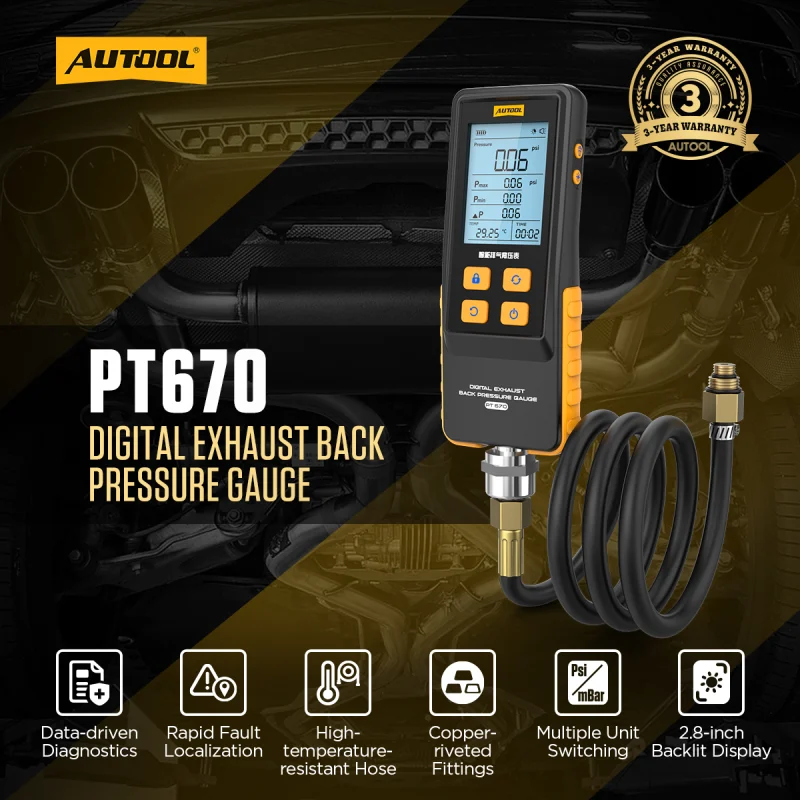







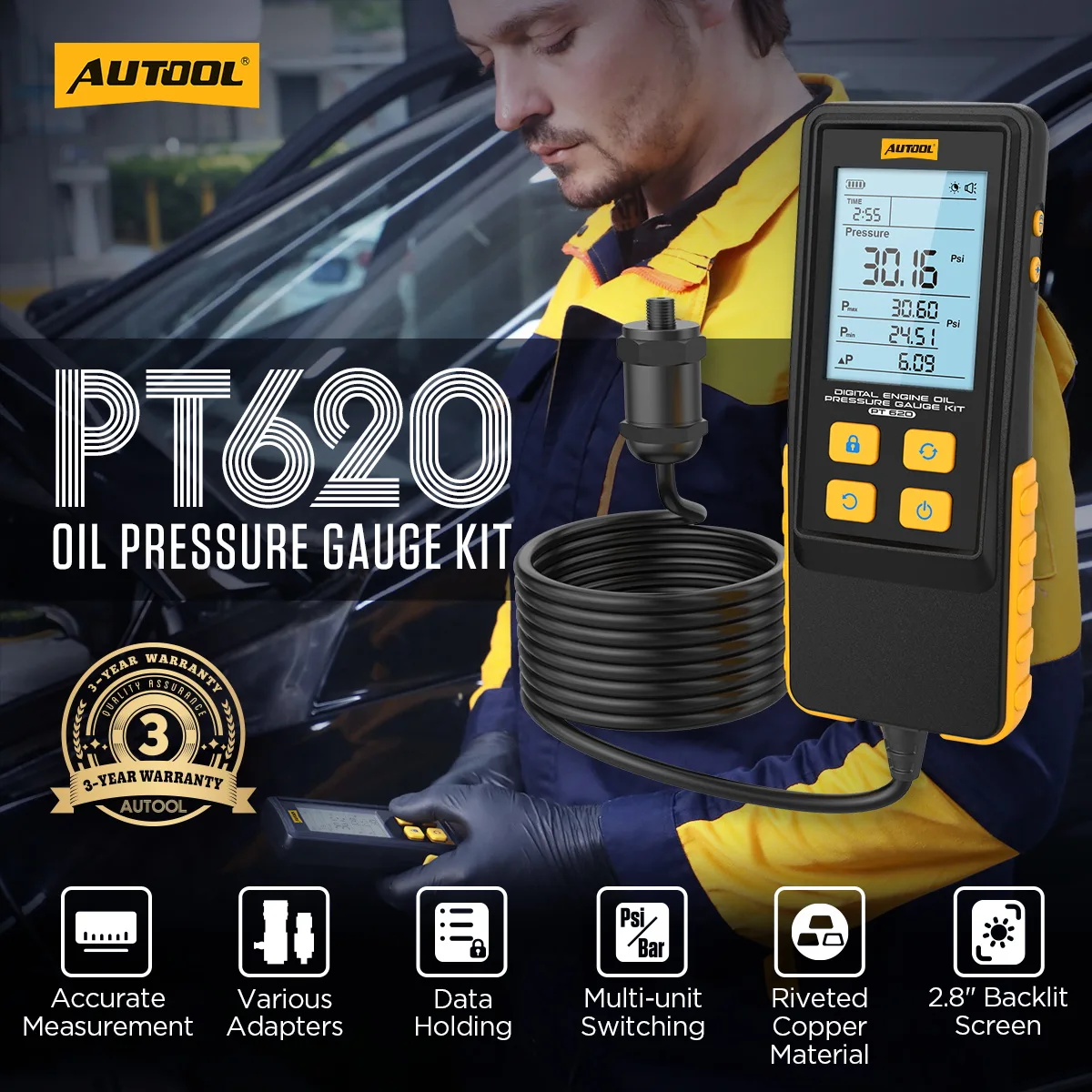
AUTOOL PT620 zestaw cyfrowego testera ciśnienia oleju silnikowego
US$169.00
Najważniejsze cechy
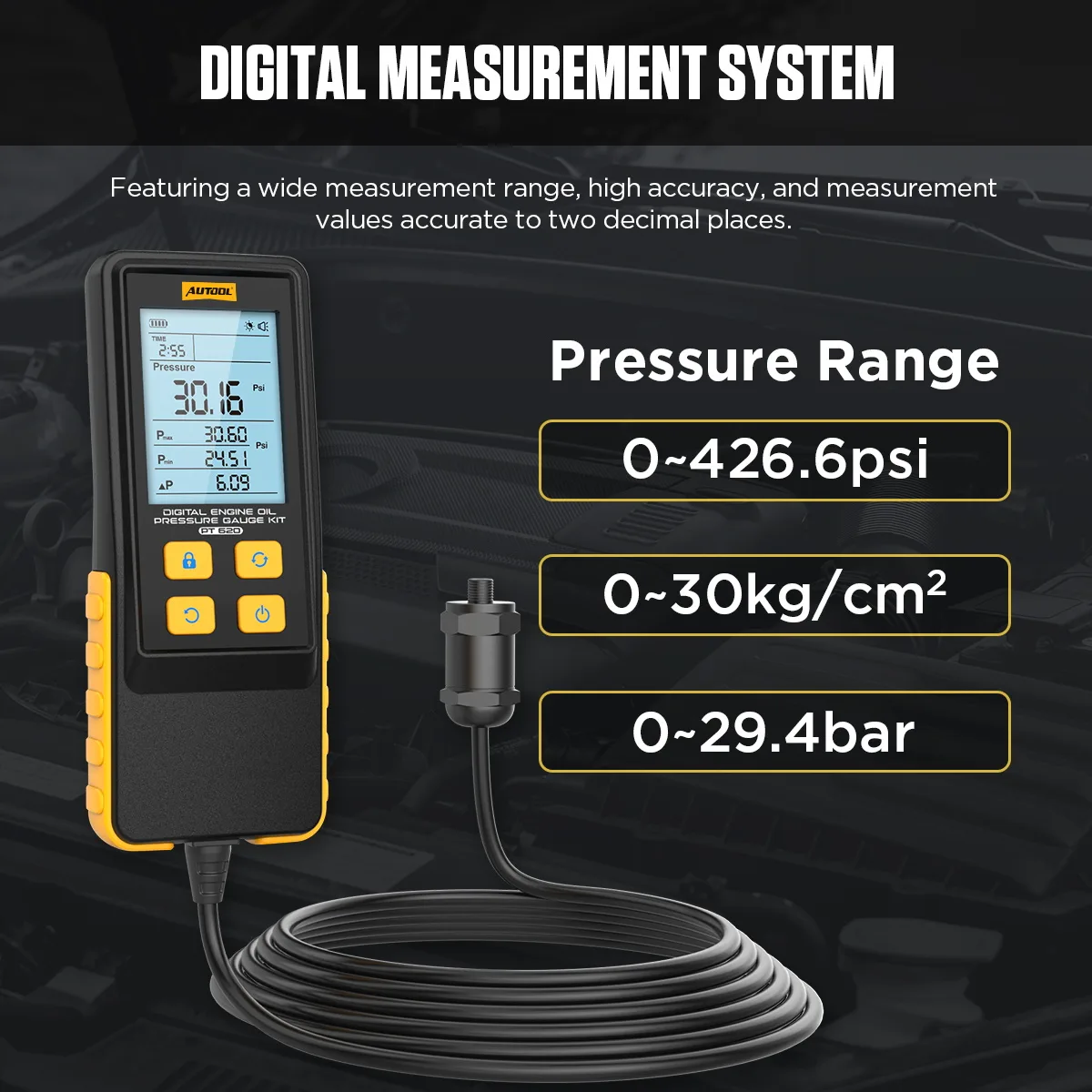
- Mierz ciśnienie obiegu oleju silnikowego w wyświetlanym zakresie 0–426.6 psi.
- Porównuj odczyty ciśnienia z dokładnością 0.5% FS i rozdzielczością wyświetlania 0.01.
- Sprawdzaj ciśnienie bieżące, maksymalne, minimalne i różnicowe wraz z czasem pomiaru.
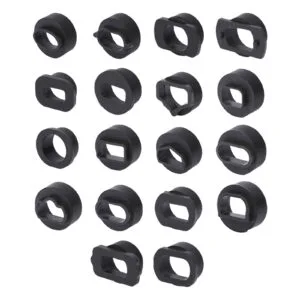
- Dopasuj typowe porty ciśnienia oleju silnikowego za pomocą 18 typów złączy.
- Używaj adapterów gwintowanych, kątowego szybkozłącza i olejoodpornego węża przy punktach testowych silnika.
- Test ciśnienia oleju silnikowego: Mierz ciśnienie obiegu oleju silnikowego w wyświetlanym zakresie 0–426.6 psi.
- Dokładność 0.5% FS / rozdzielczość 0.01: Porównuj odczyty ciśnienia z dokładnością 0.5% FS i rozdzielczością wyświetlania 0.01.
- Maks. / min. / różnica: Sprawdzaj ciśnienie bieżące, maksymalne, minimalne i różnicowe wraz z czasem pomiaru.
- 18 typów adapterów: Dopasuj typowe porty ciśnienia oleju silnikowego za pomocą 18 typów złączy.
- Połączenia w ciasnych miejscach: Używaj adapterów gwintowanych, kątowego szybkozłącza i olejoodpornego węża przy punktach testowych silnika.
- 3-letnia gwarancja Urządzenie główne: 3 lata · Akcesoria: 1 rok
- Zwroty w ciągu 90 dni Zwroty spełniające warunki w ciągu 90 dni
- Oficjalny sklep Oryginalne produkty · Bezpośrednie wsparcie
AUTOOL PT620 · Zestaw cyfrowego testera ciśnienia oleju silnikowego
Odczytuj ciśnienie oleju silnikowego w porcie czujnika
Mierz ciśnienie oleju silnikowego we właściwym porcie czujnika i porównuj je ze specyfikacją serwisową pojazdu. PT620 śledzi ciśnienie bieżące, maksymalne, minimalne i różnicowe, a 18 typów złączy i olejoodporny wąż umożliwiają dostęp do różnych punktów silnika w komorze silnikowej.
- Zakres ciśnienia oleju 0–426.6 PSI
- Podana dokładność 0.5% FS
- Bieżące / maks. / min. / różnica
- 18 typów adapterów
- Wąż olejoodporny
Najważniejsze funkcje
Bieżące, min./maks. i różnicowe ciśnienie oleju
Cyfrowy pomiar ciśnienia
Mierzy ciśnienie oleju silnikowego cyfrowym systemem pomiarowym w wyświetlanym zakresie do 0–426.6 PSI, z rozdzielczością wyświetlania 0.01.
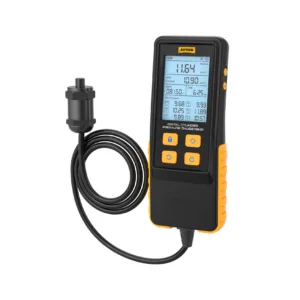
Podświetlany wyświetlacz 2.8 cala
Podświetlany ekran 2.8 cala wyraźnie pokazuje informacje o ciśnieniu, ułatwiając odczyty w słabo oświetlonym warsztacie lub komorze silnika.
Przełączanie jednostek
Przełączaj jednostki ciśnienia między PSI, Bar i kg/cm², aby dopasować je do różnych praktyk serwisowych i informacji referencyjnych pojazdu.
Wyświetlanie maks. / min. / różnicy
Interfejs może pokazywać bieżące ciśnienie, bieżące ciśnienie maksymalne, bieżące ciśnienie minimalne, różnicę ciśnień i czas pomiaru.
Blokada danych, kasowanie i zerowanie
Użyj przycisku blokady do zatrzymania bieżącego interfejsu, w razie potrzeby skasuj dane testowe i wyzeruj wartość ciśnienia przed testem.
Zestaw nitowanych adapterów miedzianych
Dołączone adaptery miedziane wspierają typowe połączenia portów czujników ciśnienia oleju silnikowego i są odporne na zużycie oraz utlenianie przy normalnym użytkowaniu.
Zasilanie bateriami AAA
PT620 używa czterech baterii AAA 1.5V. Przed użyciem otwórz pokrywę baterii z tyłu urządzenia, włóż baterie z prawidłową polaryzacją i dokładnie zamknij pokrywę.
Połączenia ciśnienia oleju
Adaptery gwintowane, kątowe szybkozłącze i olejoodporny wąż umożliwiają podłączenie do punktów testowych ciśnienia oleju silnikowego.
18 typów adapterów
Porównanie PT620 i grafiki adapterów wymieniają 18 typów złączy akcesoriów do przygotowania testu ciśnienia oleju silnikowego.
Typowe rozmiary gwintów
Pokazane rozmiary adapterów obejmują M10×1.0, M10×1.25, M12×1.25, M12×1.5, M12×1.75, M14×1.25, M14×1.5, M16×1.25, M16×1.5, M18×1.5, 3/8-24UNF, 1/2-20UNF, NPT-1/4-18, NPT-1/8-27, NPT-3/8-18, ZG1/8-28, ZG1/4-19 i ZG3/8-19. Przed podłączeniem dopasuj gwint i sposób uszczelnienia do punktu testowego silnika.
Kątowe szybkozłącze
Złącze kątowe pomaga w ciasnych miejscach komory silnika, gdzie proste połączenie może być niewygodne.
Wąż olejoodporny
Wąż przesyłowy jest przeznaczony do połączeń potrzebnych przy testowaniu ciśnienia oleju. Przed każdym testem sprawdź wąż i złączki.
Automatyczne wyłączenie
Urządzenie automatycznie wyłącza się po 5 minutach bezczynności, gdy nie jest przyłożone ciśnienie.
Dokładność pomiaru ciśnienia
Dokładność: 0.5% FS.
3 lata ochrony gwarancyjnej
Urządzenie główne: 3-letnia gwarancja. Standardowe akcesoria: 1-letnia gwarancja. Warunki gwarancji.
Przebieg obsługi serwisowej
Zamontuj adapter i testuj zgodnie z procedurą
Krok 1
Wyjmij czujnik
Wyjmij czujnik ciśnienia oleju silnikowego zgodnie z procedurą serwisową pojazdu.
Krok 2
Podłącz adapter
Wybierz odpowiedni adapter do modelu pojazdu i podłącz go do sondy pomiarowej.
Krok 3
Wyzeruj miernik
Przytrzymaj przycisk zasilania przez ponad 2 sekundy, aby uruchomić przyrząd, a następnie wyzeruj wartość ciśnienia przed testem.
Krok 4
Podłącz do silnika
Pewnie podłącz sondę pomiarową do punktu testowego ciśnienia oleju silnikowego.
Krok 5
Uruchom silnik
Uruchamiaj silnik dopiero po prawidłowym podłączeniu złączki i przygotowaniu miernika.
Krok 6
Odczytaj ciśnienie
Sprawdź bieżące ciśnienie i powiązane wyświetlane wartości na ekranie PT620.
Krok 7
Pomiar w porcie czujnika
Wybierz właściwy adapter do portu czujnika ciśnienia oleju i wyzeruj miernik przed pomiarem. Przed uruchomieniem silnika i odczytem ciśnienia wykonaj procedurę podłączenia.
Bezpieczne użytkowanie
Kontroluj gorący olej, wąż i narażenie na ciśnienie
Nie przeciążaj
Używaj miernika w znamionowym zakresie testowym i nie przekraczaj podanego ciśnienia przeciążenia.
Dopasuj adapter do portu
Wybierz odpowiedni adapter do pojazdu i portu czujnika ciśnienia oleju silnikowego. Nie wciskaj adaptera na siłę do niezgodnego portu.
Zabezpiecz połączenie przed uruchomieniem
Pewnie podłącz sondę pomiarową do punktu testowego ciśnienia oleju silnikowego. Uruchamiaj silnik dopiero po prawidłowym podłączeniu złączki i przygotowaniu miernika.
Usuń ciśnienie przed wyłączeniem
Po pomiarze wyłącz urządzenie przy ciśnieniu atmosferycznym.
Sprawdź wąż i złączki
Przed każdym testem sprawdź wąż i złączki. Dokręć luźne złączki przed rozpoczęciem pracy.
Najpierw sprawdź złączki
Regularnie sprawdzaj części wymagające dokręcenia lub podłączenia. Dokręć luźne złączki przed rozpoczęciem pracy.
Unikaj cieczy korozyjnych
Unikaj kontaktu z cieczami korozyjnymi i w razie potrzeby czyść po użyciu części mające kontakt z mediami chemicznymi.
Chroń obudowę
Nie ocieraj produktu o szorstkie powierzchnie ani nie uszkadzaj obudowy podczas przechowywania i pracy.
Przechowuj w suchym miejscu
Przechowuj produkt w suchym miejscu. Nie przechowuj go w miejscach gorących, wilgotnych lub słabo wentylowanych.
Porównaj ciśnienie oleju ze specyfikacją
Używaj węża dopuszczonego do oleju i właściwego adaptera silnika, a następnie porównaj ciśnienie przy określonej temperaturze i prędkości obrotowej silnika ze specyfikacją pojazdu.
Porównanie modeli
Wybierz odpowiedni zestaw do pomiaru ciśnienia
Porównaj modele
Wybierz jeden lub więcej modeli. Domyślnie wybrano PT620 Oil Pressure Gauge Kit.
| Product Name | ModelPT610 Cylinder Pressure Gauge | ModelPT620 Oil Pressure Gauge Kit | ModelPT630 Fuel Pressure Gauge | ModelPT635 Fuel Pressure Gauge(High-end version) | ModelPT640 GDI Fuel Pressure Gauge | ModelPT650 Transmission Oil Pressure Gauge | ModelPT660 Brake System Pressure Tester |
|---|---|---|---|---|---|---|---|
| Measurement & Readout | |||||||
| Display Screen | 2.8-inch | 2.8-inch | 2.8-inch | 2.8-inch | 2.8-inch | 2.8-inch | 3-inch |
| Data Storage | 6 Sets of Data | ×Brak w zestawie | ×Brak w zestawie | ×Brak w zestawie | ×Brak w zestawie | ×Brak w zestawie | Locks the current reading; check the current specification for multi-record storage. |
| Pressure Range | 0-426.6psi 0-30kg/cm² 0-29.4bar | 0-426.6psi 0-30kg/cm² 0-29.4bar | 0-426.6psi 0-30kg/cm² 0-29.4bar | 0-426.6psi 0-30kg/cm² 0-29.4bar | 0-5221.3psi 0-367kg/cm² 0-360bar | 0-426.6psi 0-30kg/cm² 0-29.4bar | 0–210 bar |
| Dual-Channel Pressure Testing | ×Brak w zestawie | ×Brak w zestawie | ×Brak w zestawie | ×Brak w zestawie | ×Brak w zestawie | ×Brak w zestawie | Two brake positions/calipers via L/R channels |
| Data Lock/Clear/Record | ✓W zestawie | ✓W zestawie | ✓W zestawie | ✓W zestawie | ✓W zestawie | ✓W zestawie | ✓W zestawie |
| Multi-Parameter Display | Current Temp Measurement Time Real-Time Pressure Value Average Pressure Value Pressure value of each cylinder | Measurement Time Pressure Maximum Pressure Minimum Pressure Differential | Maximum Value Minimum Value Differential Pressure Value Measurement Time Real-Time Pressure Value | Maximum Value Minimum Value Average Value Temperature Value Measurement Time Real-Time Pressure Value | Maximum Value Minimum Value Differential Pressure Value Measurement Time Real-Time Pressure Value | Maximum Value Minimum Value Differential Pressure Value Measurement Time Real-Time Pressure Value | Left/right real-time pressure, minimum, maximum, and front/rear pressure difference |
| Pressure Units | Psi Bar Kg/cm² | Psi Bar Kg/cm² | Psi Bar Kg/cm² | Psi Bar Kg/cm² | Psi Bar Kg/cm² | Psi Bar Kg/cm² | psi / bar / kg/cm² |
| Connections & Applications | |||||||
| Accessory Connectors | 10 Types | 18 Types | 17 Types | 31 Types | 3 Types | 12 Types | Check the selected package contents for included adapter types and quantities. |
| Equipped Toolbox | ✓W zestawie | ✓W zestawie | ✓W zestawie | ✓W zestawie | ✓W zestawie | ✓W zestawie | ✓W zestawie |
| Applicable Scenarios | Engine Cylinder | Engine Oil Circulation System | Automotive Fuel System | Automotive Fuel System | Fuel Injection Pump Pressure in the Automotive Direct Injection System | Automotive Transmission Pressure | Internal brake-system fluid pressure; two-position/caliper comparison |
Instrukcja i pomoc
Znajdź instrukcję i wskazówki dotyczące adapterów
Instrukcja obsługi AUTOOL PT620
Otwórz instrukcję PDF dotyczącą testowania ciśnienia oleju AUTOOL PT620, wyboru jednostki, przygotowania adapterów i węża, odczytów maksymalnych i minimalnych, zerowania, bezpieczeństwa i rozwiązywania problemów.
Zawartość zestawu
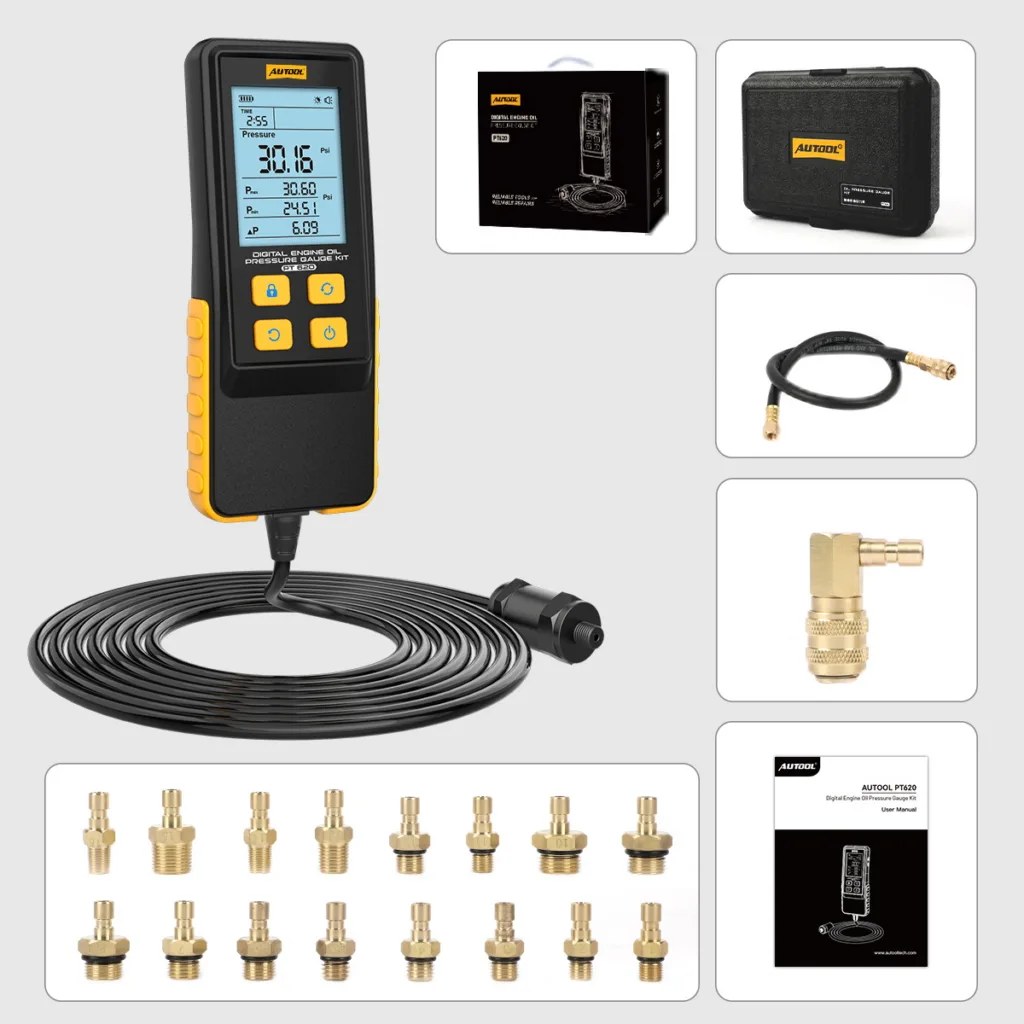
Zobacz zawartość opakowania
- Urządzenie główneAUTOOL PT620 zestaw manometru oleju
- Walizka do przechowywaniaOchronna walizka transportowa
- Opakowanie detaliczneOpakowanie produktu AUTOOL PT620
- ElementWąż Olejoodporny wąż przesyłowy
- ElementZłącze Kątowe szybkozłącze
- AdapteryZestaw adapterów
- DokumentacjaInstrukcja obsługi
Pytania kupujących
Pytania o podłączenie i odczyt ciśnienia
Co testuje AUTOOL PT620?
PT620 bada ciśnienie obiegu oleju silnikowego w zgodnych samochodach, motocyklach, ciężarówkach i innych pojazdach po dopasowaniu adaptera portu czujnika i ciśnienia znamionowego. Nie jest testerem ciśnienia cylindrów, paliwa, GDI, skrzyni biegów ani hamulców.
Jaki zakres ciśnienia obsługuje PT620?
Grafiki produktu pokazują zakres wyświetlania 0-426.6 PSI, 0-30 kg/cm² i 0-29.4 Bar. Instrukcja obsługi podaje zakres 0-30 Bar i ciśnienie przeciążenia 40 Bar.
Jakie jednostki ciśnienia może wyświetlać PT620?
PT620 obsługuje PSI, Bar i kg/cm². Używaj przycisku jednostek ciśnienia, aby przełączać je zgodnie z wymaganiami testu.
Czy PT620 zapisuje wiele zestawów danych testowych?
PT620 obsługuje blokadę danych, blokadę interfejsu, kasowanie danych i zerowanie ciśnienia. Nie traktuj PT620 jako modelu z pamięcią wielu zestawów danych, chyba że potwierdza to najnowsza wersja produktu i pomoc sprzedawcy.
Jakich baterii używa PT620?
PT620 używa czterech baterii AAA 1.5V. Przed użyciem otwórz pokrywę baterii z tyłu urządzenia, włóż baterie z prawidłową polaryzacją i dokładnie zamknij pokrywę.
Ile typów adapterów jest dołączonych?
Porównanie i grafiki adapterów wymieniają 18 typów złączy akcesoriów do PT620. Grafika adapterów pokazuje opcje gwintów metrycznych, UNF, NPT i ZG oraz kątowe szybkozłącze i olejoodporny wąż przesyłowy. Przed testem sprawdź wymagany rozmiar adaptera.
Czy przed testem trzeba wyzerować miernik?
Tak. Włącz miernik i wyzeruj wartość ciśnienia przed testem. Instrukcja podaje również, że po zakończeniu pomiaru wyłączenie należy wykonać przy ciśnieniu atmosferycznym.
Czy PT620 można używać do testowania ciśnienia paliwa, GDI, skrzyni biegów lub hamulców?
PT620 służy do testowania ciśnienia oleju silnikowego. Do ciśnienia paliwa porównaj PT630 lub PT635. Do ciśnienia GDI porównaj PT640. Do ciśnienia oleju skrzyni biegów porównaj PT650. Do wewnętrznego ciśnienia płynu układu hamulcowego porównaj PT660.
Co zawiera zestaw PT620?
Zawartość zestawu: jednostka główna PT620, walizka do przechowywania, opakowanie detaliczne, wąż przesyłowy, kątowe szybkozłącze, zestaw adapterów i instrukcja obsługi.
Jak długo trwa gwarancja?
Urządzenie główne: 3-letnia gwarancja. Standardowe akcesoria: 1-letnia gwarancja. Warunki gwarancji.
Opinie klientów 5
Easy to use, and the display is clear when checking engine oil pressure. A handy tool to have in the garage.
Good tool for Audi 2.0t diagnostics
This worked very well for trying to get a handle on the common Audi 2.0t low oil pressure issue (B8 series A5 in this case). Since these cars often develop low oil pressure warnings at low rpm with a warm engine, I thought I’d share our results.
I wanted a device that would log the lowest pressure while driving so we could see what happened to trigger these car warnings and see if the pressure was really low enough to be a major concern. These cars don’t have pressure sensors, only low pressure warning triggers for the alert, so no way to see pressures without an external gauge such as this.
I did not see many options for a reasonably priced alternative that was available fast so I rolled the dice and ordered this oil pressure test kit even though it had few reviews and most of them were Vine sponsored. The thing showed up less than 12 hours after ordering which was great. Always a little suspicious of Chinese goods I was pleasantly surprised to find the build quality of the device, packaging, and adapters all looked quite good. No rough threads or questionable milled bits. On mine the hose with quick coupler fitting and hose came screwed on black threaded sensor right out of the box. The quick coupler was well made and seemed secure enough when attached to an adapter to be ok taped to the engine while driving around a bit.
One thing to note, the adapter assortment is vast, but they are not labeled with the thread spec, so it’s necessary to verify what the car has. In our case I knew we needed an m10x1 thread, which turned out to be the #1 adapter and also the first on the printed list that came in that box. The adapters are numbered 1-16, but the printed list of sizes included is not numbered. It may be that the list is in numerical order that it matches the adapter numbers, but I can’t confirm. I included a picture of the list in my review.
We removed the upper oil pressure sensor from the car, screwed in the #1 adapter that matched its threads, and then connected the quick coupler. I just put a jumper wire in the cars sensor plug to ground so the car would not constantly beep at us during the test. A tee adapter would allow for use of both this and the car sensors at the same time, but we did not have one yet so we just went for it.
The wire from the unit’s sensor was long enough to run up across the engine, out under the rear edge of the hood, and into the passenger side window so we could monitor it in real time while driving.
Bottom line, once we figured out the interface buttons, it worked great and confirmed we did have adequate oil pressure at idle when warm, which we deemed sufficient for idle speed (though below audi specs) and immediately rises above idle, topping out at the car’s relief valve pressure of about 51-52 psi. There is about a second or so of latency between pressure changes and the display reading shift, but it’s a nice window into the engine pressure and range.
Worth noting it works a bit like a weight scale in that holding down one of the buttons recalibrates to zero, which you don’t want to do with it hooked up and car running or actual pressure becomes zero on the display. A short tap of the same button instead of long hold resets the high and low recording to zero without resetting the calibration. This is crucial for lowest pressure log since it will start at zero before you turn the car on! So after starting the engine you’ll want to tap that button to zero out the pressure high/low without changing the baseline calibration to zero. Took us a minute to figure that all out. It’s a good device which I can recommend.
The rest of this review only pertains to other Audi 2.0t engine owners in case they are in the same boat. We were dealing with this plus usual bad piston ring design oil consumption issue. We used this tester after tearing the engine down to replace pistons and timing chains. We removed all the stupid oil screens, decided the cam journals and balance shaft bearings were ok, and the oil pump had been replaced already so we kept it. We installed new Wossner pistons that use factory 21mm connecting rod pins and rods, but have proper wide waffle oil control rings. This totally solves the oil consumption and black oil too! We did leave the two stage oil pump in high pressure mode by not connecting the wire near the sump that allows it to shift into low pressure mode at lower revs. But we still get low pressure at warm idle, just not catastrophically low. Maybe 13-15 psi. It instantly jumps up above 20 psi above idle and is linear with revs up to 51 psi limit. Not sure where the oil pressure leakage is that is still haunting us, but seems fine to drive for now. Possibly intake cam phaser. I’ll try to post a YouTube video on this whole deal soon. Will update this review with what to look for if I do.
Good
Works well. Easy to use. Seems to be pretty accurate. Has multiple adapters for any situation. Large screen that's easy to see and read.