AUTOOL Blog, Repair Information
3-Minute Brake Fluid Test Guide: How to Check Your Brake Fluid Condition at Home

August 12, 2026
Share:
 autoolstore.com
Repair testing / 8 sub-categories
Diagnostic tools for leak tracing, visual inspection, battery health, circuits, pressure, spark, oil, and electrical readings.
Repair maintenance / 6 sub-categories
Service equipment for fluid exchange, A/C diagnostics, refrigerant recovery, oil handling, and cooling-system work.
Carbon cleaning / 3 sub-categories
Carbon-removal equipment for injectors, intake valves, components, and workshop cleaning jobs.
Wheel tire / 3 sub-categories
Equipment for alignment, lifting, tire repair, tire mounting, and service-bay workflows.
Tool storage / 1 sub-category
Storage products for keeping workshop tools, test equipment, and accessories organized.
EV charging / 1 sub-category
EV charging products for new-energy vehicle service, workshop use, and installation scenarios.
OBD diagnosis / 5 sub-categories
OBD-related testers, ECU programming power supplies, cable products, used-car inspection tools, and key frequency diagnostics.
Accessories / 8 sub-categories
Replacement parts, adapters, consumables, cables, and add-ons for major diagnostic and service equipment.
Many car owners regularly check engine oil, tire pressure, and brake pads, but one important maintenance item is often overlooked—brake fluid. Brake fluid plays a critical role in the braking system by transferring hydraulic pressure from the brake pedal to the brake components, allowing your vehicle to slow down and stop safely.
Over time, brake fluid absorbs moisture from the air. This reduces its boiling point and can affect braking performance. As brake fluid deteriorates, drivers may notice symptoms such as longer stopping distances, a soft brake pedal, or reduced braking response.
Fortunately, checking brake fluid condition does not always require a workshop visit. With a simple inspection and a professional brake fluid tester, vehicle owners can quickly understand the condition of their brake fluid and take action before potential safety issues occur.
Many drivers assume brake fluid, like engine oil, only needs to be replaced based on mileage. However, brake fluid replacement intervals depend not only on driving distance but also on environmental conditions, driving habits, and vehicle type.
In general, most vehicles are recommended to replace brake fluid every 2 years or approximately 40,000 km (25,000 miles). Vehicles used in high-temperature, high-humidity environments or high-performance vehicles may require more frequent inspections.
The key characteristic of brake fluid is that it is highly hygroscopic, meaning it naturally absorbs moisture from the air over time. As moisture content increases, the boiling point of brake fluid decreases significantly.
During repeated braking or high-speed driving, brake system temperatures can rise rapidly. If the brake fluid contains excessive moisture, vapor bubbles may form, reducing braking force and affecting driving safety.
Regular brake fluid testing helps identify fluid degradation before it affects braking performance.
In addition to following the recommended replacement schedule, certain vehicle symptoms can indicate that brake fluid condition should be checked.
Under normal conditions, the brake pedal should feel firm and responsive. If the pedal becomes increasingly soft or requires deeper pressing to achieve the same braking effect, there may be air in the braking system, or the brake fluid performance may have deteriorated.
If your vehicle previously stopped quickly with light brake pedal pressure but now requires a longer distance to stop, degraded brake fluid may be one possible cause.
As brake fluid ages, hydraulic pressure transmission efficiency may decrease. Drivers may notice slower brake response, inconsistent braking force, or reduced braking performance during daily driving.
Fresh brake fluid is usually light in color and transparent. Over time, it may gradually turn dark yellow or brown due to contamination and aging.
If the brake fluid in the reservoir appears noticeably darker, further inspection is recommended.
Method 1: Check Brake Fluid Color
Open the brake fluid reservoir cap and inspect the fluid condition. If the fluid remains clear and transparent, it is generally in good condition. If it appears dark, cloudy, or contains sediment, additional testing is recommended.
However, color alone is not a completely reliable indicator. Some brake fluid may still appear normal while already containing excessive moisture.
Method 2: Check Brake Fluid Level
Check the MIN and MAX markings on the brake fluid reservoir. If the fluid level has dropped significantly, inspect the braking system for possible leaks.
Please note that a lower brake fluid level does not always mean the fluid needs replacement. It may also be related to brake pad wear.
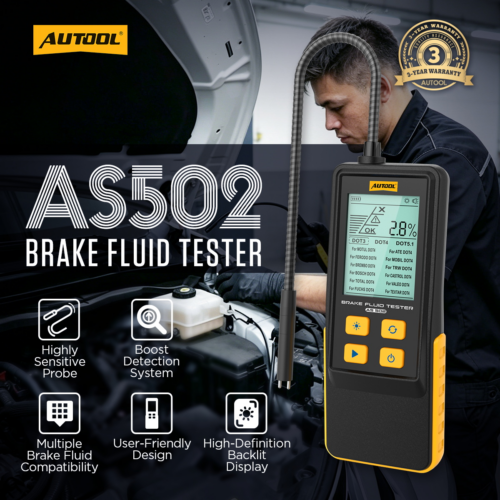
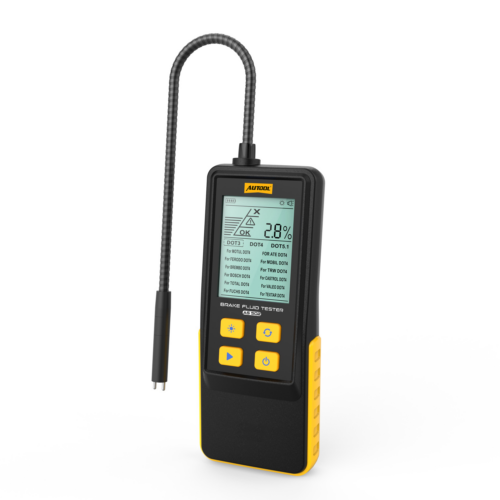
For a faster and more accurate assessment, a professional brake fluid tester is the ideal solution. AUTOOL offers two reliable brake fluid testing solutions: the AUTOOL AS501 and AUTOOL AS502 Brake Fluid Testers.
Both models are designed for DIY users, automotive enthusiasts, and professional technicians. They quickly measure the moisture content in brake fluid, helping users determine whether the fluid remains safe for continued use or requires replacement.
Feature | AS501 | AS502 |
Product Image |  |  |
Screen | 1.8-inch display | 2.8-inch display |
Test Mode | Standard mode | Standard mode + Expert mode |
Supported Fluids | 6 types (ENV-4, ENV-6, DOT3, DOT4, DOT5, DOT5.1) | 3 types (DOT3, DOT4, DOT5.1) |
Power Supply | 3V | 6V |
Probe Material | Iron Oxide | 304 stainless steel |
Response Time | 10 seconds | 10 seconds |
Probe Length | 26cm | 26cm |
Testing Principle | Moisture content detection | Moisture content detection |
AUTOOL AS501 Advantages
AUTOOL AS502 Advantages
Instead of replacing brake fluid based only on time or mileage, it is better to evaluate its actual condition through professional testing.
When symptoms such as a soft brake pedal, reduced braking performance, longer stopping distance, or a brake warning light appear, the brake fluid should be inspected as soon as possible.
For routine vehicle maintenance, using a professional brake fluid tester to measure moisture content is a more scientific and accurate way to determine brake fluid condition.
Whether you are a DIY car owner or a professional technician, a reliable brake fluid tester helps you quickly evaluate brake fluid quality, avoid unnecessary replacements, and reduce potential safety risks caused by neglected maintenance.
Test regularly, replace when necessary, and keep your braking system performing at its best for every journey.
In addition to brake fluid testers, AUTOOL also manufactures testers for other types of fluids, such as transmission fluid testers and engine oil testers. If you would like to learn more about AUTOOL brake fluid testers, please click on the contact information or button below to contact us directly.
WhatsApp: +86 189 2647 7404
Email: [email protected]