AUTOOL Blog, Uncategorized
Which Car Lift Should You Choose for Wheel Alignment Services?

August 9, 2026
Share:
 autoolstore.com
Repair testing / 8 sub-categories
Diagnostic tools for leak tracing, visual inspection, battery health, circuits, pressure, spark, oil, and electrical readings.
Repair maintenance / 6 sub-categories
Service equipment for fluid exchange, A/C diagnostics, refrigerant recovery, oil handling, and cooling-system work.
Carbon cleaning / 3 sub-categories
Carbon-removal equipment for injectors, intake valves, components, and workshop cleaning jobs.
Wheel tire / 3 sub-categories
Equipment for alignment, lifting, tire repair, tire mounting, and service-bay workflows.
Tool storage / 1 sub-category
Storage products for keeping workshop tools, test equipment, and accessories organized.
EV charging / 1 sub-category
EV charging products for new-energy vehicle service, workshop use, and installation scenarios.
OBD diagnosis / 5 sub-categories
OBD-related testers, ECU programming power supplies, cable products, used-car inspection tools, and key frequency diagnostics.
Accessories / 8 sub-categories
Replacement parts, adapters, consumables, cables, and add-ons for major diagnostic and service equipment.
With the growing number of vehicles on the road, wheel alignment has become an essential and profitable service for repair shops, tire stores, and quick-service centers. Whether it involves tire replacement, suspension repairs, vehicle pulling to one side, or uneven tire wear, professional wheel alignment plays a critical role in vehicle maintenance and driving safety.
When setting up a wheel alignment service, choosing the right lift is just as important as selecting a professional alignment machine. The lift directly affects alignment accuracy, workflow efficiency, and the overall customer experience.
The most commonly used lifts for wheel alignment include:
So, what makes these two lift types different? Why are 2-post lifts generally not recommended for professional alignment work? And what features should you look for when choosing an alignment lift?
This guide will help you make the right choice.
During wheel alignment, the vehicle must remain stable, level, and in a naturally loaded condition. Therefore, not every type of lift is suitable for alignment services.
The two most widely recommended options are:
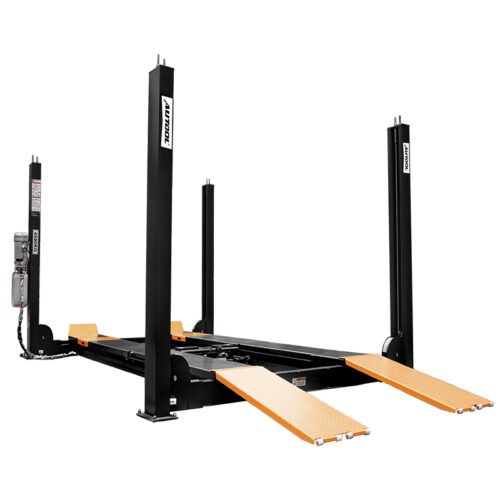
The 4-post lift remains one of the most widely used solutions for professional wheel alignment. The vehicle drives directly onto the platform and is lifted through four supporting posts, keeping all four wheels in their natural loading condition—making it ideal for accurate alignment measurements.
The four-point support structure distributes vehicle weight evenly across the platform. During lifting and alignment procedures, the vehicle remains stable with reduced movement, helping technicians achieve more accurate alignment results.
Because the vehicle remains naturally supported, 4-post lifts are highly suitable for extended alignment procedures. Even when a vehicle stays on the platform for a long period, the stable chassis position helps maintain consistent measurement accuracy.
Vehicles simply drive onto the platform without the need to locate specific lifting points. Compared with 2-post lifts, this makes operation faster and more convenient—especially for shops handling frequent alignment jobs.
Many professional 4-post lifts are equipped with a secondary lift platform.
After alignment measurements are completed, technicians can continue with:
This improves bay utilization and allows one workstation to handle multiple service tasks.
With higher load capacity and excellent stability, 4-post lifts are well suited for:
4-post lifts are commonly used in:
For shops planning to build long-term alignment services, the 4-post lift remains a proven and reliable choice.
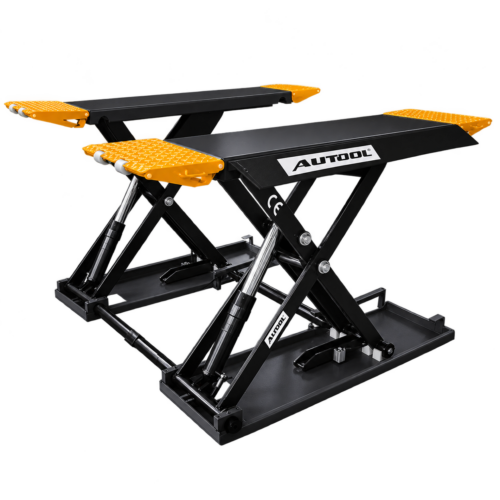
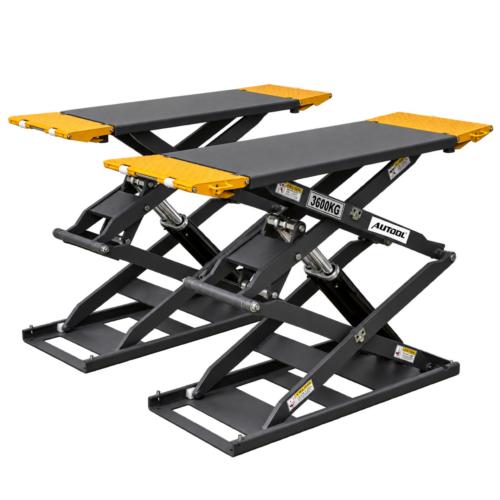
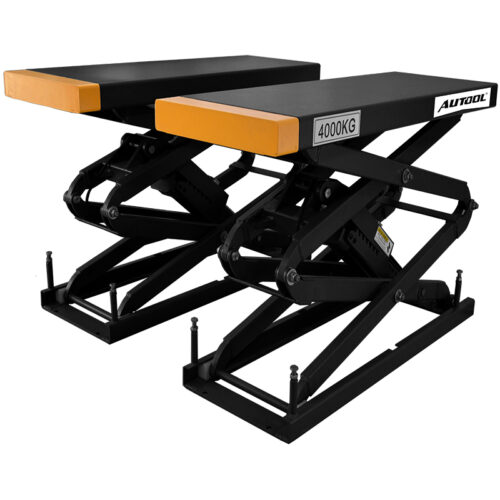
In recent years, large scissor lifts have become increasingly popular for professional wheel alignment applications.
Using a large scissor lifting structure combined with alignment turntables and rear slip plates, these lifts can fully support professional alignment operations.
Compared with traditional 4-post lifts, scissor lifts feature a more compact structure and require less floor space. They are especially suitable for workshops with limited service bays.
Many large scissor lifts feature an in-ground design. When not in use, the platform can sit flush with the workshop floor, creating a cleaner, more organized, and modern service environment.
With a lower platform height, scissor lifts make drive-on/drive-off easier—especially for low-clearance vehicles and EVs—enhancing both customer experience and efficiency.
As repair facilities move toward premium and modern workshop designs, more dealerships, EV service centers, and professional repair chains are choosing scissor
lifts to create a more advanced service environment.
Scissor lifts are commonly used in:
However, compared with 4-post lifts, scissor lifts usually require a higher investment and have stricter requirements for installation accuracy, foundation conditions, and maintenance. The final choice should depend on your workshop layout, budget, and service requirements.
Many repair shops already have 2-post lifts and wonder:
“Can a 2-post lift be used for wheel alignment?” In most professional applications, the answer is no.
The Suspension Is Not in a Natural Load Condition
A 2-post lift supports the vehicle through lifting arms under the chassis.
Once lifted:
However, professional wheel alignment requires the vehicle to simulate normal driving conditions. This makes 2-post lifts unsuitable for achieving consistent alignment accuracy.
Less Stability Than 4-Post or Scissor Lifts
Wheel alignment requires a highly stable and level platform.
Compared with 4-post and scissor lifts, 2-post lifts typically have:
These limitations become even more obvious with heavier SUVs and EVs.
Missing Professional Alignment Features
Professional alignment operations usually require:
Standard 2-post lifts generally do not provide these features.
While alignment may be possible in some situations, achieving professional-grade accuracy is difficult.
Choosing the right lift is essential for accurate alignment results. A professional wheel alignment lift should include:
Precision-Level Platform
Alignment accuracy depends heavily on platform levelness.
Problems such as:
can directly affect measurement results. Professional alignment lifts use high-strength platform structures designed to maintain long-term stability and flatness.
Turntables and Rear Slip Plates
These accessories are essential for professional alignment work.
Turntables
Installed under the front wheels, they allow the wheels to rotate freely during adjustment, reducing steering resistance and improving steering angle accuracy.
Rear Slip Plates
Allow rear wheels to move naturally during adjustment, preventing suspension stress from affecting alignment measurements. Without these components, even advanced alignment equipment may not achieve accurate results.
Stable and Synchronized Lifting
Uneven lifting can change vehicle position and affect alignment accuracy.
Professional alignment lifts should feature:
Ready for Future Vehicle Trends
With more EVs and large SUVs entering the market, lift capacity and platform size are becoming increasingly important.
Recommended specifications include:
This ensures your workshop is prepared for future vehicle demands.
Support More Repair Services
Choosing a lift equipped with a secondary lift system allows technicians to complete these tasks without repositioning the vehicle.
This not only saves valuable time but also increases bay utilization, improves workflow efficiency, and helps your shop handle more services in the same workspace.
For repair shops looking to offer wheel alignment services, choosing the right lift is critical. It affects not only alignment accuracy but also work efficiency, customer experience, and overall shop operations.
The two most widely adopted solutions for wheel alignment are:
4-post lift deliver excellent stability, durability, and operational simplicity, making them the ideal choice for most repair shops, tire centers, and dedicated alignment bays.
Scissor lift provide a space-saving design and a cleaner, more modern appearance, making them especially suitable for premium service centers, EV workshops, and businesses focused on creating a professional workshop environment.
By comparison, 2-post lifts are generally not recommended for professional wheel alignment due to their unstable loading condition, reduced measurement stability, and lack of essential alignment accessories.
When selecting an alignment lift, focus on these key factors:
A properly selected alignment lift does more than support a vehicle—it helps your workshop achieve higher accuracy, faster workflow, and a more professional service experience.
If you would like to learn more about four-wheel alignment systems or would like to receive a discount, please click the button below to contact us.