Uncategorized
Why are tire changers so expensive?

August 9, 2026
Share:
 autoolstore.com
Repair testing / 8 sub-categories
Diagnostic tools for leak tracing, visual inspection, battery health, circuits, pressure, spark, oil, and electrical readings.
Repair maintenance / 6 sub-categories
Service equipment for fluid exchange, A/C diagnostics, refrigerant recovery, oil handling, and cooling-system work.
Carbon cleaning / 3 sub-categories
Carbon-removal equipment for injectors, intake valves, components, and workshop cleaning jobs.
Wheel tire / 3 sub-categories
Equipment for alignment, lifting, tire repair, tire mounting, and service-bay workflows.
Tool storage / 1 sub-category
Storage products for keeping workshop tools, test equipment, and accessories organized.
EV charging / 1 sub-category
EV charging products for new-energy vehicle service, workshop use, and installation scenarios.
OBD diagnosis / 5 sub-categories
OBD-related testers, ECU programming power supplies, cable products, used-car inspection tools, and key frequency diagnostics.
Accessories / 8 sub-categories
Replacement parts, adapters, consumables, cables, and add-ons for major diagnostic and service equipment.
Many people are taken aback by the price when purchasing a tire changer for the first time. Although they all perform the same basic task of changing tires, some models cost just a few hundred dollars, while others can sell for over ten thousand dollars.
This is particularly true in European and North American markets, where professional repair shops increasingly prioritize rim protection, efficiency when handling low-profile tires, and equipment durability. Consequently, tire changers have evolved from simple tools into high-value pieces of equipment.
Why are tire changers so expensive?
Is it really necessary for small repair shops to purchase the most expensive models?
In reality, for most small and medium-sized repair shops, choosing a semi-automatic tire changer equipped with an assist arm—offering a balance of cost-effectiveness and practical functionality—is often a more sensible choice than blindly pursuing high-end equipment.
In European and American markets, tire changers generally fall into three price categories.
These are typically basic semi-automatic models, primarily aimed at:
• Small tire shops
• Home garages
• Startup repair shops
• Used car service centers
While they offer basic mounting and demounting functions, they feature lower levels of automation and have limited capability for handling run-flat tires, low-profile tires, and large-diameter rims.
Consequently, although these machines are inexpensive to purchase, the long-term cost of ownership is not necessarily low.
This is currently the most mainstream price segment in European and American markets.
Products in this category typically feature:
• Assist arms
• More stable clamping systems
• Robust pneumatic structures
• Enhanced rim protection
• Broader tire compatibility
For repair shops that frequently service SUVs, performance vehicles, and low-profile tires, mid-range models are capable of meeting most operational needs.
For example, the AUTOOL TCA505/506 models come equipped with assist arms and are moderately priced:
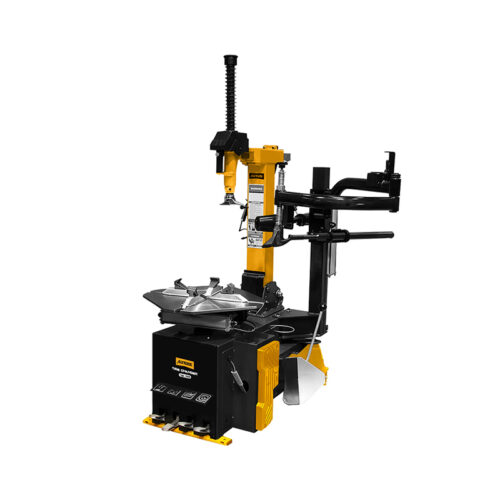
High-end tire changers primarily come from specialized European and American brands and are typically used in the following settings:
• Large-scale tire centers
• Dealership service centers (4S shops)
• Luxury vehicle repair centers
• High-end modification shops
These machines typically feature fully automatic operation, lever-less tire changing capabilities, intelligent rim protection, and advanced hydraulic systems. They offer superior efficiency and are better suited for frequently handling tires that demand advanced mounting and demounting techniques—such as run-flat tires, ultra-low-profile tires, and large-diameter wheels.
However, the purchase price, maintenance costs, and long-term repair expenses for this type of equipment are very high.
For small repair shops with limited daily tire service volume, achieving a quick return on investment is difficult.
Many people assume that the high price of tire changers is solely due to the brand. In reality, the price is primarily determined by the equipment’s structural design and manufacturing costs.
The assist arm is one of the features that most significantly impacts the price.When handling stiff tires or run-flat tires, standard tire changers require constant manual pressure to hold the tire in place, making the process physically demanding.
Machines equipped with assist arms can press the tire down more easily and reduce the risk of scratching the wheel rim. This is particularly important given the increasing prevalence of large-diameter tires in European and American markets; the absence of an assist arm can noticeably hinder work efficiency.
Consequently, semi-automatic tire changers equipped with assist arms are typically much more expensive than basic models.
A tire changer is, by nature, a piece of heavy-duty machinery.
If the steel used for the chassis is too thin, it can lead to the following issues:
• Deformation over prolonged use
• Reduced turntable stability
• Misalignment of the clamping mechanism
• Increased machine vibration
Therefore, high-quality tire changers usually utilize thicker steel and more robust welded structures, both of which directly increase manufacturing costs.
Tire changers rely heavily on pneumatic systems.
Poor-quality pneumatic cylinders can result in insufficient power, air leaks, and sluggish response times. Conversely, higher-quality motors and pneumatic components ensure stable performance and a longer service life—key reasons why high-end equipment commands a premium price.
Fully automatic tire changers are expensive because they incorporate numerous automated features—such as leverless systems and automatic positioning—which significantly raise manufacturing costs.
In European and American markets, well-known brands (such as Hunter) command significantly higher prices.
This is because the purchase includes not just the equipment itself, but also brand reputation, after-sales service networks, and technical support. However, for many small and medium-sized repair shops, paying a brand premium does not necessarily translate into higher profits.
Many newly opened repair shops often fall into a common misconception:
“Buying the most expensive equipment is definitely the best choice.”
In reality, however, the suitability of the equipment depends on the nature of your business.
If your shop primarily services passenger cars and standard SUVs—handling routine tire replacements—you likely won’t be able to fully utilize the advanced capabilities of an ultra-high-end, fully automatic tire changer.
Instead, you should focus on the following factors:
• Stability and durability
• Ease of use
• Rim protection capabilities
• Presence of an assist arm
• Cost-effectiveness of long-term maintenance
For most small to medium-sized repair shops, a cost-effective semi-automatic tire changer is often the more practical choice.
Take the AUTOOL TCA506 tire changer, for example; it features an assist arm and comes with a three-year warranty. This makes it an ideal option for budget-conscious repair shops, tire shop startups, and small to medium-sized businesses that prioritize value for money.
Compared to basic semi-automatic models, it significantly simplifies the tire-changing process;
Yet, compared to ultra-high-end fully automatic equipment, the initial investment is much lower, making it easier to recoup costs.
This is why an increasing number of small and medium-sized repair shops are opting for “cost-effective semi-automatic models equipped with assist arms.”
Tire changers are expensive not merely due to branding, but because of their complex mechanical structures, stringent stability requirements, the need for sustained high-intensity operation, and increasing levels of automation.
However, a higher price tag does not necessarily mean a better fit.
For most small and medium-sized repair shops, the priority is not obtaining the “top-of-the-line” model, but rather finding a machine that is reliable, durable, and offers a reasonable return on investment.
Consequently, a reasonably configured, moderately priced semi-automatic tire changer equipped with an assist arm is often the choice that best aligns with practical operational needs.