Uncategorized
AUTOOL: Can Tire Changers Damage Wheels?

August 6, 2026
Share:
 autoolstore.com
Repair testing / 8 sub-categories
Diagnostic tools for leak tracing, visual inspection, battery health, circuits, pressure, spark, oil, and electrical readings.
Repair maintenance / 6 sub-categories
Service equipment for fluid exchange, A/C diagnostics, refrigerant recovery, oil handling, and cooling-system work.
Carbon cleaning / 3 sub-categories
Carbon-removal equipment for injectors, intake valves, components, and workshop cleaning jobs.
Wheel tire / 3 sub-categories
Equipment for alignment, lifting, tire repair, tire mounting, and service-bay workflows.
Tool storage / 1 sub-category
Storage products for keeping workshop tools, test equipment, and accessories organized.
EV charging / 1 sub-category
EV charging products for new-energy vehicle service, workshop use, and installation scenarios.
OBD diagnosis / 5 sub-categories
OBD-related testers, ECU programming power supplies, cable products, used-car inspection tools, and key frequency diagnostics.
Accessories / 8 sub-categories
Replacement parts, adapters, consumables, cables, and add-ons for major diagnostic and service equipment.
Many vehicle owners notice scratches, chipped paint, or marks around the wheel edge after replacing their tires. Their first reaction is often: “Did the tire changer damage my wheel?” The truth is that a tire changer can potentially cause wheel damage, but the machine itself is not the only factor. The actual risk depends on multiple elements, including the equipment design, operating technique, and tire type.
For modern automotive workshops, wheel protection and reducing the risk of damage have become key considerations when choosing tire service equipment.
Wheel damage most commonly occurs with tires that are inherently harder to handle—such as run-flat tires or low-profile tires. These tires have stiff sidewalls and strong rebound. Without proper support, they require greater mechanical force during mounting and demounting. If not carefully controlled, metal components can easily come into contact with the wheel rim edge.
Older machines often rely heavily on the operator’s experience to judge clearance and force. If the machine lacks precision or protective features, scratches are far more likely during operation.
Damage can also result from insufficient lubrication, incorrect positioning, or forcing a stuck tire off the rim. These factors can easily cause damage to the wheel rim edge.
Many premium vehicles now feature polished, chrome-plated, or high-gloss painted wheels. These finishes are more sensitive than standard wheels. Even minor friction during tire service can leave visible marks.
For professional workshops, the goal is not simply to remove and install tires. The key is achieving safe and low-damage tire service.
The main purpose of a helper arm is to:
This is especially important when servicing run-flat tires, SUV tires, and ultra-low-profile tires, where tire mounting and demounting are more challenging.
That is why more professional workshops are choosing AUTOOL tire changers equipped with a helper arm. The helper arm not only improves working efficiency but also significantly reduces the risk of wheel damage.
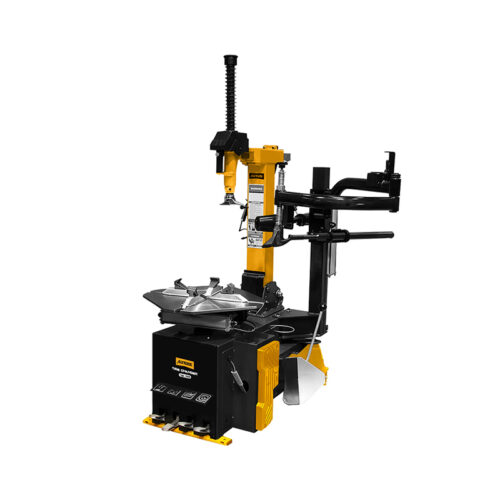
Modern professional tire changers often include additional wheel protection designs, such as:
Although these components may seem like small details, they play an important role in protecting wheels during daily service operations.
Many wheel scratches happen because the tire is too tight during removal or installation.
Proper tire lubricant helps to:
It is an essential step for safer tire changing.
Many tire changers are equipped with protective parts from the factory.
However, after long-term use, components may wear out, including:
When these parts become worn or damaged, metal components may directly contact the wheel surface and cause scratches. Regular equipment inspection and maintenance are essential for professional workshops.
Not necessarily.
Generally speaking, higher-end machines offer more stable frames, more precise clamping systems, better auxiliary arms, and more comprehensive scratch-prevention designs—especially when handling high-end tires and run-flat tires.
However, a higher price doesn’t always mean it’s the right fit for every shop.
What really matters is whether the machine matches your shop’s actual needs.
For workshops mainly servicing standard passenger cars and SUVs, a semi-automatic tire changer with a helper arm and reliable clamping system may be sufficient. For workshops frequently handling luxury vehicles, customized wheels, run-flat tires, or large-diameter tires, a professional tire changer with a helper arm and advanced wheel protection features is a better choice.
For professional workshops, choosing a tire changer is not only about whether it can remove a tire.
The real questions are:
How efficiently can it complete the job?
How well can it protect the wheel?
If your daily service includes run-flat tires or premium vehicles, a helper arm is an essential feature to consider. Its purpose is not to increase “forceful tire removal capability.” Instead, it makes the entire process more controlled and stable, reducing stress on the wheel from the beginning.
A high-rigidity machine structure helps to:
This becomes especially important when servicing large-diameter wheels.
AUTOOL tire changers equipped with helper arms are designed for modern workshop requirements. The focus is not only on efficiency but also on achieving the right balance between productivity and wheel protection, allowing technicians to handle challenging tires with greater confidence.
Tire changers are high-frequency use equipment.
Over time, the following parts are subject to wear:
That’s why after-sales support and parts availability are just as critical as the machine itself.
AUTOOL’s helper arm tire changers are designed not only to support run-flat tire service but also to provide better wheel protection and a more reliable long-term workshop experience.
A tire changer doesn’t inevitably damage wheels. The real issue is whether the equipment is designed to handle the complexity of modern tires and whether it offers adequate protective features.
As wheels become more expensive and tires become more challenging to service, workshops need more than equipment that simply works. They need equipment that helps reduce risk.
A tire changer with a helper arm and protective design features does more than improve efficiency — it helps reduce rework, customer complaints, and unnecessary repair costs. For professional workshops, protecting wheels is just as important as completing the tire change itself.