
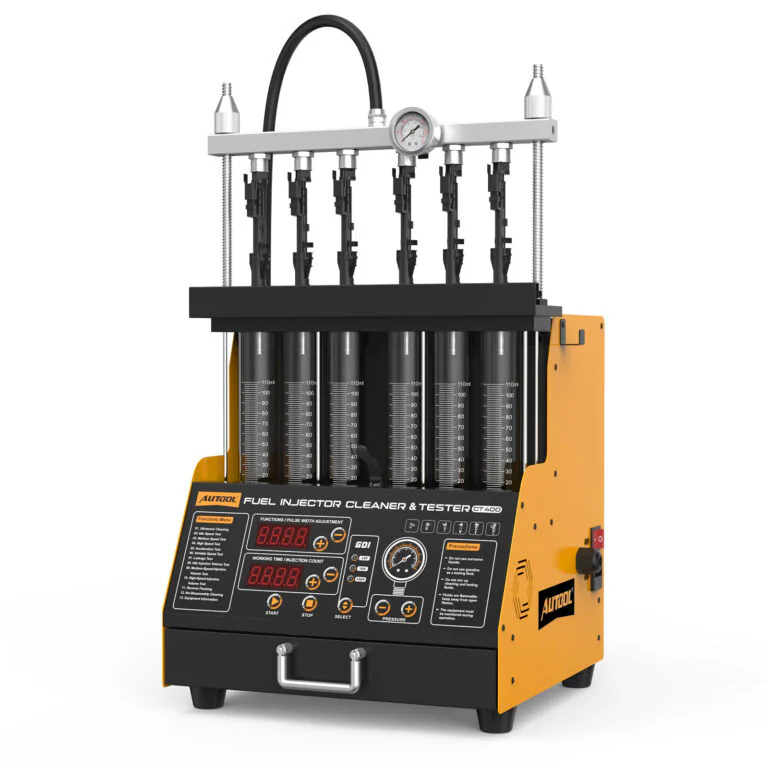
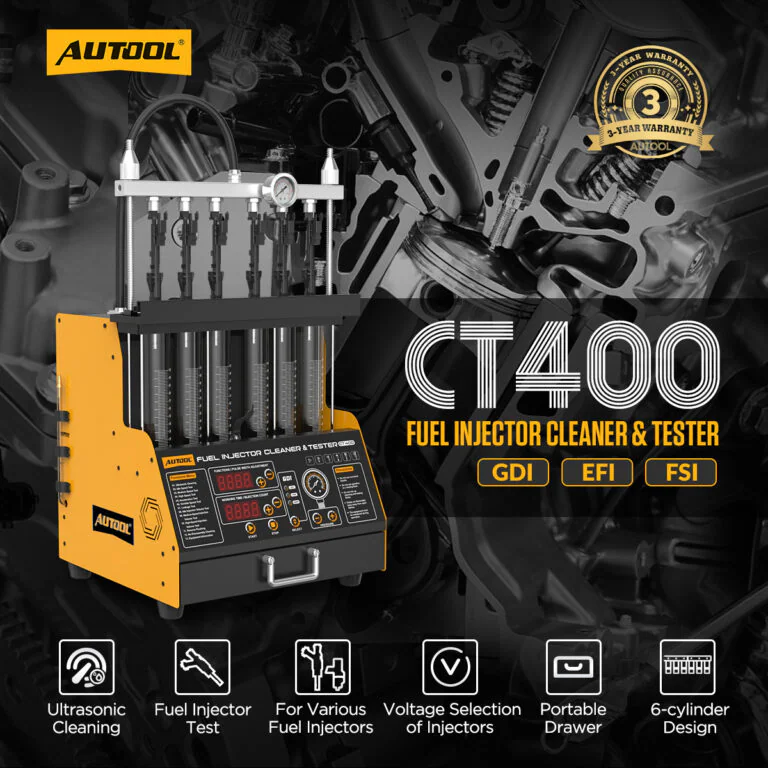

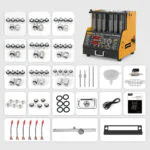
AUTOOL CT400 6-Cylinder GDI/EFI/FSI Fuel Injector Cleaner and Tester
Original price was: US$575.00.US$509.00Current price is: US$509.00.
- GDI / EFI / FSI Drive
- Six-Injector Comparison
- Clean, Test + Recheck
- Integrated Digital Controls
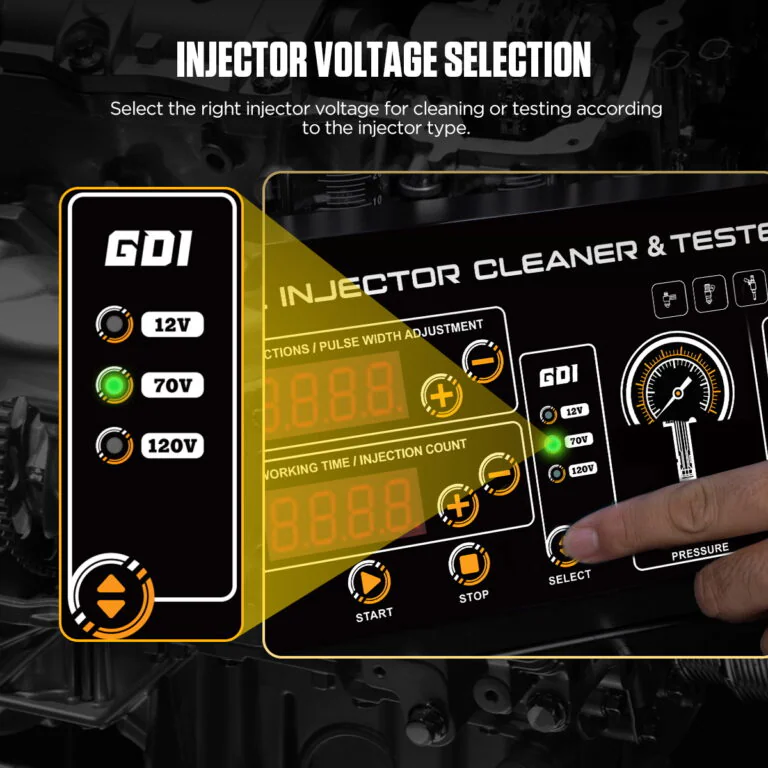
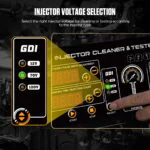
- GDI / EFI / FSI Drive: Select 12 V, 70 V, or 120 V injector drive for compatible standard gasoline, EFI, FSI, and selected GDI injectors.
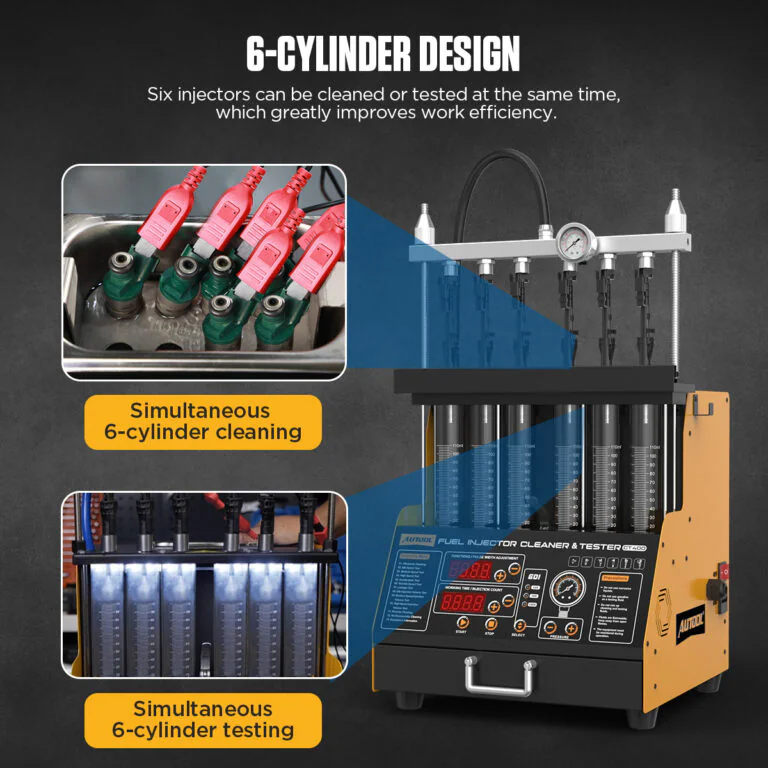
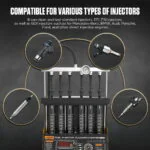
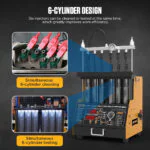
- Six-Injector Comparison: Mount up to six compatible injectors to compare spray appearance and collected volume under the same setup.
- Clean, Test + Recheck: Use ultrasonic cleaning and permitted reverse flushing, then repeat leakage, spray, and volume observations under matched conditions.
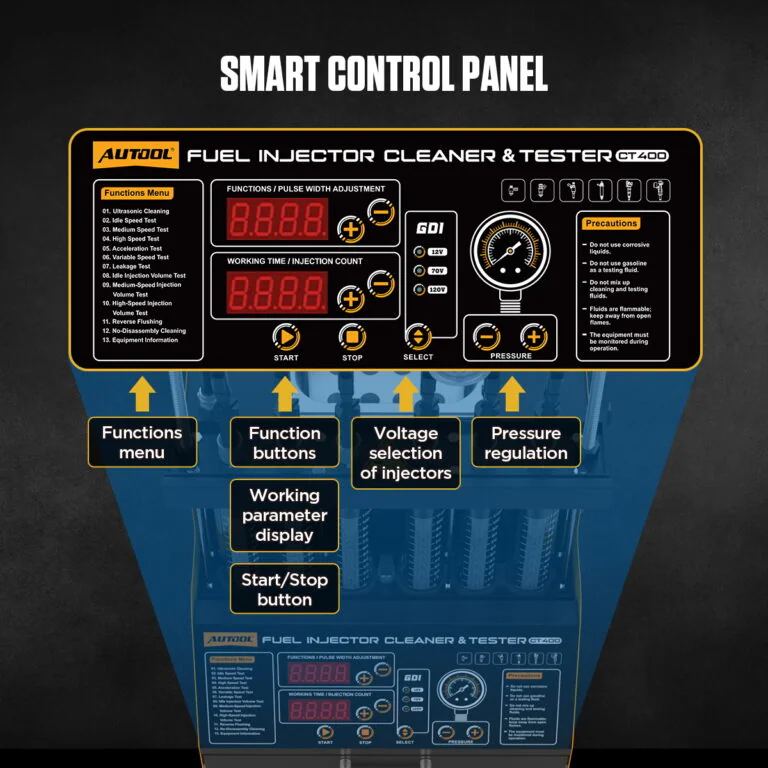
- Integrated Digital Controls: Set function, time, pulse, voltage, and pressure from one panel for a repeatable bench setup.
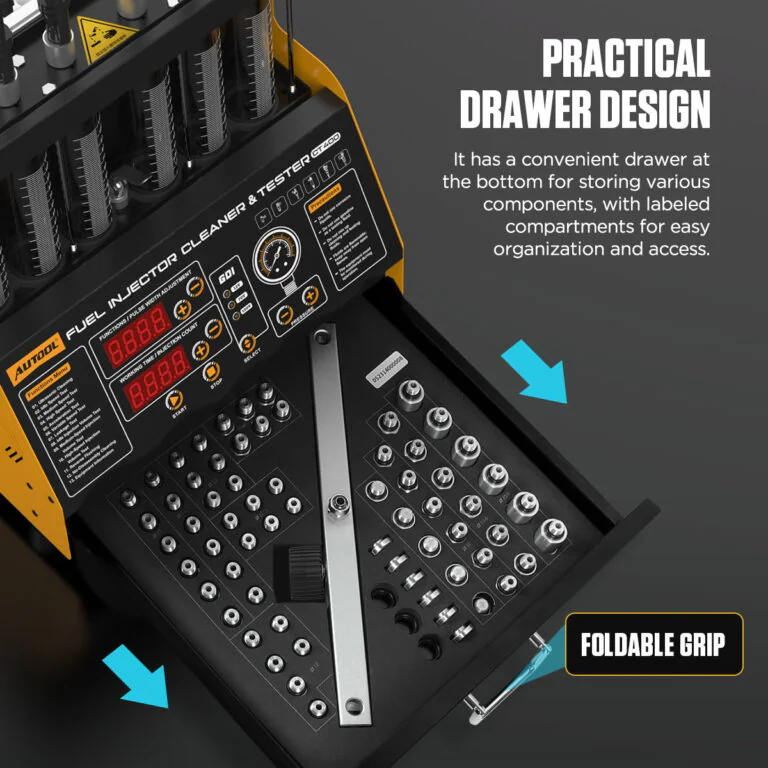
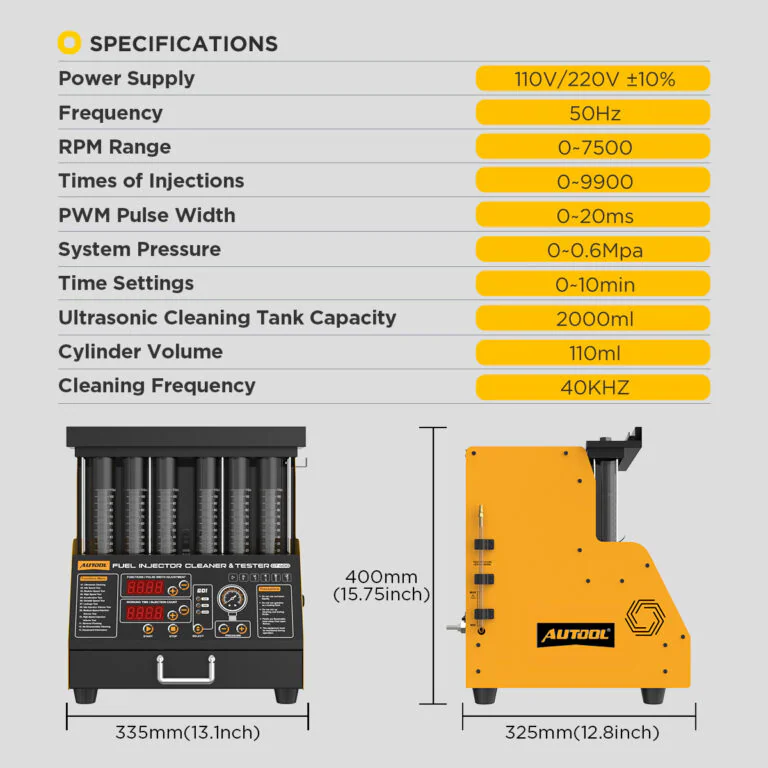
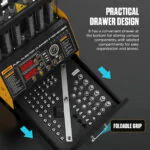
- 2,000 mL Tank + Drawer: A 2,000 mL ultrasonic tank supports batch cleaning, while the drawer organizes adapters, plugs, cables, and seals.
- GDI / EFI / FSI Drive: Select 12 V, 70 V, or 120 V injector drive for compatible standard gasoline, EFI, FSI, and selected GDI injectors.
- Six-Injector Comparison: Mount up to six compatible injectors to compare spray appearance and collected volume under the same setup.
- Clean, Test + Recheck: Use ultrasonic cleaning and permitted reverse flushing, then repeat leakage, spray, and volume observations under matched conditions.
- Integrated Digital Controls: Set function, time, pulse, voltage, and pressure from one panel for a repeatable bench setup.
- 2,000 mL Tank + Drawer: A 2,000 mL ultrasonic tank supports batch cleaning, while the drawer organizes adapters, plugs, cables, and seals.
- 3-Year Warranty Main unit 3 years · Accessories 1 year
- 90-Day Returns Eligible returns within 90 days
- Official Store Genuine products · Direct support
AUTOOL CT400 · Six-Position Multi-Drive Injector Bench
Drive and Compare Selected Injectors at Three Voltages
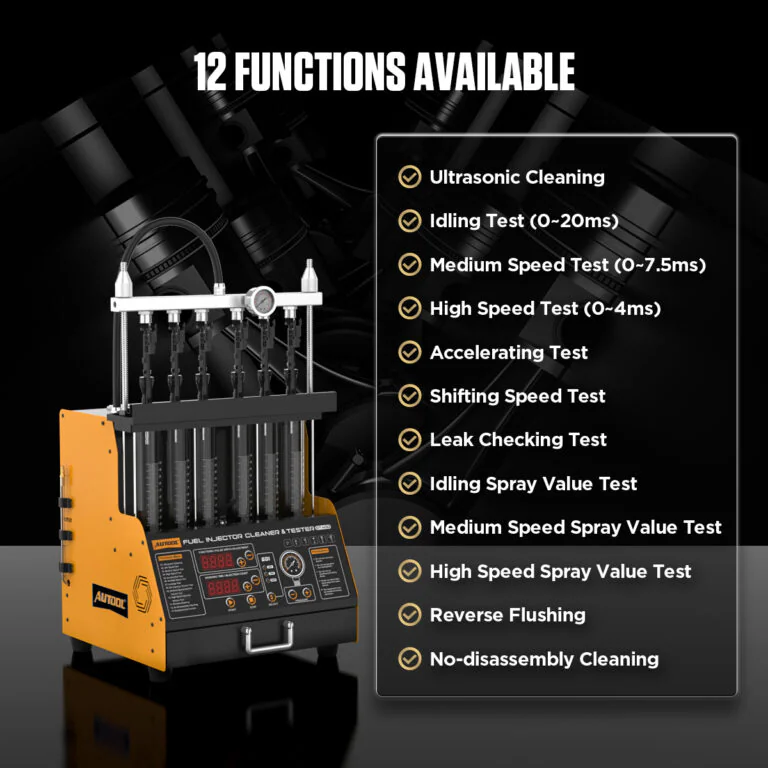
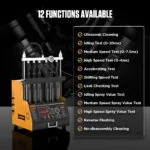
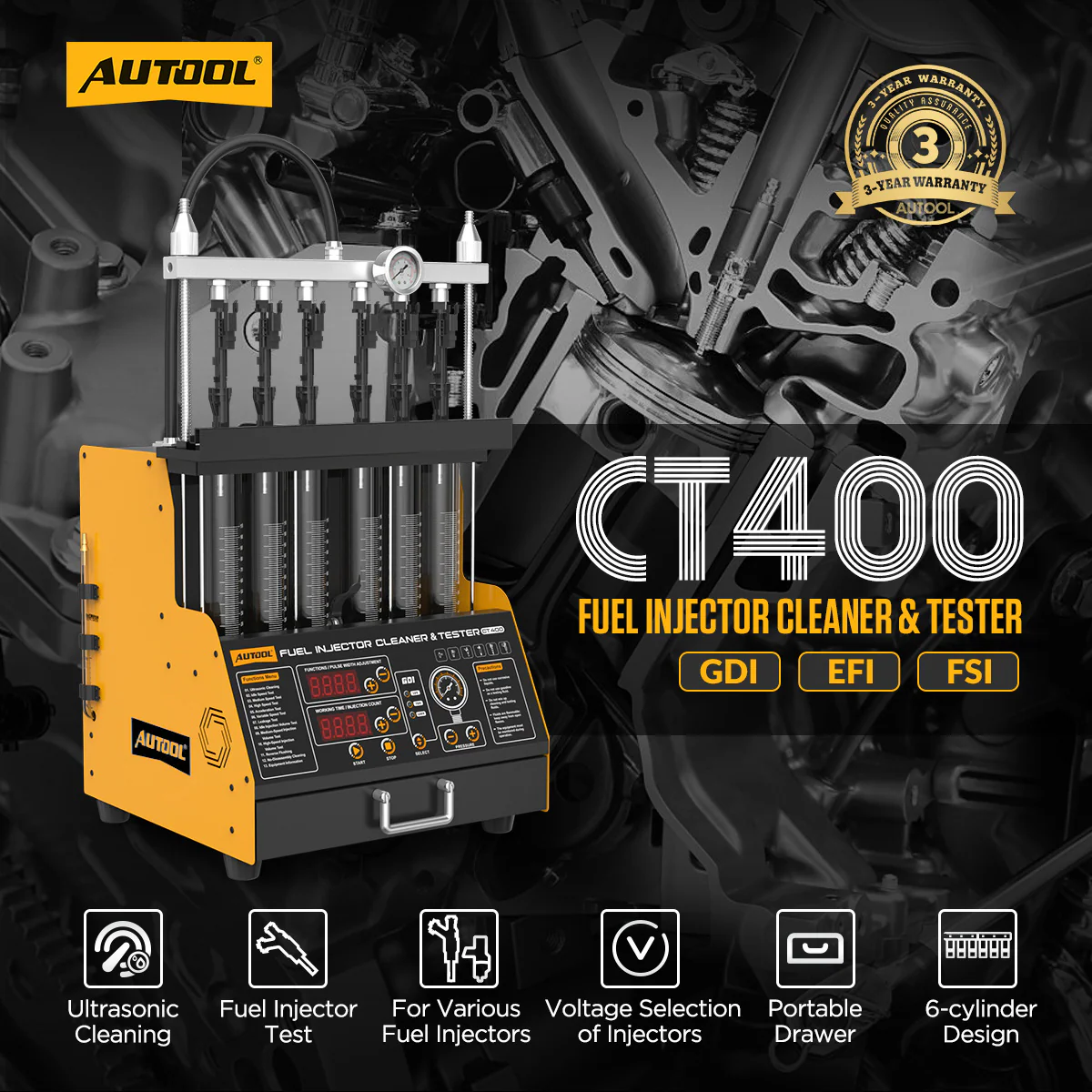
Ultrasonically clean compatible standard gasoline, EFI, FSI and selected GDI injectors, then compare up to six for spray, leakage and collected volume under matched low-pressure conditions. Select 12 V, 70 V or 120 V drive to match supported injector requirements. A 2 L cleaning tank, 3 cleaning and 9 test functions, adjustable bench controls and storage drawer support organized clean-and-retest work.
- EFI / FSI / Selected GDI
- 6-Position Injector Comparison
- 12 / 70 / 120 V Drive
- 2 L Ultrasonic Cleaning Tank
- 3 Cleaning + 9 Test Functions
Key Features
Selectable Injector Drive with Six Test Positions
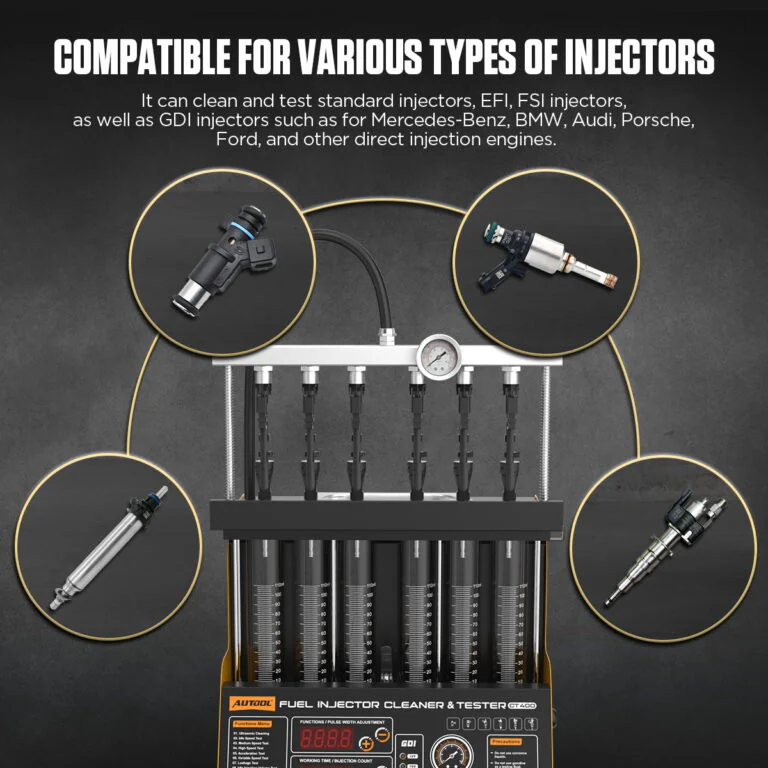
Compatible Standard and Direct-Injection Service
This fuel injector tester cleans and performs low-pressure comparative checks on compatible standard gasoline, EFI, FSI, and selected GDI injectors when the correct adapter, connector, electrical drive, seal set, and procedure are available.
12 V / 70 V / 120 V Selection
Select 12 V, 70 V or 120 V drive to match the injector type and its operating requirements.
Six-Position Side-by-Side Testing
Mount up to six compatible injectors to compare spray appearance and collected volume under the same setup. Plug all unused positions when testing fewer injectors.
3 Cleaning and 9 Testing Functions
Use ultrasonic cleaning, reverse flushing where permitted, optional on-vehicle cleaning with separately required accessories, leakage checks, spray-pattern modes, and preset low-pressure operating cycles.
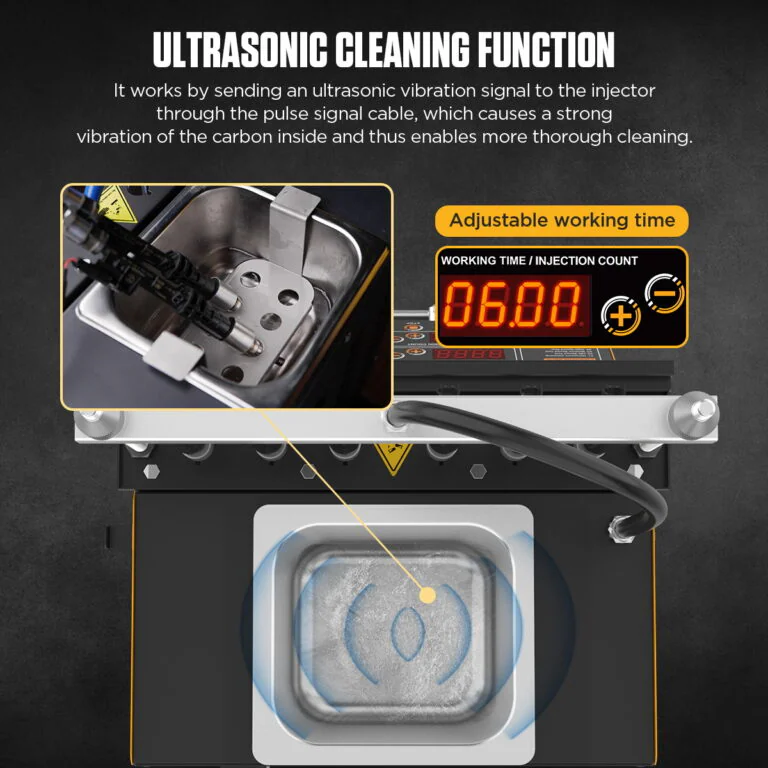
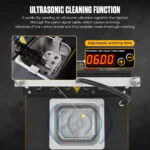
Ultrasonic Injector Cleaning with Pulse Drive
Pulse actuation and ultrasonic energy work with an approved cleaning fluid to loosen deposits; cleaning outcome must be checked by repeating the same observation cycle afterward.
2,000 mL Cleaning Tank
This fuel injector cleaning machine has a 2,000 mL ultrasonic tank for batch cleaning before matched low-pressure comparison; follow the supplied manual for the working fill level and fluid limits.
Spray, Volume, and Leakage Observation
Compare closed-injector drips, spray shape and collected volume in the measuring cylinders to guide triage and matched group comparison.
Reverse Flushing for Applicable Injectors
Reverse flushing can help move contamination from compatible top-feed injectors or strainers; confirm that the injector design and manufacturer procedure permit it before use.
Integrated Digital Controls
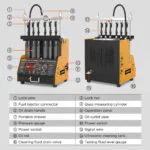
Select the function and set the supported time, pulse, voltage, and pressure controls from one panel for a more repeatable bench setup.
Fluid Drain and Recovery
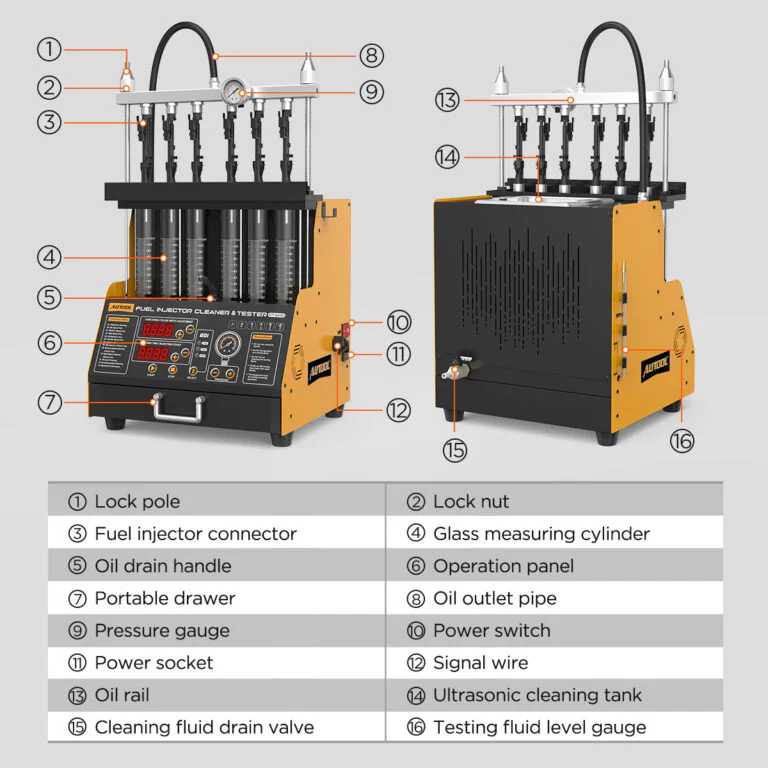
Use the drain path to empty or recover the appropriate fluid as instructed, keeping ultrasonic cleaning fluid separate from the testing circuit.
Accessory Storage Drawer
Keep adapters, plugs, cables, seals, and small fittings organized near the work area to reduce setup delays and misplaced parts.
Optional Cleaning Without Injector Removal
The machine supports an optional on-vehicle cleaning workflow only with the specified special adapters; those accessories and the vehicle-specific procedure must be confirmed separately.
3 Years Warranty Support
Main unit: 3-year warranty. Standard accessories: 1-year warranty. Warranty Policy.
How to Use
Identify the Injector, Select Drive, Clean, Test, and Compare
Identify the Injector and Service Scope
Record the manufacturer and part number; confirm standard gasoline, EFI, FSI, or selected GDI applicability, electrical drive, feed direction, cleaning permission, replacement seals, and whether CT400’s low-pressure comparison is suitable for the job.
Select the Correct Adapter and Drive
Choose the correct connector, rail adapter and plugs, then select voltage for the injector type. If the setting is uncertain, start at 12 V and increase gradually to 70 V and then 120 V until the injector operates correctly. Avoid prolonged operation at an incorrect high voltage.
Add Approved Cleaning Fluid
Fill the ultrasonic tank with a cleaning fluid approved for the injector and machine. Never operate the ultrasonic function dry, and do not assume every injector permits ultrasonic cleaning.
Run Ultrasonic Cleaning
Connect the pulse lead, secure the injectors, and run the selected cleaning cycle according to the manual. Treat cleaning as a controlled process whose effect must be checked afterward.
Mount Injectors for Testing
Install up to six compatible injectors with the correct seals and fittings. Verify clamping and channel sealing; plug every unused measuring position before pressurizing the test circuit.
Add Test Fluid and Configure the Test
Use approved non-corrosive injector test fluid in the test circuit, then set the documented drive, pressure, pulse, time, and selected low-pressure test mode. Keep cleaning and testing fluids separate.
Observe, Repeat, and Recover Fluid
Compare leakage, spray appearance, and collected volume under identical settings; swap channels when needed to rule out fixture or channel error. Repeat the same test after cleaning, then drain or recover fluids as instructed.
Safety & Compatibility
Confirm Electrical Drive, Adapter, Fluid, and Pressure
Low-Pressure GDI Boundary
CT400 may clean and comparatively observe selected compatible GDI injectors at bench pressure; it is not a professional high-pressure GDI characterization, coding, or calibration system.
Verify Part-Number Compatibility
Match the injector part number, electromagnetic or other drive type, connector, polarity, adapter, feed direction, seals, permitted pressure and cleaning method. Select the voltage using the procedure in Step-by-Step Workflow.
Use Approved Test Fluid
Use the non-corrosive injector test fluid specified for the machine and application. Do not use gasoline or corrosive cleaning solution in the test circuit.
Use Approved Cleaning Fluid
Use an ultrasonic cleaning fluid permitted by both the injector manufacturer and CT400 instructions. Do not run the ultrasonic tank without fluid.
Keep Fluids Separate
Cleaning and testing fluids have different duties and material risks. Keep them in their assigned circuits and follow the applicable safety data, ventilation, ignition-control, handling, and disposal requirements.
Secure and Seal the Fixture
Install the correct seals and fittings, secure the rail, inspect for leaks, and plug unused positions before applying pressure. Replace one-time seals or clips when the vehicle procedure requires it.
Conditional Reverse and On-Vehicle Cleaning
Use reverse flushing only on compatible feed designs. Cleaning without injector removal requires special adapters and a vehicle-specific procedure; it is not included merely because the mode appears on the panel.
Diesel Service Limit
CT400 can ultrasonically clean compatible diesel injectors when their approved procedure permits it. Diesel opening-pressure, spray, common-rail, return-flow, coding, and calibration tests require dedicated equipment.
Test Results
Read Spray, Leakage, and Volume Under One Setup
Drips While Closed
First check the adapter, seal, rail, and channel for leakage. If the injector itself continues to drip after an approved clean-and-retest cycle, seat wear or an internal fault may require specialist evaluation or replacement.
One Cylinder Collects Less
A lower collected volume can indicate restriction, but it can also come from a mounting leak, unstable setup, or channel issue. Verify pressure and sealing, swap channels, then repeat under the same settings before judging the injector.
Uneven or Coarse Spray
Deflected, split, coarse, or dripping spray may reflect deposits or internal damage. Repeat after permitted cleaning; if the pattern remains abnormal, continue with injector-specific service or replacement guidance.
Difference Narrows After Cleaning
A smaller group difference under the same conditions suggests that a removable restriction may have been reduced. Record the settings and result, fit required new seals, and verify the repair on the vehicle.
No Meaningful Change
The injector may already be clean, the deposit may not be recoverable, or an electrical or mechanical fault may be present. Avoid repeated uncontrolled cleaning and continue diagnosis.
Balanced Bench Result, Vehicle Fault Remains
The cause may be outside the injectors. Check vehicle fuel pressure, control signals, wiring, ignition, compression, intake leakage, and other relevant systems using the service procedure.
Use Bench Results with Injector Specifications
Use CT400 to compare supported injectors under matched low-pressure settings. Use injector-specific limits and dedicated equipment for OEM calibration, coding, or original-pressure GDI leakage and delivery checks.
Compare Models
Compare Injector Drive and Heating Options
Model Guide
Choose one or more models. CT400 is selected by default.
| Product Name | CT150 | CT160 | CT200 | CT400 | CT450 | CT500 | FN602 | FN603 | FN606 | FN608 |
|---|---|---|---|---|---|---|---|---|---|---|
| Setup & Control | ||||||||||
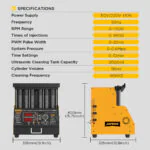
| Input Voltage | 110/220V | 110/220V | 110/220V | 110/220V | 110/220V | 110/220V | 110/220V | 110/220V | 110/220V | 110/220V |
| Pulse Settings | 0-20ms | 0-20ms | 0-20ms | 0-20ms | 0-20ms | 0-40ms, Step Size 0.1ms | 0-20ms | 0-20ms | 0-40ms, Step Size 0.1ms | 0-40ms, Step Size 0.1ms |
| Time Setting Range | 0-10min | 0-10min | 0-10min | 0-10min | 0-10min | 0-10min | 0-10min | 0-10min | 0-10min | 0-10min |
| Simulated RPM Range | 0-7500rpm | 0-7500rpm | 0-7500rpm | 0-7500rpm | 0-7500rpm | 0-7500rpm | 0-7500rpm | 0-7500rpm | 0-7500rpm | 0-7500rpm |
| Supported Voltage Settings | Fixed 12 V drive; no selectable 12 / 70 / 120 V modes | Fixed 12 V drive; no selectable 12 / 70 / 120 V modes | Fixed 12 V drive; no selectable 12 / 70 / 120 V modes | 12V 70V 120V | 12V 70V 120V | 12V 70V 120V | 12V 70V 120V | 12V 70V 120V | 12V 12V-70V 120V-180V | 12V 12V-70V 120V-180V |
| Language Settings | × | × | × | × | × | 2 Types (Chinese, English) | × | × | 2 Types (Chinese, English) | 2 Types (Chinese, English) |
| Pressure Gauge Display | ✓ | ✓ | ✓ | ✓ | ✓ | ✓ | ✓ | ✓ | ✓ | ✓ |
| LCD Display | ✓ | ✓ | ✓ | ✓ | ✓ | ✓ | ✓ | ✓ | ✓ | ✓ |
| Cleaning & Fluid System | ||||||||||
| Test Tube Volume | 110ml | 100ml | 110ml | 110ml | 110ml | 110ml | 100ml | 110ml | 110ml | 110ml |
| Cleaning Tank Volume | 1000ml | 2000ml | 1700ml | 2000ml | 2000ml | Confirm tank capacity for your order | 2000ml | 2000ml | 550ml | 550ml |
| Ultrasonic Cleaning Power | 70w | 70w | 70w | 70w | 70w | 70w | 70w | 70w | 70w | 70w |
| Built-in Pump | 1 | 1 | 1 | 1 | 1 | 1 | 1 | 1 | 1 | 2 |
| Cleaning Fluid Heating | × | ✓ (45℃) | × | × | ✓ (50℃) | × | ✓ (45℃) | ✓ (45℃) | ✓ (50℃) | ✓ (50℃) |
| Test Liquid Level Gauge | ✓ | ✓ | ✓ | ✓ | ✓ | ✓ | ✓ | ✓ | ✓ | ✓ |
| Cleaning Fluid Recovery Valve | ✓ | ✓ | ✓ | ✓ | ✓ | ✓ | ✓ | ✓ | ✓ | ✓ |
| Removable Cleaning Tank | × | × | × | × | × | × | ✓ | × | ✓ | ✓ |
| Number of Fuel Pumps | 1 | 1 | 1 | 1 | 1 | 1 | 1 | 1 | 1 | 2 |
| Functions & Injector Coverage | ||||||||||
| Basic Functions | 3 Cleaning Functions 9 Testing Functions | 3 Cleaning Functions 9 Testing Functions | 3 Cleaning Functions 9 Testing Functions | 3 Cleaning Functions 9 Testing Functions | 3 Cleaning Functions 10 Testing Functions | 3 Cleaning Functions 12 Testing Functions | 3 Cleaning Functions 10 Testing Functions | 3 Cleaning Functions 10 Testing Functions | 3 Cleaning Functions 12 Testing Functions | 3 Cleaning Functions 12 Testing Functions |
| Adapter Connectors | 3 Types | 5 Types | 3 Types | 9 Types | 9 Types | 9 Types | 9 Types | 9 Types | 9 Types | 9 Types |
| Injector Test Positions | 4 Fuel Injectors | 4 Fuel Injectors | 6 Fuel Injectors | 6 Fuel Injectors | 6 Fuel Injectors | 6 Fuel Injectors | 4 Fuel Injectors | 6 Fuel Injectors | 6 Fuel Injectors | 8 Fuel Injectors |
| Fuel Injector Cleaning Type | Standard Fuel Injector | Standard Fuel Injector | Standard Fuel Injector | Standard Fuel Injector GDI, EFI, FSI Long Fuel Injectors | Standard Fuel Injector GDI, EFI, FSI Long Fuel Injectors | Standard Fuel Injector GDI, EFI, FSI Long Fuel Injectors | Standard Fuel Injector GDI, EFI, FSI Long Fuel Injectors | Standard Fuel Injector GDI, EFI, FSI Long Fuel Injectors | Standard Fuel Injector GDI, EFI, FSI Long Fuel Injectors | Standard Fuel Injector GDI, EFI, FSI Long Fuel Injectors |
| Low Impedance Injectors Supported | Compatible units only; confirm injector part number and drive requirements | Compatible units only; confirm injector part number and drive requirements | Compatible units only; confirm injector part number and drive requirements | Compatible units only; confirm injector part number and drive requirements | Compatible units only; confirm injector part number and drive requirements | Compatible units only; confirm injector part number and drive requirements | Compatible units only; confirm injector part number and drive requirements | Compatible units only; confirm injector part number and drive requirements | Compatible units only; confirm injector part number and drive requirements | Compatible units only; confirm injector part number and drive requirements |
| Operation & Equipment | ||||||||||
| Oil Baffle Design | × | × | × | × | × | ✓ | ✓ | ✓ | ✓ | ✓ |
| Operating Condition Simulation Test | ✓ | ✓ | ✓ | ✓ | ✓ | ✓ | ✓ | ✓ | ✓ | ✓ |
| Storage Drawer | × | × | × | ✓ | ✓ | ✓ | ✓ | ✓ | ✓ | ✓ |
Manual & Downloads
Use the Manual for Setup and Test Modes
AUTOOL CT400 User Manual
Open the PDF manual for CT400 ultrasonic cleaning, injector voltage selection, six-position spray and volume tests, reverse flushing, safety, and troubleshooting.
Package
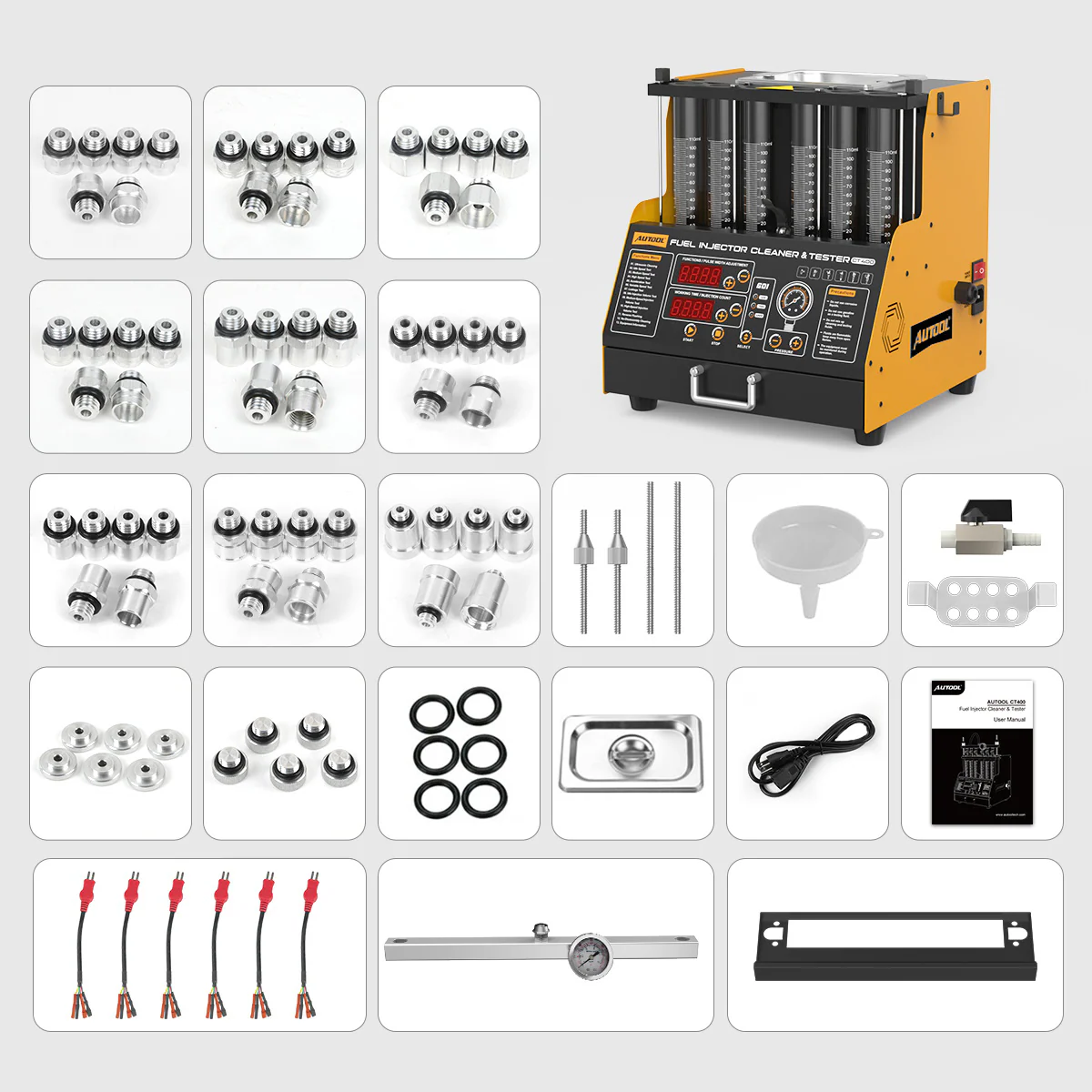
What’s Included
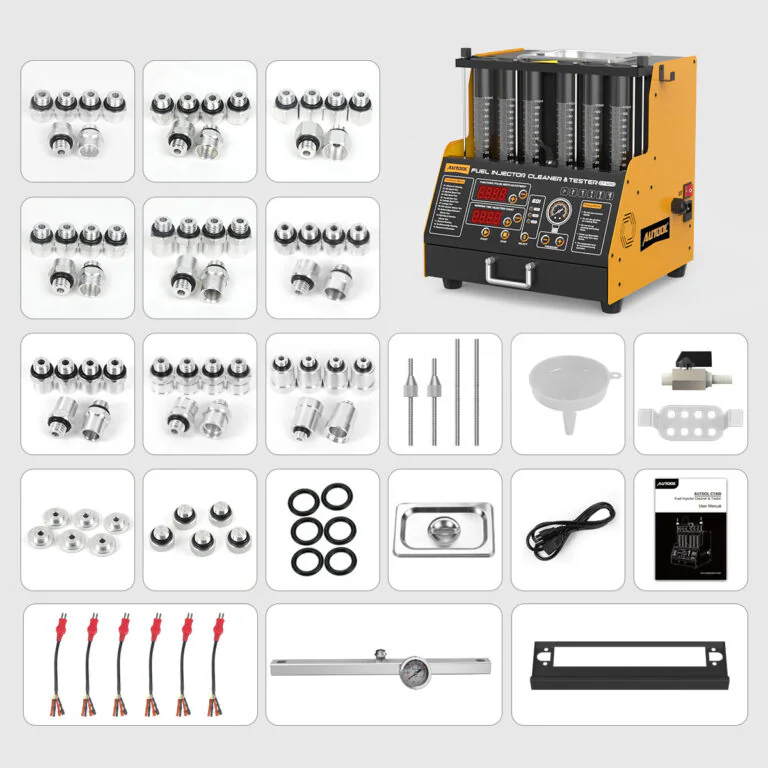
- Main UnitAUTOOL CT400 six-position fuel injector testing machine with ultrasonic cleaning.
- Injector Adapters and ConnectorsAdapter sets, connector parts, fittings, sealing rings, and related hardware.
- Test Setup PartsFuel-rail and measuring-cylinder parts, signal harnesses, and locking hardware used by the included configurations.
- Five Position PlugsFive plugs for sealing unused positions during single-injector testing.
- Fluid-Handling PartsFunnel, drain-related parts, ultrasonic-tank cover, and associated fittings.
- Documentation and PowerUser manual and power cable; plug and voltage configuration must match the ordered regional version.
FAQs
Drive, Fit, and Test Questions
Can CT400 test GDI injectors at original engine pressure?
CT400 drives, cleans, and compares selected compatible GDI injectors under low-pressure bench conditions. Use dedicated high-pressure equipment for original-engine GDI verification, OEM calibration, or coding.
How many injectors can CT400 handle?
It has six injector positions. When testing fewer than six, securely plug every unused test position; five plugs are supplied for single-injector testing.
How do I select 12 V, 70 V, or 120 V?
Select voltage according to the injector type. If the setting is uncertain, start at 12 V and increase gradually to 70 V and then 120 V until the injector operates correctly; an incorrect setting may result in no injection or a machine alarm.
What can I compare on the bench?
Under identical setup conditions, you can compare closed-injector leakage, spray appearance, collected volume, and response during the available low-pressure cycles. Use injector-specific limits only when the test procedure and conditions match.
Can AUTOOL CT Series Products Clean And Test Diesel Injectors?
AUTOOL CT series products can clean diesel injectors, but they cannot test diesel injectors. If diesel injector testing is required, confirm the correct dedicated equipment before ordering.
- No. Compatible diesel injectors may be ultrasonically cleaned when their approved procedure permits it, but diesel testing requires dedicated mechanical or common-rail equipment, depending on injector type.
Can I Use Cleaning Fluid To Test Injectors?
No. Cleaning fluid is corrosive and may damage internal machine components, corrode rubber parts, and cause leakage. Use professional injector test fluid for testing. If equipment is damaged because cleaning fluid is used during injector testing, repair costs may need to be borne by the user.
- No. Use approved cleaning fluid in the ultrasonic tank and approved non-corrosive injector test fluid in the testing circuit. Do not use gasoline or mix the fluids.
Does CT400 heat the cleaning tank?
No. CT400 does not heat the cleaning tank. Choose a model with documented heating if the approved cleaning process requires it.
Can I reverse-flush every injector?
No. Reverse flushing is only for compatible injector designs, such as applicable top-feed units or strainers, and must be permitted by the injector service procedure.
Can CT400 clean injectors without removal?
Yes, as an optional procedure with the required special adapters. Confirm the accessory set, vehicle procedure, fluid, and safety requirements before use.
What should I do if one channel reads low?
Check the fixture, seals, pressure stability, and channel first. Swap positions and repeat under the same settings before deciding that the injector is restricted.
What is the warranty?
Main unit: 3-year warranty. Standard accessories: 1-year warranty. Warranty Policy.
How Should I Choose Test Fluid?
Test fluid is used to evaluate fuel injector performance. Use the injector test fluid specified in the product manual to simulate test conditions consistently. For consistent results, use professional automotive injector test fluid. If unavailable, medical alcohol with over 75% alcohol content can be used as an alternative.
How Should I Choose Cleaning Fluid?
Cleaning fluid removes carbon deposits from fuel injectors and is typically corrosive and flammable. For consistent results, use professional ultrasonic cleaning fluid or professional engine carbon cleaning fluid. If unavailable, 75%+ medical alcohol can be used as a substitute, but cleaning performance may vary.
Do I Need To Add Fluid Before Ultrasonic Cleaning?
Yes. Before using the ultrasonic cleaning function, add the professional carbon cleaning fluid first. Do not run the ultrasonic tank dry; doing so may damage the ultrasonic system.
How Do I Set Test Parameters On CT400?
You do not need complicated special settings. Select the injector type and test function, then set the required voltage, pressure, time, and pulse parameters.
How Do I Select The Correct Voltage When Testing GDI Injectors?
Select the voltage according to the injector type. If you are unsure, gradually increase the voltage from 12V to 70V to 120V until the injector functions correctly. If the voltage selection is incorrect, there may be no fuel injection or the machine may alarm.
Will The Wrong Voltage Damage A GDI Injector?
Short-term incorrect voltage usually will not immediately damage the injector. However, do not apply incorrect high voltage to an injector for a long time. If the injector does not work properly, adjust to the correct voltage in time.
How Do I Test A Single Injector With CT400?
When testing a single injector, plug the other five cylinders. CT400 comes with five plugs for this purpose.
What Is The Difference Between CT200 And CT400?
CT200 only supports 12V standard fuel injectors. CT400 supports both 12V standard injectors and GDI injectors, making it compatible with a wider range of injector types and vehicles. CT200 does not have dedicated accessory storage, while CT400 includes a drawer for injector adapters and other accessories.
What Is The Difference Between CT400, CT450, And CT500?
Compared with CT400, CT450 adds the Pulse Injection Test. Compared with CT450, CT500 further adds Wide Pulse Injection Test and Continuous Injection Test for more advanced injector testing. For cleaning, CT450 features ultrasonic cleaning with heating up to 50°C, while CT400 and CT500 do not have a heating function.
What Is The Difference Between FN608 And FN606?
FN608 supports testing for 8 cylinders, while FN606 supports testing for 6 cylinders. FN608 is equipped with two independent fuel pumps, each corresponding to a separate left or right fuel rail. If one pump fails, only the corresponding rail is affected while the other side can continue working. FN606 has a single fuel pump, so if that pump fails, the whole system stops working until the pump is replaced.
What Is The Difference Between FN608 And CT500?
- FN608 supports 8-cylinder testing, while CT500 supports 6-cylinder testing.
- FN608 has a heating cleaning tank that can maintain up to 50°C, while CT500 does not support heating.
- FN608 supports 12V, 12-70V, and 120-180V voltage ranges, while CT500 supports 12V, 70V, and 120V.
- FN608 also has a cleaning tank that can be used independently or together with the main unit, plus two independent fuel pumps.
- CT500 has an integrated cleaning tank and one fuel pump.
What Is The Difference Between CT150, CT160, And CT200?
- Four standard 12 V injectors: CT150; choose CT160 when heated ultrasonic cleaning is required.
- Six standard injectors: CT200 adds two test positions.
- For low-pressure cleaning and testing of compatible GDI high-pressure injectors, compare CT400, CT450, CT500, FN606, and FN608 by supported injector type and test functions.
How Long Is The Warranty?
Main unit: 3-year warranty. Standard accessories: 1-year warranty. Warranty Policy.
Mike T. ✓ Verified Purchase –
Great addition to our small shop, handles GDI perfectly
Bought this for my independent shop because sending out GDI injectors was getting too expensive and taking too long. This CT400 paid for itself in the first month. The ultrasonic bath is strong and the various test modes (idle, medium, high speed) simulate real-world conditions perfectly. Only reason for giving it 4 stars instead of 5 is that the manual is a bit hard to read (poor translation). But honestly, if you know what you’re doing, the machine is basically plug-and-play. Comes with plenty of adapters too. Highly recommended for small shops.
Alvis Gibbon ✓ Verified Purchase –
Excellent, the cleaning cycle and ultrasonic combination made the three faulty…
Excellent, the cleaning cycle and ultrasonic combination made the three faulty injectors come around – highly recommend this. Great Value for money
Cernty ✓ Verified Purchase –
I’ve been using the CT400 injector cleaner for 2 months, and it’s a game-changer…
I’ve been using the CT400 injector cleaner for 2 months, and it’s a game-changer for my repair shop. It supports GDI, EFI, and most European and Asian models perfectly. Ultrasonic cleaning is strong, testing is accurate, and the 6-cylinder design saves so much time. Easy to operate, stable performance, and highly recommended for every mechanic!