




If your AUTOOL dry ice blaster is not spraying ice, is not spraying air, or appears to be discharging ice from the bottom, start with the air supply, pellet condition and machine settings. These checks can help narrow down the cause before replacement parts are considered.
AUTOOL dry ice blasting machines are used to clean carbon deposits from accessible engine components, as well as mud and oil contamination on chassis surfaces. Cleaning results depend on access, the type of contamination and the operating conditions.
Before You Start: Check the Compressor, Dry Ice and Protective Equipment#
For the setup discussed here, check that the supply can maintain 6 bar or more during spraying, within the limits of your specific machine and air system. Follow the pressure and airflow requirements in the model-specific manual.
Read the pressure gauge while the spray-gun trigger is pressed. A compressor set to 7 bar at standby may still be unable to maintain sufficient pressure and airflow during continuous blasting. Motor power and tank size alone do not establish that the air supply is adequate.
Air Supply Checklist
- Compressor setup: Suggested starting point: above 7.5 kW and above 300 L tank capacity. Confirm the requirements for your model.
- Pressure and airflow: Check pressure during spraying and verify the required continuous airflow. A standby pressure setting alone is not sufficient.
- Air and pellet condition: Use dry, oil-free air and approximately 3 mm, unclumped dry ice pellets, subject to your model’s requirements.
Stay within the pressure ratings of the machine, hoses and fittings.
Use dry ice pellets approximately 3 mm in diameter, subject to your model’s requirements, and check for obvious clumping. Use suitable oil and moisture separation or drying equipment. Drain compressor-tank condensate according to the compressor instructions, particularly if no drying or filtration system is fitted. Excess moisture can contribute to clumping and feeding problems.
- Wear safety goggles to protect against flying debris.
- Wear cold-protection gloves and avoid direct skin contact with dry ice.
- Wear earplugs or earmuffs for hearing protection.
- Use a protective-earth socket and confirm that the machine is properly grounded.
- Check power cables, air hoses and fittings for damage, and keep the work area well ventilated.
The AUTOOL HTS705 manual specifies protective grounding and appropriate eye, hand and hearing protection. Consult the manual for your exact model before operating the machine.
Find the manual for your AUTOOL dry ice blaster →
Dry Ice Blaster Not Spraying Air or Ice: Check the Handle and Connections#
If pressing the handle switch produces neither air nor dry ice, check the following before assuming that the switch has failed:
- Confirm that the machine has power and is in the correct operating mode.
- Confirm that the compressor is supplying air.
- With the equipment stopped and safely isolated, check that the handle connector is fully seated and inspect the cable for visible damage.
If these checks reveal no obvious issue, the handle switch or its wiring may require diagnosis. Record the machine model and pressure reading, and provide a video showing what happens when the trigger is pressed. Arrange replacement parts only after the fault has been confirmed.
Do not bridge connector pins with a screwdriver or bypass the handle switch. Connector testing should be performed under model-specific guidance from qualified support personnel to avoid incorrect connections or unexpected activation.
Ask Hanna for troubleshooting support →
Why Is the Dry Ice Blaster Discharging Ice from the Bottom?#
Some models have a lower discharge outlet. If the feed mechanism supplies more dry ice than can leave through the spray gun, excess ice may exit through this outlet instead of continuing to accumulate in the mechanism. Confirm the location and purpose of any outlet for your specific model; ice inside the housing alone does not establish the cause.
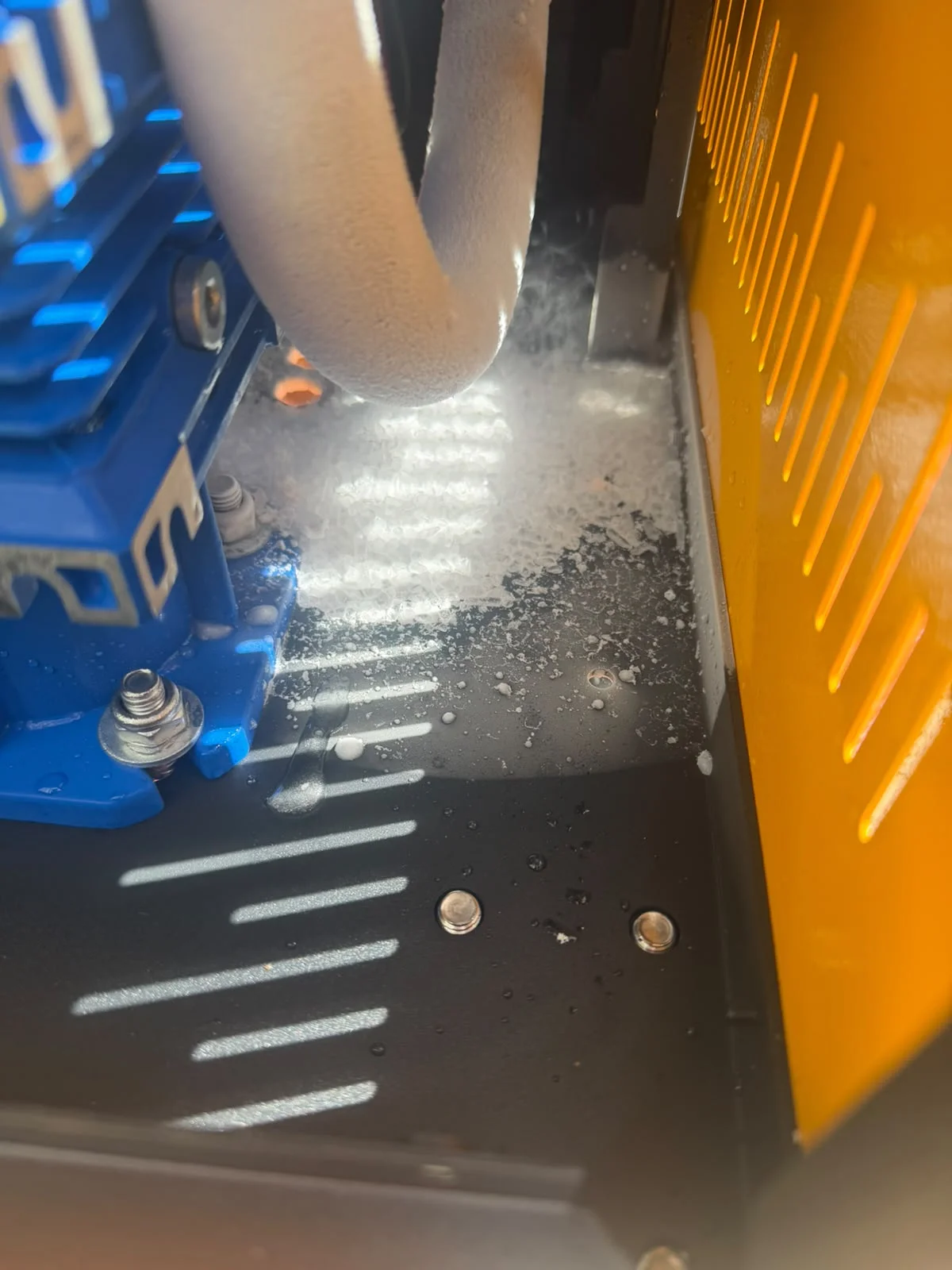
Customer Example: HTS705 Set to Approximately 7 Bar at Standby
In a reported HTS705 support case, a customer found that the spray gun did not discharge ice on first use, while ice came out from the bottom of the machine. The customer had set the pressure to approximately 7 bar before starting.
That standby setting did not establish whether the air supply remained adequate during spraying. Support therefore asked the customer to check the actual running pressure and whether the ice-feed setting was too high.
Check Running Pressure and Reduce the Ice Feed
- If operation is abnormal, stop spraying and assess the setup safely.
- Check whether supply pressure drops during spraying and verify that the compressor meets the model’s continuous airflow requirement.
- Reduce the ice-feed setting according to the manual, then observe the result during a safe, controlled test.
- If ice still does not leave the gun, stop and contact support for further checks of the ice outlet hose and related piping.
When pressure drops while the ice feed is set high, the incoming ice may not be carried out through the gun quickly enough. The customer example records the diagnostic approach and recommended checks; it does not establish a confirmed repair outcome.
What Contamination Can a Dry Ice Blaster Clean?#
AUTOOL dry ice blasting machines can clean carbon deposits from accessible engine components and remove mud and oil contamination from chassis surfaces. The nozzle must be able to reach the target area, and results vary with deposit adhesion, air delivery and operating settings.
Set realistic expectations for rust removal. Dry ice blasting may remove some loose surface rust, but it cannot be relied upon to remove firmly bonded or deep corrosion completely. Severe corrosion may require a separate assessment and a different treatment, such as mechanical preparation.
What Information Should You Send to AUTOOL Support?#
Prepare the following details so support can assess the issue more efficiently:
- Machine model and a clear photograph of the nameplate;
- Compressor power, tank capacity, airflow rating and air-treatment equipment;
- Dry ice pellet size and condition;
- Pressure readings at standby and during sustained spraying;
- The position of the ice-feed control;
- A video of the control panel, spray gun and visible lower discharge area, recorded from a safe position.
Before cleaning, confirm eye, hand and hearing protection, protective grounding and adequate ventilation. Stop spraying when abnormal operation occurs. If basic checks do not resolve the issue, contact AUTOOL for model-specific after-sales guidance.
Need help with a dry ice blaster not spraying ice or air? Contact Hanna on WhatsApp →
Official reference: AUTOOL HTS705 user manual. Requirements and procedures can differ by model.


Discussion
Comments 0
Need help with an order, warranty or a fault? Contact support
No comments yet. Ask a question or share how the tool worked for you.