AUTOOL Blog, Purchase Guides
Fuel Injector Tester: Do You Really Need the Top-Tier Model?

August 23, 2026
Share:
 autoolstore.com
Repair testing / 8 sub-categories
Diagnostic tools for leak tracing, visual inspection, battery health, circuits, pressure, spark, oil, and electrical readings.
Repair maintenance / 6 sub-categories
Service equipment for fluid exchange, A/C diagnostics, refrigerant recovery, oil handling, and cooling-system work.
Carbon cleaning / 3 sub-categories
Carbon-removal equipment for injectors, intake valves, components, and workshop cleaning jobs.
Wheel tire / 3 sub-categories
Equipment for alignment, lifting, tire repair, tire mounting, and service-bay workflows.
Tool storage / 1 sub-category
Storage products for keeping workshop tools, test equipment, and accessories organized.
EV charging / 1 sub-category
EV charging products for new-energy vehicle service, workshop use, and installation scenarios.
OBD diagnosis / 5 sub-categories
OBD-related testers, ECU programming power supplies, cable products, used-car inspection tools, and key frequency diagnostics.
Accessories / 8 sub-categories
Replacement parts, adapters, consumables, cables, and add-ons for major diagnostic and service equipment.
In automotive repair and maintenance, the fuel injector is a core component of the engine’s fuel delivery system. Its spray pattern, fuel delivery consistency, and opening and closing performance directly affect engine power, fuel economy, idle stability, and emissions.
After extended use, injectors may develop carbon buildup, clogging, leakage, or poor atomization. Simply reading fault codes or relying on a road test may no longer be enough to accurately identify these problems.
A fuel injector tester and cleaner is a specialized diagnostic tool designed for automotive repair. It simulates the vehicle’s ECU control signals and allows technicians to perform injector cleaning, spray pattern inspection, flow comparison, and leak testing under controlled pressure, RPM, and pulse conditions.
These machines are available in 2-cylinder, 4-cylinder, 6-cylinder, and 8-cylinder configurations. Many repair professionals and DIY users are unsure about the differences between them, which applications they are designed for, and whether they can support GDI (Gasoline Direct Injection) injectors.
So, do you really need the highest-spec model? This guide will help you choose the right fuel injector tester based on your actual repair needs.
A fuel injector tester and cleaner is an automotive diagnostic device that combines ultrasonic cleaning, operating-condition simulation, performance testing, and data comparison. It is mainly used to diagnose and restore gasoline injectors and is widely used for DIY maintenance, general repair shops, high-end vehicle service centers, and dealerships.
By simulating engine operating conditions, the equipment enables comprehensive injector testing and helps identify hidden faults that traditional diagnostic methods may not reveal.
Its core functions include:
Unlike a standalone cleaning machine, an integrated fuel injector tester and cleaner combines cleaning, testing, and comparison in one workflow. This eliminates repeated disassembly and testing, helping improve both repair efficiency and diagnostic accuracy. For modern automotive repair shops, it can be an essential tool for professional injector service.
The basic principle is simple: the injector is removed from the vehicle, and the tester simulates the vehicle’s ECU control logic and fuel pressure conditions. This allows each injector to operate independently on the test bench for direct and accurate performance evaluation.
The equipment mainly consists of two core modules:
Ultrasonic Cleaning Module
The ultrasonic cleaning module uses high-frequency ultrasonic vibrations together with a dedicated cleaning solution to remove fine carbon deposits and stubborn varnish from inside the injector.
For GDI direct injectors, which have precision internal structures and can develop significant deposits, ultrasonic cleaning can help clear small nozzle openings and restore the injector’s original spray performance.
This addresses some of the limitations of conventional cleaning methods.
Intelligent Operating-Condition Simulation and Testing Module
The built-in control system allows users to adjust injection frequency, pulse width, and working pressure to simulate different engine operating conditions.
The tester sends standardized electronic control signals to operate the injectors while its precision pressure and metering systems collect and compare real-time data, including spray pattern, fuel delivery, opening and closing response and sealing performance.
Professional equipment such as the AUTOOL FN608 supports not only conventional low-pressure MPI (Manifold Port Injection) injectors, but also GDI high-pressure direct injectors and piezoelectric injectors.
This makes it suitable for a wide range of applications, from everyday passenger vehicles to luxury and performance vehicles, while providing a more versatile solution for professional injector testing and cleaning.
Traditional injector troubleshooting mainly relies on technician experience, visual inspection, and fault-code reading. While these methods are convenient and quick, they have limitations when it comes to identifying hidden or performance-related injector faults.A dedicated injector tester, by contrast, delivers quantitative data and precise fault localization — completely filling the gaps left by traditional approaches.
Comparison | Traditional Cleaning & Diagnosis | Fuel Injector Tester & Cleaner |
Cleaning Effectiveness
| Mainly cleans the surface, with limited ability to remove deposits and varnish from internal precision components.
| Ultrasonic cleaning + dynamic reverse flushing: combines ultrasonic cavitation, cleaning-solution action, and energized reverse flushing in a dedicated cleaning tank. |
Diagnostic Capability | Diagnostic Capability Mainly checks whether the injector turns on/off or produces a clicking sound; cannot accurately evaluate performance degradation. | Precisely identifies potential faults by testing fuel delivery, spray pattern, injection performance, sealing condition, and other parameters. |
Work Efficiency | Relies heavily on technician experience. Soaking may take hours, testing is largely manual, and repeated disassembly may be required. | Fast, batch, and standardized workflow improves bay turnover while enabling professional injector service. |
Economic Benefits | Relies mainly on technician time and labor, resulting in lower efficiency and higher hidden costs. | Provides a more complete repair solution with higher efficiency, lower risk, faster return on investment, and greater growth potential. |
Safety & Environment | Can create a messy work environment, expose technicians to cleaning fluids, and create waste-disposal concerns. | Closed-loop cleaning with a built-in drain valve allows waste fluid to be collected centrally and reused where applicable. |
In simple terms, traditional diagnosis often relies on experience and judgment, while a professional injector tester provides measurable data to help identify faults. This can reduce unnecessary repairs and repeat work while improving shop professionalism and customer confidence.
Fuel injector testers are commonly available in 2-cylinder, 4-cylinder, 6-cylinder, and 8-cylinder configurations. A common misconception is that “more cylinders are always better.” In reality, different configurations come with different hardware, pressure capabilities, vehicle compatibility, and application scenarios. The right choice depends on your actual needs—not simply on choosing the highest specification.
Target users: DIY enthusiasts, small motorcycle repair shops, and users looking for a backup or auxiliary unit.
2-cylinder models are entry-level devices with basic low-pressure fuel systems and simplified drive circuits. They are mainly suitable for: motorcycle EFI injectors, oder MPI injectors on passenger vehicles, basic injector cleaning , spray pattern inspection and simple leak testing.
Key limitation: Lower pressure, no high-voltage drive module, and limited flow measurement accuracy. Most 2-cylinder models do not support GDI direct injectors and are therefore not designed for the higher-precision requirements of modern direct-injection service.
Target users: Small repair shops mainly servicing conventional passenger vehicles.
4-cylinder models are suitable for most common 4-cylinder gasoline vehicles and can test the injectors from a vehicle in one operation.
They support comprehensive cleaning and testing of conventional MPI injectors.
Some higher-spec 4-cylinder models may offer limited compatibility with entry-level GDI applications. However, high-pressure stability and flow measurement accuracy may be limited, making them less suitable for frequent GDI or high-end vehicle service.
Best for: Small repair shops with limited budgets that mainly service conventional MPI vehicles and rarely work with GDI systems.
Target users: General repair shops servicing both mainstream vehicles and mid-to-high-end GDI vehicles.
The 6-cylinder model offers a strong balance of performance, accuracy, efficiency, and cost-effectiveness, making it a popular choice for professional repair shops.
It is equipped with:
It can support 4-cylinder and 6-cylinder GDI direct-injection vehicles, including popular applications from brands such as Volkswagen, Toyota, BMW, Audi, and Land Rover.
It allows simultaneous testing and data comparison of all injectors on a vehicle in a single run — eliminating redundant work and delivering the ideal balance of efficiency, accuracy, and cost-effectiveness for over 90% of repair shop needs.
Target users: Luxury vehicle specialists, dealerships, and large multi-bay repair facilities.
The 8-cylinder model is the top-tier configuration, offering broader vehicle coverage and more comprehensive testing capabilities. It supports 4-, 6-, and 8-cylinder applications, including conventional MPI and GDI injectors, as well as injectors used in larger-displacement performance and luxury vehicles. It can also support precise testing of piezoelectric injectors.
Depending on the configuration, features may include:
With more comprehensive functions and broader application coverage, the 8-cylinder model is better suited to shops with high repair volumes, a wide range of vehicle types, and demanding professional service requirements.
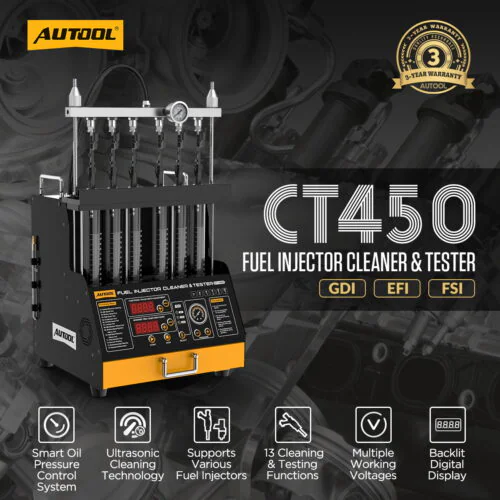
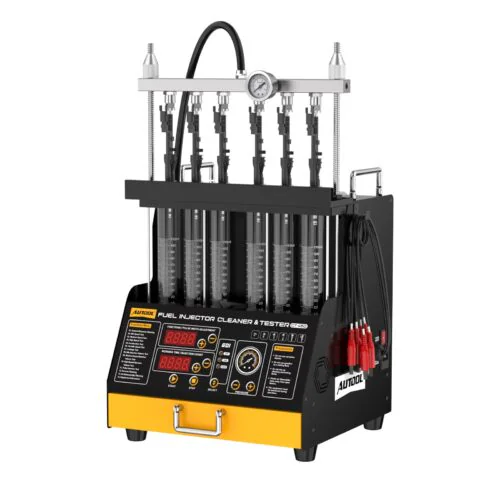
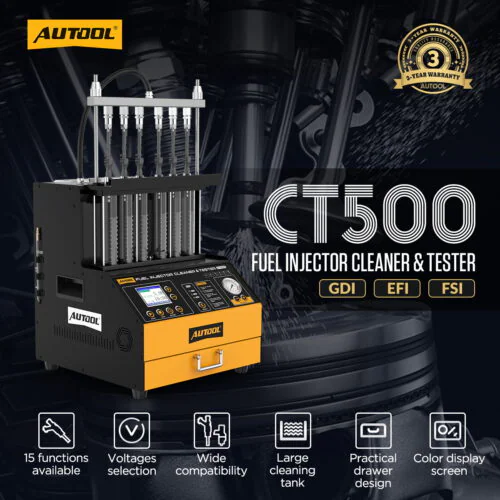
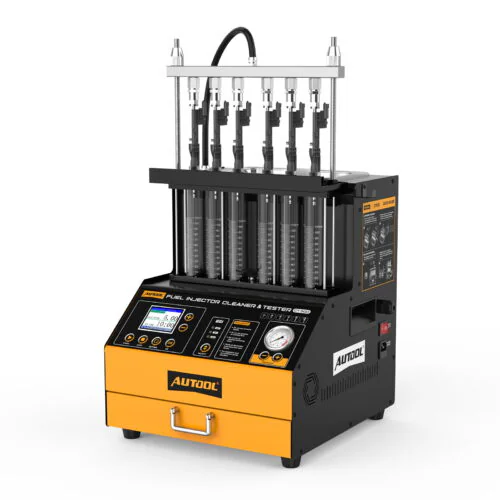
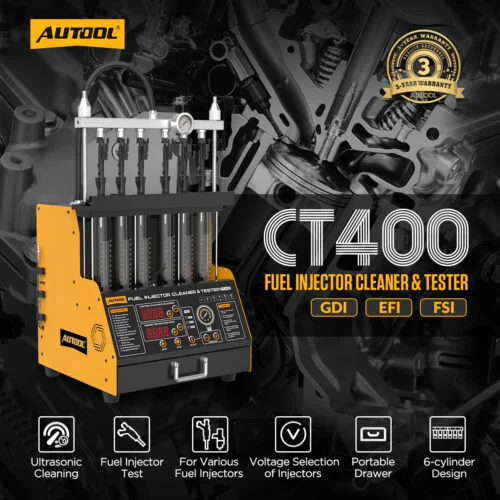
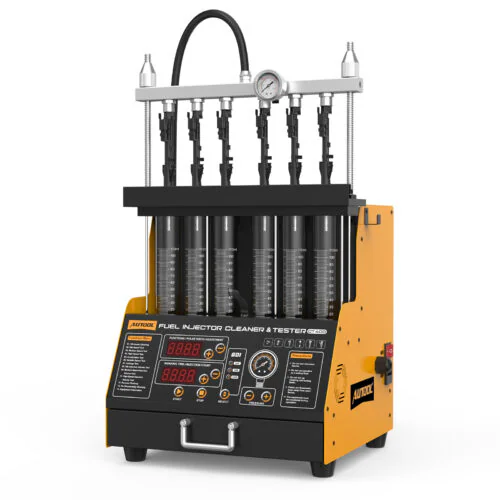
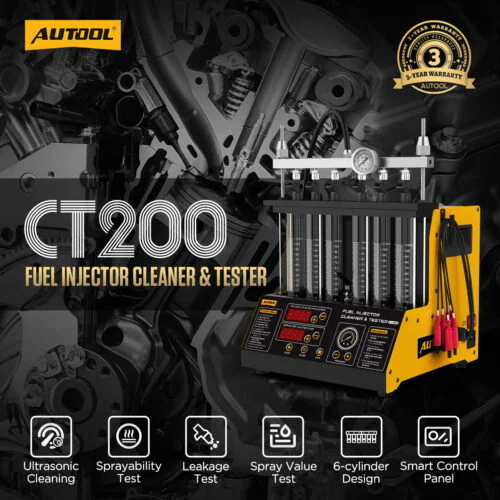
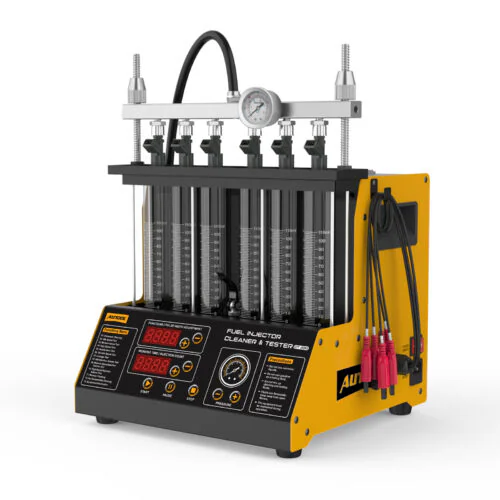
Many users wonder why lower-cylinder-count testers can’t handle GDI direct injectors. The answer lies in hardware — not the number of test positions.
GDI injectors operate at significantly higher pressure, drive voltage, and injection precision than conventional MPI injectors. To test them properly, a machine must be equipped with a high-pressure fuel system, a 70V–120V high-voltage drive module, and high-precision independent flow metering units.
Entry-level 2-cylinder and basic 4-cylinder units use low-pressure pumps, standard 12V drivers, and simplified metering systems — which fall far short of GDI testing requirements. In contrast, professional 6-cylinder and 8-cylinder models come factory-equipped with full GDI hardware, making them inherently compatible with high-end direct injection vehicles.
Additionally, since mainstream automotive engines are primarily 4, 6, or 8-cylinder, multi-position testers allow simultaneous comparison of all injectors on a vehicle — dramatically outperforming lower-cylinder models that require multiple test runs. This makes them far more suitable for high-volume professional repair environments.
User Profile | Recommended Model | Why |
DIY enthusiasts, motorcycle repair | 2-Cylinder | Affordable, meets basic maintenance needs |
Small shops serving conventional MPI vehicles | 4-Cylinder | Cost-effective and sufficient for the job |
General repair shops servicing mainstream + GDI vehicles | 6-Cylinder | Best value — balanced performance, accuracy, and efficiency for most scenarios |
Luxury specialists, dealerships, large facilities, all-vehicle coverage | 8-Cylinder | Full functionality, maximum precision, covers all fuel-injected vehicle types |
In short, choosing an injector tester doesn’t mean chasing the highest cylinder count or the most advanced features. Match the machine to your actual workflow, vehicle range, and budget — and you’ll avoid wasted capability while ensuring every repair need is met with confidence.