Product Presentation
Circulation pump vs. vacuum suction: which is more suitable for you?

March 9, 2026
Share:
 autoolstore.com
AUTOOL Coolant Service Guide
Cooling system upkeep is a fundamental service in automotive repair and maintenance. As vehicle technology has advanced, traditional manual draining and filling methods have gradually given way to specialized equipment.
Today, mainstream coolant exchange machines usually fall into two categories: electric circulation pump type and pneumatic vacuum suction type. The key question is not which technology sounds more advanced, but which one matches the service model, vehicle condition, and workflow of your repair shop.
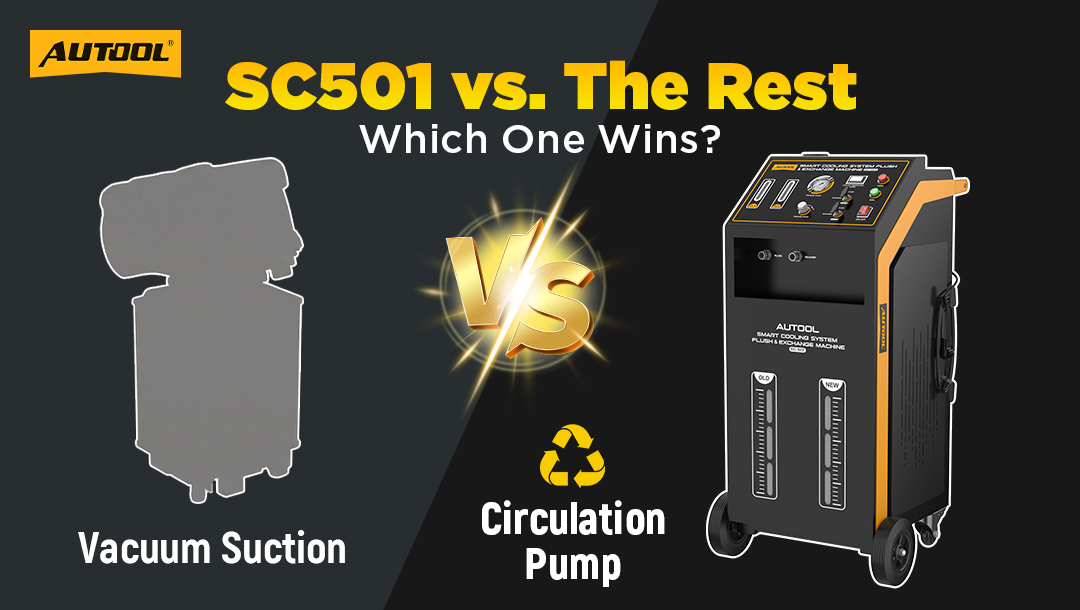
Circulation pump-type equipment, such as the AUTOOL SC501 cooling system flush machine, uses a built-in electric pump to actively push new coolant into the vehicle’s cooling system while simultaneously extracting the old fluid.
This enables a circulating flush and synchronous exchange. During operation, new and old coolant flow in opposite directions through transparent hoses, allowing technicians to monitor color changes and assess flushing effectiveness.
Representative products: AUTOOL SC501 and MotorVac CoolantClean III.
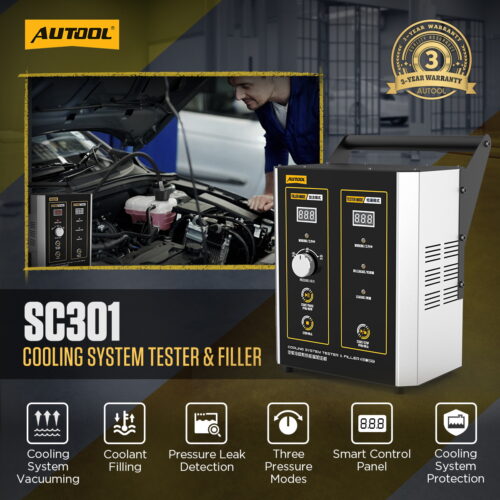
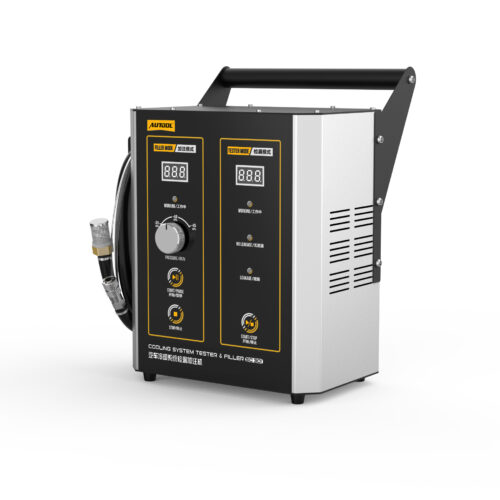
Vacuum suction-type equipment, such as UView Vac-U-Fill, uses compressed air to generate a vacuum. It first extracts old coolant from the cooling system by creating and maintaining a vacuum state.
Then it relies on atmospheric pressure to rapidly draw new coolant into the system. This method mimics the OEM filling process and is especially fast for filling and air evacuation.
Representative product: UView 570000 Vac-U-Fill.
| Dimension | Electrically Driven Circulation Pump Type | Pneumatic Vacuum Suction Type |
|---|---|---|
| Cleaning Capability | Enables circulating flush, providing physical scrubbing action against scale, rust, and other deposits. | Primarily relies on chemical cleaners and has no physical scrubbing effect. |
| Exchange Efficiency | Moderate. Technicians monitor new and old coolant color to determine completion. | Vacuum suction completes the fill in seconds and is extremely efficient. |
| Air Bleed Effect | Minor air pockets may remain. | Vacuum filling eliminates air pockets and requires no burping. |
| Additional Functions | Mainly fluid exchange and flushing. | Can include built-in system leak test capability. |
| Operational Complexity | Simple and intuitive. Technicians monitor color changes through the sight glass. | Requires air connection and slightly more steps. |
| Power Requirements | Requires an electrical outlet. | Requires a 90 PSI compressed air source. |
| Equipment Cost | Moderate. | Higher. |
| Applicable Scenarios | Routine maintenance and contaminated system cleaning. | Quick fluid exchange and leak detection. |
Regardless of the type chosen, professional coolant exchange machines usually support several core functions.
Purpose: removes scale, rust, sludge, and other contaminants from the cooling system. The machine circulates cleaning solution or water through the system, using fluid flow to dislodge deposits.
When to use: vehicles that have not been maintained for a long time, have cloudy or contaminated coolant, or have a history of overheating.
Purpose: drains old coolant while simultaneously filling fresh coolant. The ideal standard is a replacement rate as close to 100% as possible.
Transparent hoses and sight glasses allow technicians to compare old and new coolant color and confirm completion.
Mechanical knob control, such as on the AUTOOL SC501 coolant flush machine, offers a simple design, low failure rate, and no need for specialized training.
Intelligent panel control, such as MotorVac CoolantClean III, offers selectable modes and broader functionality for advanced applications.
Tank layout affects structure, footprint, waste fluid handling, and service convenience. Choose by workflow rather than capacity alone.
| Design Type | Representative Product | Capacity | Advantages | Disadvantages |
|---|---|---|---|---|
| Single-Tank Design | AUTOOL SC501 Coolant exchange machine | 25L new fluid | Simple structure and low cost. | Requires a separate container for waste fluid. |
| Dual-Tank Design | MotorVac CoolantClean III | 24.6L new + 26L waste | Separate new and waste tanks with high integration. | Larger footprint. |
| Large-Capacity Waste Tank | UView Vac-U-Fill | 11.3L new + 45.4L waste | Fewer waste fluid disposal cycles. | Choose only if the workflow needs this waste capacity. |
One of the most common technician questions is whether a cleaning agent should be used. The answer depends on the system condition. It is not mandatory for every service.
| Situation | Reason | Recommended Action |
|---|---|---|
| The vehicle has not been serviced in over 3 years | Deposits may have built up in the system. | Add cleaning agent and let it run for 15-30 minutes, then perform a circulating flush. |
| Coolant appears rusty or cloudy | Corrosion or contamination is present. | Cleaning is essential; otherwise, fresh coolant will quickly degrade. |
| Visible deposits in the radiator | Heat dissipation efficiency is compromised. | Use a cleaning agent to soften deposits, then perform a circulating flush. |
| The engine has a history of overheating | Scale may have formed. | Use a heavy-duty cleaning agent followed by a circulating flush. |
| Switching coolant types, such as OAT to HOAT | Old residue may cause chemical reactions. | Perform a thorough flush to remove all residue of the old coolant. |
| Situation | Reason |
|---|---|
| Routine maintenance following manufacturer intervals | Coolant already contains corrosion inhibitors and the system is clean. |
| Coolant is clear and shows no signs of contamination | No additional cleaning is needed. |
| An aging system with potential leak risks | Cleaning agents may worsen existing leaks. |
| Coolant was recently replaced | Repeated flushing is unnecessary and wasteful. |
Follow the recommended ratio on the product instructions.
Let the engine idle for 10-30 minutes to circulate the cleaning agent.
Use the machine to completely drain the old coolant together with the cleaning agent.
Perform a circulating flush with clean water to remove any remaining residue.
Refill the system with fresh coolant.
Check the coolant level and re-inspect after a road test.
Among coolant replacement machines, the AUTOOL SC501 antifreeze exchange machine is a noteworthy electrically driven circulating pump type.
Mechanical knob control eliminates complex electronic components, resulting in a low failure rate and suitability for high-intensity workshop use.
The machine removes scale and rust while efficiently replacing antifreeze, offering dual functionality.
Red-tone level display and transparent pipe sight glass clearly show the status of old and new coolant.
This helps prevent cooling system damage caused by operational errors.
The capacity meets the needs of most passenger cars and light trucks, reducing the frequency of coolant additions.
AC 100-240V support makes the machine globally compatible.
Choosing a coolant flush machine essentially means choosing a technology that suits your business model. Electric-driven circulation pump models, such as the AUTOOL SC501 coolant flush machine, are popular for many repair shops because of their stability, reliability, and thorough cleaning capability.
Vacuum suction models are known for high efficiency and strong air-bleed performance, making them suitable for shops that prioritize maximum filling speed and leak detection. Regardless of the type chosen, correct operation and the right timing of cleaning agent application are crucial for professional cooling system maintenance.
Contact AUTOOL customer service for purchasing details, discounts, and technical support.
Related Products