LANGUAGE & CURRENCY
Uncategorized
Car Battery Suddenly Dead? Four Professional Testers Help Detect Problems in Advance

September 9, 2026
Share:
 autoolstore.com
Repair testing / 8 sub-categories
Diagnostic tools for leak tracing, visual inspection, battery health, circuits, pressure, spark, oil, and electrical readings.
Repair maintenance / 6 sub-categories
Service equipment for fluid exchange, A/C diagnostics, refrigerant recovery, oil handling, and cooling-system work.
Carbon cleaning / 3 sub-categories
Carbon-removal equipment for injectors, intake valves, components, and workshop cleaning jobs.
Wheel tire / 3 sub-categories
Equipment for alignment, lifting, tire repair, tire mounting, and service-bay workflows.
Tool storage / 1 sub-category
Storage products for keeping workshop tools, test equipment, and accessories organized.
EV charging / 1 sub-category
EV charging products for new-energy vehicle service, workshop use, and installation scenarios.
OBD diagnosis / 5 sub-categories
OBD-related testers, ECU programming power supplies, cable products, used-car inspection tools, and key frequency diagnostics.
Accessories / 8 sub-categories
Replacement parts, adapters, consumables, cables, and add-ons for major diagnostic and service equipment.
A car battery is an essential part of a vehicle’s starting and electrical systems. When starting the engine, the battery must deliver a large amount of current in a short period of time. Once the engine is running, the alternator powers onboard electrical equipment while also recharging the battery. Although it may seem like a simple component, the battery directly affects whether the vehicle can start reliably and whether its electronic systems can operate properly.
Many drivers only realize their battery is aging when the vehicle suddenly will not start. In reality, battery performance usually declines gradually. With a professional battery tester, battery health can be checked in advance, while the starting system, charging system, and abnormal parasitic drain can also be further inspected.
If any of the following symptoms occur, it is recommended to check the battery and related electrical systems:
Important: Difficult starting is not always caused by the battery itself. A faulty starter motor, insufficient alternator output, poor electrical connections, or abnormal parasitic drain can produce similar symptoms. Therefore, a single voltage reading is often not enough. Additional test data should be considered for a more accurate diagnosis.
A professional automotive battery tester does more than simply check the current voltage. Depending on the model and available functions, it can also test CCA (Cold Cranking Amps), internal resistance, SOC (State of Charge), SOH (State of Health), remaining service life, and other battery information.
Among these, CCA reflects the battery’s ability to deliver starting current under low-temperature conditions; an increase in internal resistance usually indicates battery aging or declining performance; SOC represents the current state of charge, while SOH focuses more on evaluating the battery’s overall health condition. These test results can help determine whether the battery needs charging, should continue to be monitored, or is approaching the time for replacement.
In addition, starting system tests can monitor voltage changes at the moment the engine cranks, while charging system tests are used to check whether the alternator is operating properly. Some advanced testers also support maximum load testing, temperature monitoring, leakage current monitoring, and report printing, providing more comprehensive diagnostic information.
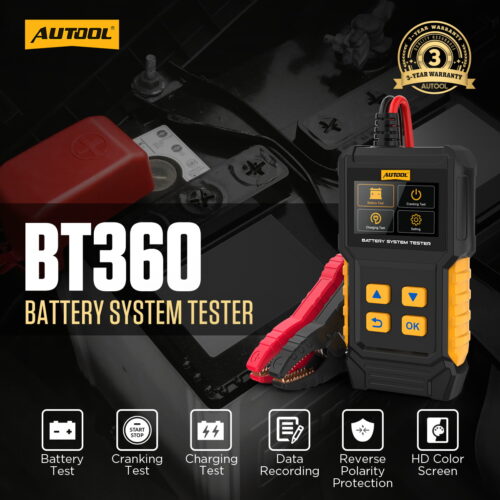
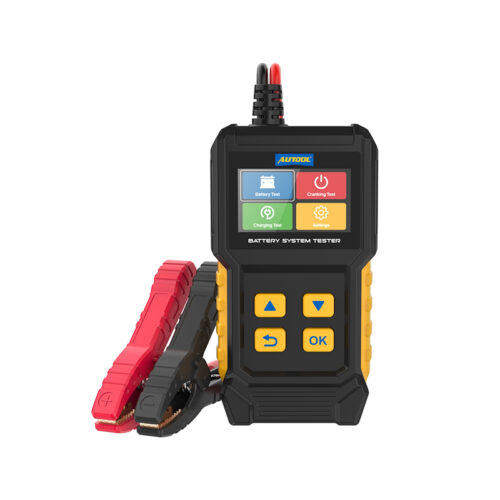
The AUTOOL BT360 is suitable for vehicle owners and basic maintenance personnel who want to quickly understand their battery condition. It supports 12V/24V lead-acid starting batteries, including conventional flooded batteries, AGM flat plate batteries, AGM spiral wound batteries, GEL batteries, and EFB batteries.
The BT360 can perform battery health tests, starting tests, and charging system tests, and display information such as voltage, CCA, internal resistance, state of charge, and remaining service life. Its color screen and operating prompts make it easier to use, while reverse-polarity protection helps improve operational safety. For routine vehicle inspections, small repair shops, or roadside assistance, it is a practical entry-level choice.
It should be noted that the BT360 is a testing device, not a battery charger. It also does not support lithium battery testing or maximum load testing.
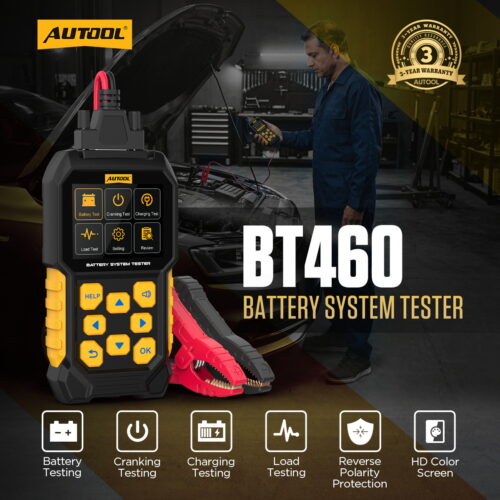
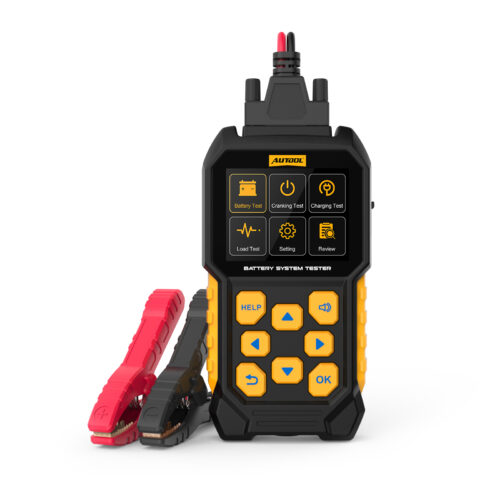
For those who want a lightweight and portable device while requiring more comprehensive functions than basic testing, the AUTOOL BT460 is a suitable choice.
The BT460 supports 12V/24V conventional flooded, AGM flat plate, AGM spiral wound, GEL, and EFB lead-acid batteries. It can test battery voltage, internal resistance, SOC, SOH, and CCA. In addition to battery health tests, starting tests, and charging system tests, it also adds maximum load testing, allowing the battery’s voltage changes to be observed when vehicle electrical equipment is switched on.
The BT460 features a 2.8-inch color display, reverse-polarity protection, and a Type-C software upgrade port, making it suitable for cars, motorcycles, vans, and trucks. Compared with the BT360, it is better suited for individual vehicle owners and technicians who require more advanced testing while still valuing portability. It should be noted that the BT460 does not support lithium battery testing.
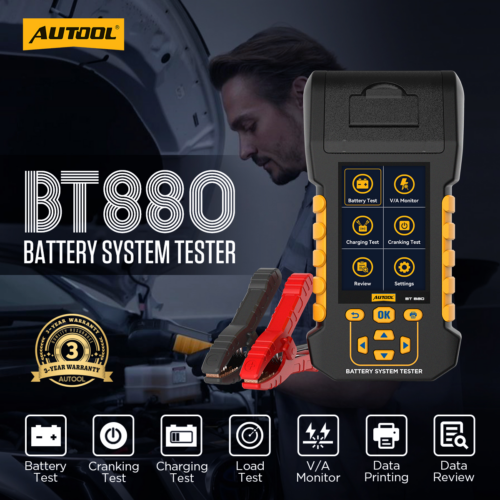
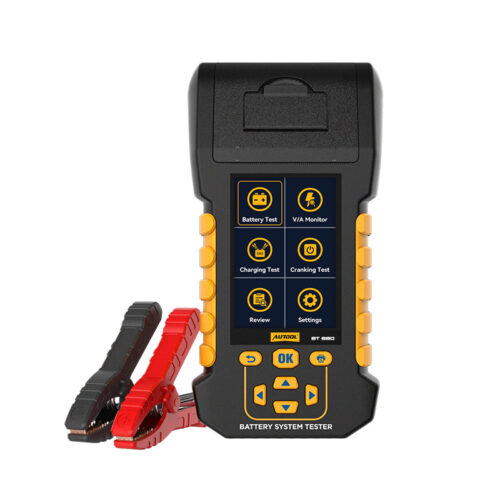
If battery health testing is not enough and abnormal power consumption after the vehicle has been parked also needs to be investigated, the AUTOOL BT880 is a suitable choice.
The BT880 supports common 12V/24V lead-acid batteries and integrates starting tests, charging tests, maximum load tests, voltage and current monitoring, and other functions. Its leakage current detection range is 15mA to 5A, and it can record current change waveforms to help technicians identify abnormal power consumption after the vehicle is switched off.
The device is equipped with a built-in temperature sensor to provide testing reference under different ambient temperatures. Its built-in thermal printer can also print test reports directly, making it convenient for repair shops to show customers the test results and keep service records. It should be noted that the BT880 does not support lithium battery testing.
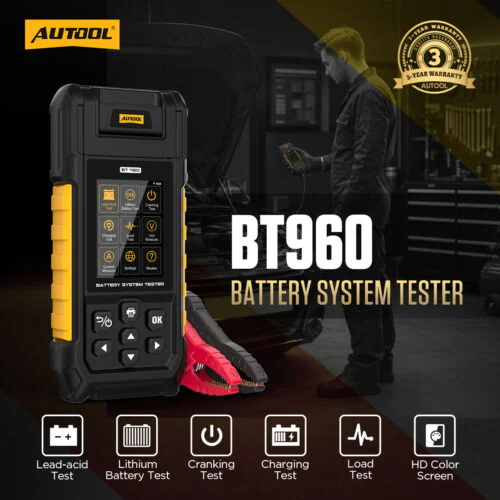
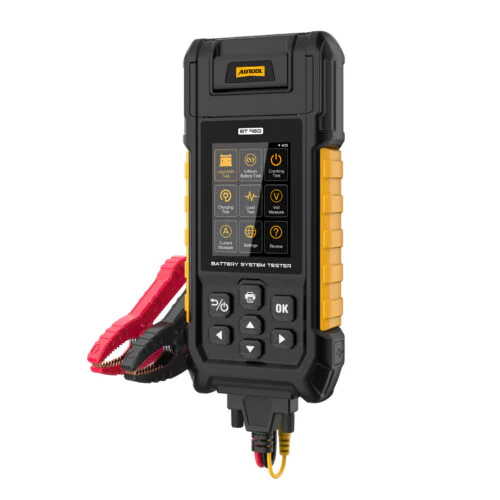
For vehicles equipped with lithium batteries or more complex electrical systems, the AUTOOL BT960 provides a more comprehensive solution.
In addition to battery system testing, starting tests, charging tests, load tests, and leakage current monitoring, the BT960 also adds lithium battery testing capability. It can be used with lithium iron phosphate, lithium polymer, and ternary lithium batteries. The device also supports 0–80V voltage measurement, 0–10A current measurement, real-time temperature monitoring, historical data recording, and on-site report printing.
For professional repair shops that handle different vehicle models and battery types, the BT960 can reduce the need to switch between multiple testing devices and help improve diagnostic efficiency.
For individual vehicle owners, the lightweight, portable, and intuitive AUTOOL BT360 or BT460 is recommended. The BT360 can meet basic inspection needs for battery health, starting performance, and the charging system. If maximum load testing is also required and more comprehensive vehicle battery system data is needed, the upgraded BT460 is a suitable choice. Both products are easy to carry in the vehicle and are suitable for checks before long trips, during seasonal changes, or when the vehicle shows starting problems.
If the main focus is testing lead-acid batteries while also diagnosing abnormal power consumption, monitoring temperature, and printing reports on-site, the BT880 is a suitable choice. It is better suited to applications with higher requirements for leakage current diagnosis and service records.
For professional repair shops, the AUTOOL BT960 is the recommended choice. In addition to battery health, starting, charging, load, and leakage current monitoring functions, it supports both lead-acid batteries and multiple types of lithium batteries. It also integrates real-time temperature monitoring, historical data recording, and thermal report printing. When handling different vehicle models and battery types, the BT960 can provide a more complete testing solution, helping improve diagnostic efficiency and making it easier to present test results clearly to customers.
You can also contact us directly—our professional technical team is available to answer any questions about AUTOOL battery testers.
Before testing, confirm the battery type, rated voltage, and testing standard shown on the battery label, and select the correct parameters according to the device instructions. Connect the red clamp to the positive terminal and the black clamp to the negative terminal, ensuring that the clamps make full contact with the battery terminals. Standard battery health tests generally need to be performed with the vehicle switched off, while starting, charging, and leakage current tests should be carried out strictly according to the product instructions.
If the test result is abnormal, the battery terminals can first be cleaned, the clamp connections checked, and the test performed again. Test data is an important reference for fault diagnosis, but it cannot completely replace a comprehensive inspection of the wiring, alternator, and starter motor.
Battery aging itself is not necessarily a problem—the real problem is failing to detect it in time. Whether choosing the BT360 or BT460 for routine inspections, the BT880 for leakage current diagnosis and report printing, or the BT960 for lithium battery testing, selecting a professional battery tester that matches the intended application can make battery condition easier to understand, improve diagnostic efficiency, and help reduce the risk of being unexpectedly stranded by a dead battery.