Uncategorized
The Ultimate Guide to the 2 Post Car Lift: How to Choose the Right One for Your Workshop

August 4, 2026
Share:
 autoolstore.com
Repair testing / 8 sub-categories
Diagnostic tools for leak tracing, visual inspection, battery health, circuits, pressure, spark, oil, and electrical readings.
Repair maintenance / 6 sub-categories
Service equipment for fluid exchange, A/C diagnostics, refrigerant recovery, oil handling, and cooling-system work.
Carbon cleaning / 3 sub-categories
Carbon-removal equipment for injectors, intake valves, components, and workshop cleaning jobs.
Wheel tire / 3 sub-categories
Equipment for alignment, lifting, tire repair, tire mounting, and service-bay workflows.
Tool storage / 1 sub-category
Storage products for keeping workshop tools, test equipment, and accessories organized.
EV charging / 1 sub-category
EV charging products for new-energy vehicle service, workshop use, and installation scenarios.
OBD diagnosis / 5 sub-categories
OBD-related testers, ECU programming power supplies, cable products, used-car inspection tools, and key frequency diagnostics.
Accessories / 8 sub-categories
Replacement parts, adapters, consumables, cables, and add-ons for major diagnostic and service equipment.
As a workshop owner, choosing a new car lift can be overwhelming given the sheer variety of models on the market. Different types of lifts have different structures and use cases – and picking the right one not only boosts repair efficiency but also ensures safety and extends equipment life. Today, we’re taking an in-depth look at one of the most popular and cost-effective options in the industry: the 2 Post Car Lift. We’ll cover its types, advantages, and ideal applications to help you make the best choice for your workshop.
A 2 post lift is a commonly used piece of equipment in the automotive repair industry that uses hydraulic power to raise vehicles off the ground. It features dedicated support arms and pads that align with OEM-recommended lift points, ensuring safe and secure lifting for a wide range of vehicles.
This type of lift is primarily used for vehicle inspection and maintenance, as well as temporary parking. It raises the vehicle to a comfortable working height, allowing technicians to access the undercarriage without bending over or using creeper boards. With long-term use, it significantly reduces back strain and the risk of repetitive stress injuries – making it a favorite among both professional mechanics and DIY enthusiasts.
Thanks to its excellent value, compact footprint, and broad vehicle compatibility (depending on capacity), the 2 post lift has become the go-to choice for individual garages and professional repair shops alike.
The two-post lift is powered by a hydraulic system. An electric motor drives a hydraulic pump to generate high-pressure fluid, which is distributed via control valves to the hydraulic cylinders inside each column. The cylinders push the pistons upward, moving the sliding carriages and support arms to lift the vehicle.
For lowering, the system releases pressure through a relief valve, allowing the vehicle to descend gradually under its own weight. The lift is also equipped with mechanical safety locks that automatically engage once the lift reaches full height, preventing accidental drops and ensuring operator safety throughout the process.
Many people ask about the concrete specifications needed for 2 post lift installation. The answer depends on the lift’s weight capacity – different capacities require different floor thicknesses. A sufficiently thick concrete slab is essential to safely support the vehicle’s weight during lifting.
As a general rule, the minimum concrete thickness for any vehicle lift is 4 to 4.5 inches, with a compressive strength of 3,000 PSI. This is adequate for 2 post lifts with a maximum capacity of up to 10,000 lbs (approximately 4.5 tons). For lifts with higher capacities, a 6-inch-thick concrete slab is recommended. Anchor bolts should be embedded at least 3.25 inches deep into the concrete.
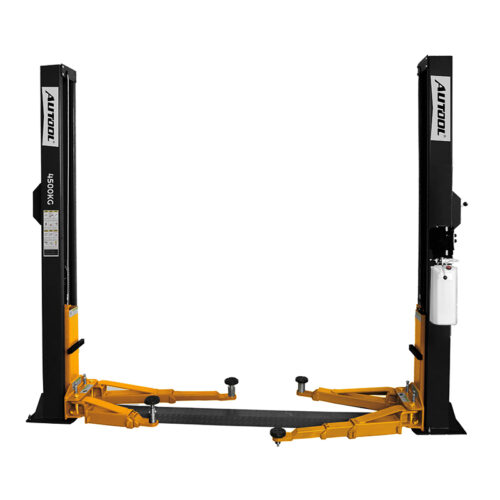
In this design, the two columns operate independently with no overhead beam connecting them. They are secured to the floor via base plates – this is the most classic and widely used two-post configuration.
Advantages
Better value for money: Simpler construction and less material keep costs down – ideal for budget-conscious buyers.
Easier installation and site adaptability: Less demanding on floor flatness and foundation quality – suitable for home garages and smaller shops.
Disadvantages
Lower torsional rigidity – not ideal for heavy-duty commercial use or intensive overhaul work.
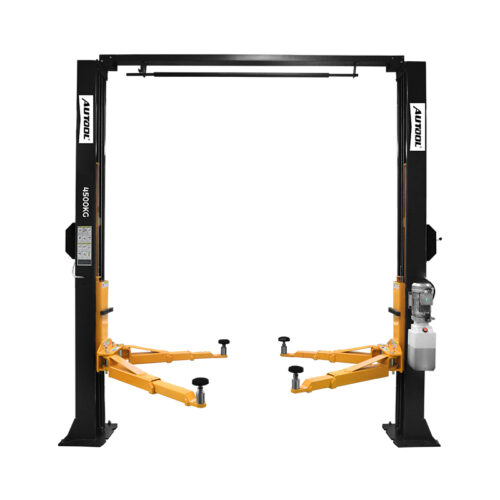
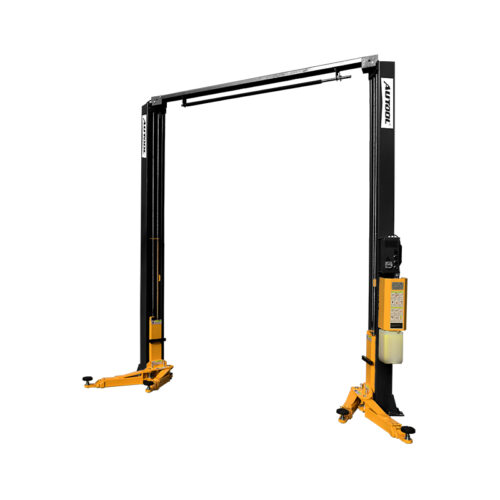
This design features a solid top beam connecting the two columns, forming a closed “portal frame” structure. This turns the two columns into a single rigid system, significantly boosting stability.
Advantages
Better synchronization: The frame structure ensures more consistent lifting height on both sides, keeping the vehicle level.
The go-to choice for heavy commercial use: Standard equipment in 4S dealerships, general repair shops, and high-frequency heavy-duty bays.
Disadvantages
Higher cost – more material, higher shipping and manufacturing expenses.
The two columns are directly opposite and parallel, with four equal-length arms. The vehicle is centered between the columns, with weight distributed roughly 50/50 front to rear.
Advantages
Disadvantages
The columns are rotated approximately 30° toward the rear, with shorter front arms and longer rear arms. The vehicle is positioned further back, with roughly 30% of the weight in front of the columns and 70% behind.
Advantages
Disadvantages
Choosing the right two-post car lift requires careful consideration of the vehicles you service, workshop height, floor conditions, and budget. The right lift can significantly improve repair efficiency while ensuring safer and more convenient operation.
If your workshop has limited ceiling height, average floor conditions, and mainly services passenger cars, sedans, and SUVs, a non-overhead asymmetric two-post lift is a cost-effective choice.
With a front-short and rear-long arm design, this lift is optimized for vehicles with a heavier front end, such as most front-wheel-drive passenger cars. After lifting, the vehicle doors can be fully opened, making interior access and cabin-related repairs more convenient.
It requires less demanding installation conditions, is easy to install, and offers excellent value for money, making it suitable for personal garages and small automotive repair shops.
For workshops that mainly service pickup trucks, light-duty trucks, vans, and other vehicles with longer wheelbases and balanced weight distribution, a non-overhead symmetric two-post lift is a better option.
Equipped with four equal-length lifting arms, this design positions the vehicle centrally during lifting, providing balanced load distribution, strong stability, and reliable lifting performance for various light commercial vehicles.
However, due to its symmetrical arm design, door opening space is more limited after lifting, making it less suitable for frequent interior access work.
For professional workshops with sufficient ceiling height, proper floor conditions, and a focus on heavy vehicle repair and undercarriage service, an overhead symmetric two-post lift is an excellent choice.
Unlike floor-plate models, it features an open area beneath the vehicle with no bottom obstruction, providing better visibility and easier access for chassis inspections and repairs.
The overhead beam structure improves overall rigidity and stability, making it suitable for heavy-duty pickups, light trucks, and large SUVs. It is widely used in professional repair shops and fleet maintenance centers.
If your workshop handles a wide range of vehicles, including passenger cars and light commercial vehicles, and requires frequent access to both the undercarriage and vehicle interior, an overhead asymmetric two-post lift offers the best overall versatility.
It combines the advantages of an overhead design, such as an open workspace underneath the vehicle, with the convenience of asymmetric lifting that allows easier door access.
This type of lift can accommodate most common vehicle models and provides an excellent working experience. However, it comes at a higher cost and requires stricter requirements for workshop space, floor strength, and ceiling height, making it more suitable for mid-to-high-end automotive service centers.
In addition to lift design, selecting the correct lifting capacity is essential for safe operation:
Each type of two-post car lift has its own advantages:
By selecting a lift based on your vehicle types, workshop conditions, and service requirements, you can maximize equipment performance, improve workflow efficiency, and create a safer working environment.