LANGUAGE & CURRENCY
AUTOOL Blog, Repair Information
How Often Should You Change Brake Fluid?Why 2, 3 or 4 Years Can All Be Correct

September 13, 2026
Share:
 autoolstore.com
Repair testing / 8 sub-categories
Diagnostic tools for leak tracing, visual inspection, battery health, circuits, pressure, spark, oil, and electrical readings.
Repair maintenance / 6 sub-categories
Service equipment for fluid exchange, A/C diagnostics, refrigerant recovery, oil handling, and cooling-system work.
Carbon cleaning / 3 sub-categories
Carbon-removal equipment for injectors, intake valves, components, and workshop cleaning jobs.
Wheel tire / 3 sub-categories
Equipment for alignment, lifting, tire repair, tire mounting, and service-bay workflows.
Tool storage / 1 sub-category
Storage products for keeping workshop tools, test equipment, and accessories organized.
EV charging / 1 sub-category
EV charging products for new-energy vehicle service, workshop use, and installation scenarios.
OBD diagnosis / 5 sub-categories
OBD-related testers, ECU programming power supplies, cable products, used-car inspection tools, and key frequency diagnostics.
Accessories / 8 sub-categories
Replacement parts, adapters, consumables, cables, and add-ons for major diagnostic and service equipment.
Your repair shop recommends changing brake fluid every two years. A friend says three years is fine. Online, you read that it only needs checking every four years. Which advice should you follow?
There is no single brake fluid change interval that applies to every vehicle. Start with the maintenance requirements for your specific model, then consider driving conditions and test results. Be clear about the difference between replacing the fluid at a set interval and checking it periodically, with replacement only when needed.
The examples and checks below will help you decide whether your vehicle is due for a fluid change or should be tested first with a suitable brake fluid tester.
HELLA’s technical guidance gives two years as a general replacement recommendation while emphasizing that the vehicle manufacturer’s model-specific interval takes priority. The two-year recommendation has a basis, but it should not be applied automatically to every vehicle.
For example, the US owner’s manual for the 2023 Ford F-150 Lightning specifies a brake fluid change every three years and states that this interval should not be exceeded. This is a scheduled replacement requirement. Low mileage alone is not a reason to extend it.
The current Tesla Model 3 owner’s manual specifies a brake fluid health check every four years, with replacement if necessary. It also notes that heavy brake use during towing, downhill driving or performance driving, particularly in hot and humid environments, may require more frequent checks and replacement.
These examples explain why intervals differ. They should not be treated as a single rule for every vehicle from the same brand, every model year or every sales market.
Brake fluid maintenance depends on more than mileage. Common DOT 3, DOT 4 and DOT 5.1 fluids are hygroscopic, meaning they absorb moisture. Increased moisture lowers the boiling point, raises the risk of vapor formation under high braking temperatures and can contribute to internal corrosion. Driving only a few thousand miles a year does not, by itself, prove that the fluid remains suitable for use. Reference: HELLA brake fluid technical guidance.
Normal braking during short everyday trips does not guarantee adequate performance under prolonged downhill braking or sustained heavy loads. If you regularly drive on mountain roads, tow or drive hard, explain those conditions to your technician and follow the manufacturer’s guidance.
Vehicle manual → Driving conditions → Test results → Service decision
Confirm the model, model year and sales market, then find the brake fluid maintenance entry. Check the following:
If you bought a used car or its service history is incomplete, arrange an initial inspection and establish a record. Do not calculate the interval only from the date you bought the vehicle.
Tell the technician if you regularly tow, drive down long descents, use the brakes heavily or operate in a hot and humid climate. Whether an earlier inspection is appropriate depends on those conditions and the vehicle manufacturer’s requirements.
Once the specified replacement interval has been reached, one satisfactory test result should not be used as a reason to extend it on your own.
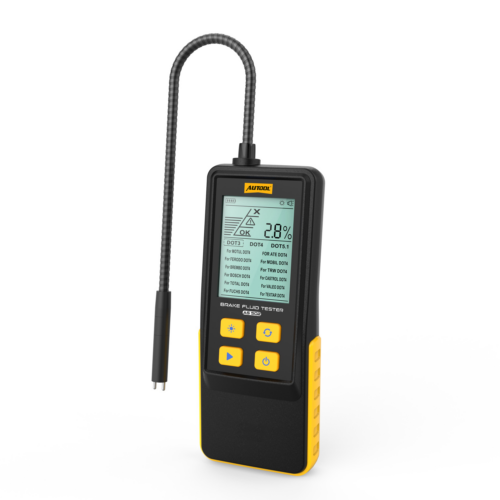
Brake fluid moisture content and boiling point provide different information. A brake fluid moisture tester helps assess moisture condition, while a brake fluid boiling point test assesses the sample’s resistance to boiling.
Test | Main purpose | What to check |
Moisture content test | Helps assess the fluid’s moisture condition. | Confirm supported fluid types, test mode and operating conditions. |
Boiling point test | Assesses the sample’s high-temperature performance. | Interpret results using the vehicle, fluid and equipment requirements. |
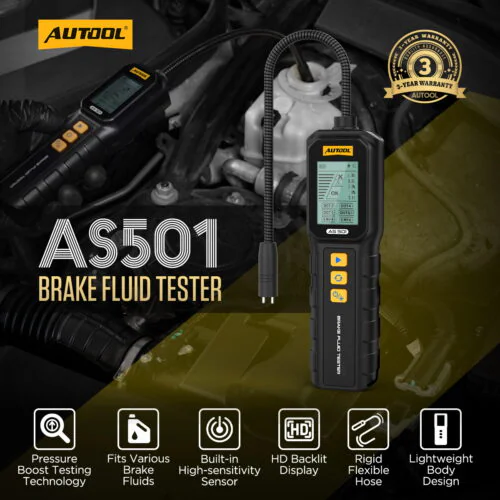
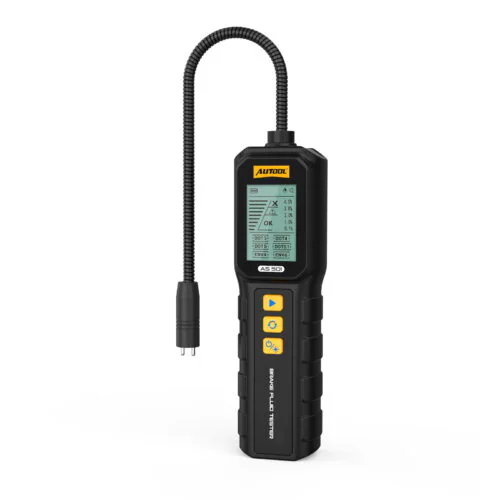
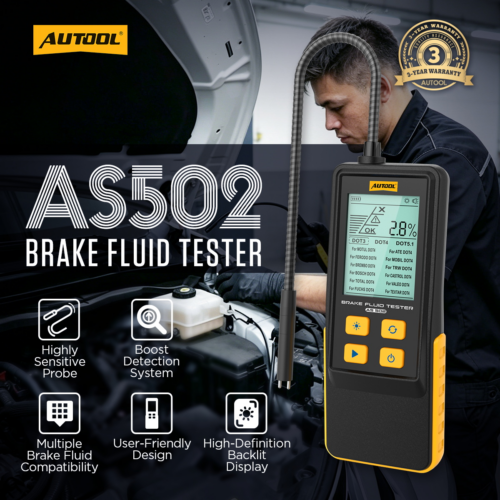
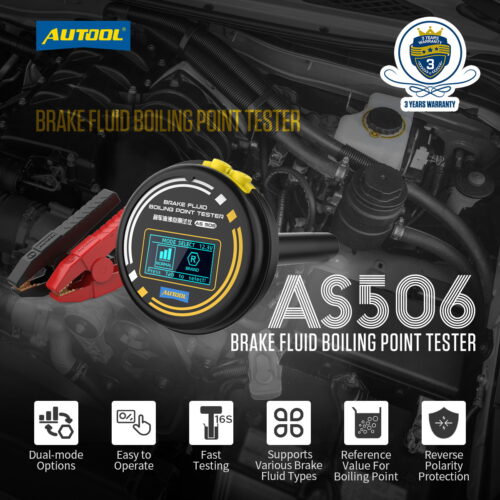
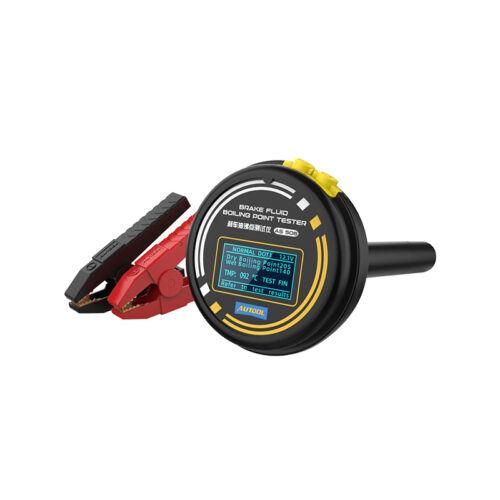
For workshops, the AUTOOL AS501 or AS502 can serve as a brake fluid moisture tester. If a boiling-point measurement is needed, consider the AUTOOL AS506 brake fluid boiling point tester. Choose the test method that matches the maintenance question and the fluid being tested.
Moisture readings must be interpreted in the context of the test method. A reading below 3% is not a universal assurance that the fluid can remain in service. The AS506 heats a fluid sample, so trained personnel should follow its instructions. Tested fluid must not be poured back into the vehicle’s reservoir.
Inspection finding | Next step |
The specified replacement interval has been reached. | Arrange replacement according to the vehicle requirements. |
Condition-based maintenance applies, and test results fail the applicable criteria. | Replace the fluid as required by the service procedure and record the results. |
The interval has not been reached, tests meet the criteria and no faults are present. | Continue inspections and maintenance according to the vehicle requirements. |
There is an obvious leak, a brake warning or an abnormal pedal feel. | Diagnose the issue first. Stop driving and arrange professional service if braking performance is abnormal. |
A soft pedal or falling fluid level does not necessarily mean the fluid has simply aged. A fluid change should not be treated as the solution to every braking problem.
As a vehicle owner, ask three practical questions: Which fluid was used? Which procedure was followed? What was recorded?
Before starting, the workshop should confirm the specified fluid, adapter fit, permitted working pressure, bleeding sequence and whether a diagnostic tool is required to run an ABS-related procedure.
Workshops looking to standardize fluid delivery and collection can consider the AUTOOL AST609 brake fluid exchange machine. Its official product page lists support for DOT 3, DOT 4 and DOT 5.1 and describes a fluid-changing workflow that one technician can operate. The equipment must still be used according to the vehicle-specific procedure and cannot replace required diagnostic operations.
The completed service record should include the date, mileage, fluid specification, test information and final inspection results. This gives you a clear basis for deciding when the next brake fluid service is due.
Need Testing and Fluid Exchange Equipment for Your Workshop?
Prepare a list of the vehicles you service, their fluid specifications and your typical fluid-change workload. Contact AUTOOL to discuss a suitable brake fluid tester, brake fluid exchange machine and adapter combination. Start with the vehicle requirements, use test data to support the decision, and select equipment that fits your workshop’s needs.
Contact AUTOOL to receive a discount on bundled purchases.