LANGUAGE & CURRENCY
Uncategorized
Key Fob Not Working? One Frequency Tester Helps Diagnose 90% of Common Key Issues

August 27, 2026
Share:
 autoolstore.com
Repair testing / 8 sub-categories
Diagnostic tools for leak tracing, visual inspection, battery health, circuits, pressure, spark, oil, and electrical readings.
Repair maintenance / 6 sub-categories
Service equipment for fluid exchange, A/C diagnostics, refrigerant recovery, oil handling, and cooling-system work.
Carbon cleaning / 3 sub-categories
Carbon-removal equipment for injectors, intake valves, components, and workshop cleaning jobs.
Wheel tire / 3 sub-categories
Equipment for alignment, lifting, tire repair, tire mounting, and service-bay workflows.
Tool storage / 1 sub-category
Storage products for keeping workshop tools, test equipment, and accessories organized.
EV charging / 1 sub-category
EV charging products for new-energy vehicle service, workshop use, and installation scenarios.
OBD diagnosis / 5 sub-categories
OBD-related testers, ECU programming power supplies, cable products, used-car inspection tools, and key frequency diagnostics.
Accessories / 8 sub-categories
Replacement parts, adapters, consumables, cables, and add-ons for major diagnostic and service equipment.
In everyday automotive repair, almost every repair shop encounters the same customer complaint:
The remote key works intermittently. Sometimes it locks or unlocks the vehicle, and sometimes it does nothing. The key’s indicator light still comes on, and even after replacing the battery, the problem remains.
Without professional testing equipment, technicians often have to troubleshoot by trial and error:
This trial-and-error approach not only slows down repairs but can also lead to unsuccessful repairs, unnecessary parts replacement, and customer complaints — all of which can hurt a shop’s reputation.
Here’s a standard, foolproof diagnostic procedure using an automotive remote key frequency tester:
Step 1: Quick Signal Check
Place the remote key near the tester’s detection area and press the lock or unlock button.
The key fob tester instantly displays:
Whether the signal is stable
The diagnostic result can then be narrowed down to two main possibilities:
Step 2: Battery Voltage Check
Many remote keys light up but still lack enough voltage or stable discharge, leading to short range or intermittent failure. The tester reads button cell voltage directly — exposing hidden battery problems.
Step 3: Infrared Key Testing
For older Mercedes-Benz, BMW, and other infrared keys — which are impossible to judge by eye — the tester instantly verifies whether the infrared emitter is working.
Result: Fault pinpointed in minutes. No disassembly. No blind parts replacement. Customer satisfaction through the roof.
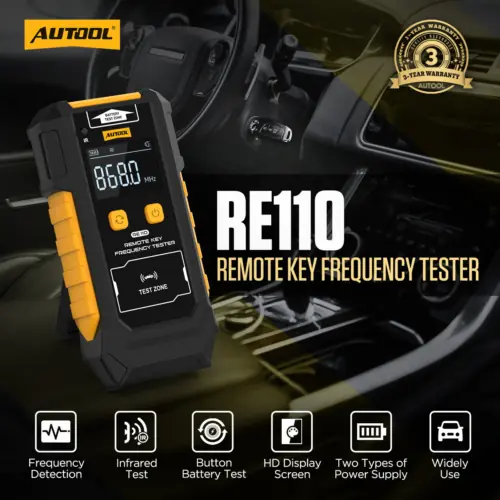
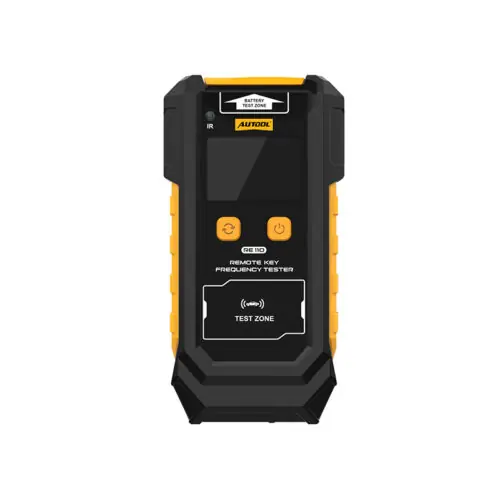
The AUTOOL RE110 Automotive Remote Key Frequency Tester is designed for automotive repair shops, locksmiths, and key service centers. Its core functions are built around common remote key diagnostic needs.
Used to take 30+ minutes to troubleshoot a key issue. Now: results in 3 seconds. Instantly know if it’s the key or the car — dramatically improving efficiency.
No more recommending expensive new keys or module replacements without evidence. Transparent, accurate diagnostics build trust and boost repeat business.
When purchasing used remote keys or stocking blank keys, technicians can check their frequency and signal status in advance. This helps reduce the risk of purchasing or stocking defective components.
Short range, random failures, and “works sometimes” problems are hard to trace with basic methods. This tester locks onto the root cause with certainty.
Many technicians misunderstand the capabilities of this device. To avoid confusion and prevent operational errors, here is a clear list of what this tool cannot do:
The RE110 is designed for signal testing, fault diagnosis, and frequency measurement only. It does not support key copying, cloning, key generation, or programming.
The RE110 can detect the RF signals used for lock/unlock functions on compatible smart keys. It does not test the LF (Low Frequency) signals used by passive keyless entry systems.
The RE110 is a diagnostic tool only. It can help identify potential problems with the remote key but cannot repair the key PCB or other internal components.
Testing near high-power electrical equipment or strong electromagnetic interference may affect measurement stability. For more reliable results, perform testing in a normal workshop environment.
The RE110 can determine whether the remote key is transmitting an RF signal, but it cannot directly identify the specific fault in the vehicle’s receiving antenna or module. Further diagnosis with appropriate vehicle diagnostic equipment may be required.
Remote key failures are a common, small-scale nuisance in every repair shop — and one of the most frequently misdiagnosed.
A compact key fob frequency tester puts an end to guesswork, wasted time, and lost customers. It’s a low-cost investment that boosts diagnostic accuracy and elevates your shop’s professionalism. Every repair shop and key service center should have one on the bench.