Presentación del producto
Bomba de circulación frente a succión por vacío: ¿cuál es más adecuada para ti?

marzo 9, 2026
Compartir:
 autoolstore.com
Guía de servicio de refrigerante AUTOOL
El mantenimiento del sistema de refrigeración es un servicio fundamental en la reparación y el mantenimiento automotriz. A medida que la tecnología de los vehículos ha avanzado, los métodos tradicionales de drenaje y llenado manual han dado paso gradualmente a equipos especializados.
Hoy en día, las máquinas de intercambio de refrigerante más comunes suelen dividirse en dos categorías: tipo bomba de circulación eléctrica y tipo succión neumática por vacío. La cuestión clave no es qué tecnología suena más avanzada, sino cuál se adapta al modelo de servicio, al estado del vehículo y al flujo de trabajo de tu taller.
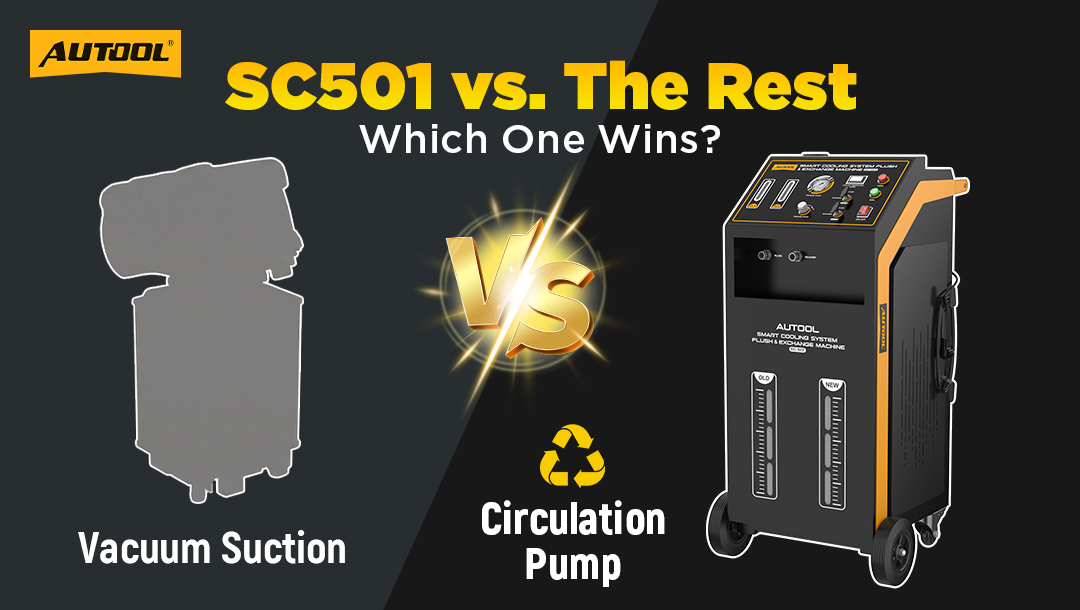
Los equipos de tipo bomba de circulación, como la máquina de limpieza del sistema de refrigeración AUTOOL SC501, utilizan una bomba eléctrica integrada para impulsar activamente refrigerante nuevo hacia el sistema de refrigeración del vehículo’s mientras extraen simultáneamente el fluido viejo.
Esto permite una limpieza por circulación y un intercambio sincrónico. Durante el funcionamiento, el refrigerante nuevo y el antiguo fluyen en direcciones opuestas a través de mangueras transparentes, lo que permite a los técnicos supervisar los cambios de color y evaluar la eficacia de la limpieza.
Productos representativos: AUTOOL SC501 y MotorVac CoolantClean III.
Los equipos de tipo succión por vacío, como UView Vac-U-Fill, utilizan aire comprimido para generar vacío. Primero extraen el refrigerante viejo del sistema de refrigeración creando y manteniendo un estado de vacío.
Después, se basa en la presión atmosférica para introducir rápidamente refrigerante nuevo en el sistema. Este método imita el proceso de llenado OEM y es especialmente rápido para el llenado y la evacuación de aire.
Producto representativo: UView 570000 Vac-U-Fill.
| Dimensión | Tipo de bomba de circulación accionada eléctricamente | Tipo de succión neumática por vacío |
|---|---|---|
| Capacidad de limpieza | Permite el lavado por circulación, proporcionando una acción física de arrastre contra incrustaciones, óxido y otros depósitos. | Depende principalmente de limpiadores químicos y no tiene efecto de limpieza física por arrastre. |
| Eficiencia de cambio | Moderada. Los técnicos supervisan el color del refrigerante nuevo y usado para determinar cuándo ha finalizado. | La succión por vacío completa el llenado en segundos y es extremadamente eficiente. |
| Efecto de purga de aire | Pueden quedar pequeñas bolsas de aire. | El llenado por vacío elimina las bolsas de aire y no requiere purga manual. |
| Funciones adicionales | Principalmente cambio de fluido y lavado. | Puede incluir capacidad integrada de prueba de fugas del sistema. |
| Complejidad operativa | Simple e intuitivo. Los técnicos supervisan los cambios de color a través de la mirilla. | Requiere conexión de aire y algunos pasos adicionales. |
| Requisitos de alimentación | Requiere una toma de corriente. | Requiere una fuente de aire comprimido de 90 PSI. |
| Coste del equipo | Moderado. | Más alto. |
| Escenarios aplicables | Mantenimiento rutinario y limpieza de sistemas contaminados. | Cambio rápido de fluido y detección de fugas. |
Independientemente del tipo elegido, las máquinas profesionales de cambio de refrigerante suelen admitir varias funciones principales.
Objetivo: elimina incrustaciones, óxido, lodos y otros contaminantes del sistema de refrigeración. La máquina hace circular solución limpiadora o agua por el sistema, usando el flujo del fluido para desprender los depósitos.
Cuándo usarlo: vehículos que no han recibido mantenimiento durante mucho tiempo, tienen refrigerante turbio o contaminado, o presentan antecedentes de sobrecalentamiento.
Objetivo: drena el refrigerante usado mientras llena simultáneamente con refrigerante nuevo. El estándar ideal es una tasa de sustitución lo más cercana posible al 100%.
Las mangueras transparentes y las mirillas permiten a los técnicos comparar el color del refrigerante usado y nuevo y confirmar la finalización.
El control mecánico mediante perilla, como en la máquina de lavado de refrigerante AUTOOL SC501, ofrece un diseño sencillo, baja tasa de fallos y no requiere formación especializada.
El control mediante panel inteligente, como MotorVac CoolantClean III, ofrece modos seleccionables y una funcionalidad más amplia para aplicaciones avanzadas.
La disposición del depósito afecta a la estructura, el espacio ocupado, la gestión del fluido residual y la comodidad de servicio. Elija según el flujo de trabajo, no solo por la capacidad.
| Tipo de diseño | Producto representativo | Capacidad | Ventajas | Desventajas |
|---|---|---|---|---|
| Diseño de depósito único | Máquina de cambio de refrigerante AUTOOL SC501 | 25L de fluido nuevo | Estructura sencilla y bajo coste. | Requiere un recipiente separado para el fluido residual. |
| Diseño de doble depósito | MotorVac CoolantClean III | 24.6L nuevo + 26L usado | Depósitos separados para líquido nuevo y usado con alta integración. | Ocupa más espacio. |
| Depósito de residuos de gran capacidad | UView Vac-U-Fill | 11.3L nuevo + 45.4L usado | Menos ciclos de eliminación de líquido usado. | Elija esta opción solo si el flujo de trabajo necesita esta capacidad de residuos. |
Una de las preguntas más comunes de los técnicos es si se debe usar un agente limpiador. La respuesta depende del estado del sistema. No es obligatorio en cada servicio.
| Situación | Motivo | Acción recomendada |
|---|---|---|
| El vehículo no ha recibido servicio en más de 3 años | Pueden haberse acumulado depósitos en el sistema. | Añada agente limpiador y déjelo actuar durante 15-30 minutos; luego realice un enjuague por circulación. |
| El refrigerante parece oxidado o turbio | Hay corrosión o contaminación. | La limpieza es esencial; de lo contrario, el refrigerante nuevo se degradará rápidamente. |
| Depósitos visibles en el radiador | La eficiencia de disipación del calor está comprometida. | Use un agente limpiador para ablandar los depósitos y luego realice un enjuague por circulación. |
| El motor tiene antecedentes de sobrecalentamiento | Es posible que se haya formado cal. | Use un agente limpiador de alta potencia seguido de un enjuague por circulación. |
| Cambio de tipos de refrigerante, como de OAT a HOAT | Los residuos antiguos pueden causar reacciones químicas. | Realice un enjuague completo para eliminar todos los residuos del refrigerante antiguo. |
| Situación | Motivo |
|---|---|
| Mantenimiento rutinario según los intervalos del fabricante | El refrigerante ya contiene inhibidores de corrosión y el sistema está limpio. |
| El refrigerante está claro y no muestra signos de contaminación | No se necesita limpieza adicional. |
| Un sistema envejecido con posibles riesgos de fugas | Los agentes limpiadores pueden empeorar las fugas existentes. |
| El refrigerante se reemplazó recientemente | Los enjuagues repetidos son innecesarios y generan desperdicio. |
Siga la proporción recomendada en las instrucciones del producto.
Deje el motor al ralentí durante 10-30 minutos para hacer circular el agente limpiador.
Use la máquina para drenar completamente el refrigerante viejo junto con el agente limpiador.
Realice un enjuague circulante con agua limpia para eliminar cualquier residuo restante.
Rellene el sistema con refrigerante nuevo.
Compruebe el nivel de refrigerante y vuelva a inspeccionar después de una prueba en carretera.
Entre las máquinas de sustitución de refrigerante, la máquina de intercambio de anticongelante AUTOOL SC501 destaca como un modelo con bomba de circulación eléctrica.
El control mediante perilla mecánica elimina componentes electrónicos complejos, lo que reduce la tasa de fallos y la hace adecuada para un uso intensivo en talleres.
La máquina elimina incrustaciones y óxido mientras sustituye eficazmente el anticongelante, ofreciendo una doble funcionalidad.
El indicador de nivel en tono rojo y el visor transparente de la tubería muestran claramente el estado del refrigerante viejo y nuevo.
Esto ayuda a evitar daños en el sistema de refrigeración causados por errores de operación.
Su capacidad cubre las necesidades de la mayoría de turismos y camionetas ligeras, reduciendo la frecuencia de recarga de refrigerante.
La compatibilidad con AC 100-240V permite usar la máquina en todo el mundo.
Elegir una máquina de enjuague de refrigerante significa, en esencia, elegir una tecnología que se adapte a su modelo de negocio. Los modelos con bomba de circulación eléctrica, como la máquina de enjuague de refrigerante AUTOOL SC501, son populares en muchos talleres por su estabilidad, fiabilidad y capacidad de limpieza profunda.
Los modelos de succión por vacío son conocidos por su alta eficiencia y excelente capacidad de purga de aire, por lo que son adecuados para talleres que priorizan la máxima velocidad de llenado y la detección de fugas. Independientemente del tipo elegido, el uso correcto y el momento adecuado para aplicar el agente limpiador son esenciales para un mantenimiento profesional del sistema de refrigeración.
Contacte con el servicio de atención al cliente de AUTOOL para obtener detalles de compra, descuentos y soporte técnico.
Productos relacionados