Uncategorized
Electronic Parking Brake Stuck? The Ultimate Emergency Release Guide

August 24, 2026
Share:
 autoolstore.com
Repair testing / 8 sub-categories
Diagnostic tools for leak tracing, visual inspection, battery health, circuits, pressure, spark, oil, and electrical readings.
Repair maintenance / 6 sub-categories
Service equipment for fluid exchange, A/C diagnostics, refrigerant recovery, oil handling, and cooling-system work.
Carbon cleaning / 3 sub-categories
Carbon-removal equipment for injectors, intake valves, components, and workshop cleaning jobs.
Wheel tire / 3 sub-categories
Equipment for alignment, lifting, tire repair, tire mounting, and service-bay workflows.
Tool storage / 1 sub-category
Storage products for keeping workshop tools, test equipment, and accessories organized.
EV charging / 1 sub-category
EV charging products for new-energy vehicle service, workshop use, and installation scenarios.
OBD diagnosis / 5 sub-categories
OBD-related testers, ECU programming power supplies, cable products, used-car inspection tools, and key frequency diagnostics.
Accessories / 8 sub-categories
Replacement parts, adapters, consumables, cables, and add-ons for major diagnostic and service equipment.
Electronic Parking Brakes (EPB) have become standard on nearly all new vehicles — from conventional cars to EVs and hybrids — effectively replacing traditional mechanical handbrakes. EPB systems offer a sleek, tech-forward experience and convenient operation. But they also present a major challenge for repair shops and roadside assistance: once the vehicle loses power or the system fails, the EPB locks up completely, and conventional tools are helpless.
Many repair shops and recovery operators have learned this the hard way: a dead vehicle with the EPB engaged, an OBD scanner that won’t connect, and no way to release the brake — forcing them to drag or forcibly dismantle the vehicle, often resulting in damaged components and costly claims. In this guide, we’ll explain what an EPB emergency release tool is, why it’s essential, and why it’s becoming a must-have for the industry.
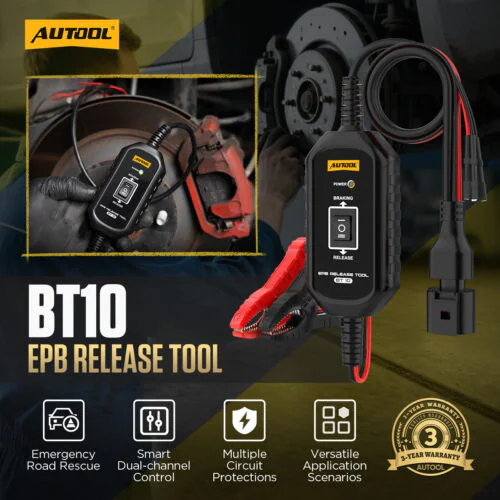
In simple terms, an EPB emergency release tool is a dedicated device that bypasses the vehicle’s factory computer and directly drives the rear parking brake motor.
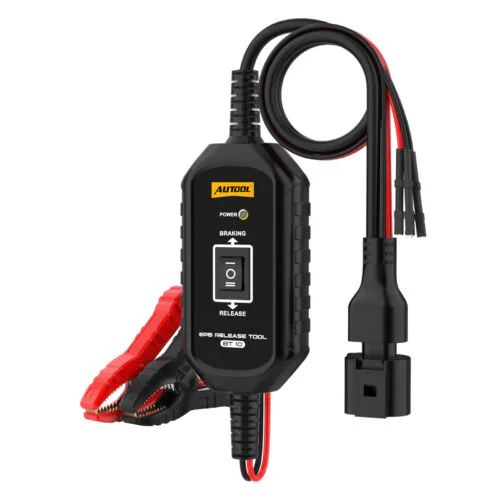
Under normal conditions, the EPB engages and releases entirely through commands issued by the vehicle’s electronic control system. But this tool requires no factory ECU, no vehicle power, and no OBD diagnostic port. It connects directly to a 12V power source, plugs into the rear brake motor connector, and manually controls the motor’s forward/reverse rotation — releasing the brake with one touch and re-locking it after service is complete.
Think of the vehicle’s electronic control system as the “brain,” and the OBD scanner as the “interpreter” talking to that brain. The EPB emergency release tool is like a set of hands that directly operates the brake mechanism — the brain can be dead, disconnected, or faulty, and the tool still works flawlessly.
In recent years, one of the biggest headaches in vehicle repair and recovery has been locked EPB systems with no solution. With mechanical handbrakes, you could simply pull the lever to release the brake — even when the vehicle was dead or broken down. But with EPB-equipped vehicles, the moment something goes wrong, you’re stuck:
Without a dedicated tool, repairs stall, response times blow out, and customer complaints pile up. That’s exactly why EPB emergency release tools are now standard equipment in every well-prepared shop.
Many technicians assume that an OBD scanner can handle any EPB issue — but that’s a major misconception. OBD works by communicating with the vehicle’s original electronic control system, which requires four conditions to be met: the vehicle must have power, the system must be intact, there must be no encryption barriers, and the wiring must be functional. If any of these conditions aren’t met, OBD is useless.
Here are three common EPB lockout scenarios where OBD is completely helpless:
When the vehicle has no power, the entire electronic control system is offline. The OBD port has no communication, no data — no way to send a release command. The EPB remains locked, and the vehicle can’t be moved or towed.
After a collision or flood, the EPB wiring or control module is often physically damaged. The factory system is dead, and OBD can’t read anything — no communication, no release.
Modern models from Tesla, BYD, VW, BMW, Mercedes-Benz, and others have factory-encrypted EPB systems. Generic OBD scanners lack the authorization to access these systems — failing every time on pad replacement or brake reset.
The EPB emergency release tool bypasses all of this. It connects directly to the brake motor, completely independent of the vehicle’s onboard systems. In every scenario above, it unlocks the brake safely and damage-free — filling the gap where OBD falls short.
No vehicle restrictions, no system barriers, no encryption issues. Covers over 99% of EPB-equipped vehicles on the market — both conventional and electric models — solving the brake reset problem on even the newest cars.
With its own external power supply, the tool works even when the vehicle is completely dead. It’s the ultimate fallback for roadside recovery.
No complex menu navigation. Just two modes: Release and Brake. No professional technical knowledge required — even a first-time user can operate it in seconds, dramatically improving efficiency.
Pure electronic drive precisely controls the motor — smooth retraction and extension without damaging the EPB motor, gears, or caliper. Eliminates the risk of secondary repairs.
Compact and easy to store — ready for roadside rescue or daily shop use. One tool handles locked EPB, brake pad replacement, and motor fault diagnosis — significantly reducing shop operating costs.
This is not a “nice-to-have” accessory. It’s a highly targeted, mission-critical tool. The following professionals and businesses should have one on hand at all times:
Recovery scenarios often involve dead batteries, accidents, or immobilized vehicles — EPB lockup is a frequent issue. OBD is useless here. The emergency release tool is often the only damage-free solution. Without it, many jobs are impossible to complete.
Routine rear brake pad replacements and brake system repairs frequently encounter computer retraction failures. Having this tool on hand allows caliper retraction to be completed quickly — improving efficiency and avoiding lost business.
Electric vehicles are universally equipped with EPB systems, with high encryption rates and sensitive electronics where OBD frequently fails. This is where an emergency release tool is most critical.
For handling complex EPB faults and power-loss diagnostics, this tool serves as a reliable backup to OBD — completing the service workflow and boosting shop professionalism.
Vehicles parked for extended periods often experience dead batteries and locked EPB systems. This tool enables quick, damage-free unlocking and maneuvering — preventing forced moves that could damage vehicles.
The EPB emergency release tool is incredibly easy to use. Just three steps — no setup, no special skills:
Step 1: External Power Connection
Connect the tool’s battery clamps (positive/negative) to the vehicle’s 12V battery terminals. The tool powers up instantly. Built-in reverse polarity protection prevents damage even if connections are reversed.
Step 2: Connect to the Brake Motor Connector
Locate the rear EPB motor connector on the vehicle. Unplug the factory connector and plug in the tool’s dedicated wiring harness. Hardware connection is complete.
Step 3: One-Button Mode Selection
Toggle to “Release” mode — the EPB motor reverses, the caliper retracts, and the brake is released. The vehicle can now be towed or pads replaced.
After service is complete, toggle to “Brake” mode — the motor returns to its normal locked position. Unplug the harness and you’re done.
No coding, no programming, no fault codes. A beginner can do it perfectly on the first try.
Without a proper tool, some technicians resort to makeshift “fixes” that appear to work in the short term — but often cause serious damage and expensive comebacks:
Forced Towing / Dragging
Dragging a vehicle with a locked EPB will destroy rear tires, score brake rotors, and in severe cases, strip EPB motor gears or burn out the motor. A problem that could have been solved for free turns into hundreds of dollars in parts and labor.
Forcibly Prying the Caliper / Manually Retracting the Piston
Prying or hammering the brake piston can deform the caliper, cause brake fluid leaks, and ruin EPB calibration accuracy. The result: brake pull, uneven pad wear, or incomplete lockup — serious safety risks that expose the shop to liability.
Pulling Fuses / Disconnecting Battery to “Reset” the System
Randomly pulling fuses or cutting power can trigger fault codes, lock the body control module, or in some cases permanently lock the EPB system — requiring expensive professional reprogramming.
Professional repair should always be damage-free, precise, and controlled. Improper repairs not only hurt your reputation — they can cost you thousands.
As EPB systems become universal, traditional repair methods and OBD-only diagnostics can no longer keep up with today’s automotive service and recovery demands. The EPB emergency release tool is not just another accessory — it’s a critical solution that fills OBD’s gaps, solves real-world industry headaches, and eliminates repair risks.
For recovery teams, it’s the only fallback for unlocking a dead vehicle’s EPB. For repair shops, it’s essential for improving efficiency, preventing improper repairs, reducing liability, and projecting professionalism. One compact tool solves EPB lockup, brake pad service, and motor diagnostics — saving time, money, and frustration. It’s one of the smartest equipment investments any shop can make today.