LANGUAGE & CURRENCY
Uncategorized
Can an Articulating Borescope Really Reveal Burnt Valves and Cylinder Scoring?

September 17, 2026
Share:
 autoolstore.com
Repair testing / 8 sub-categories
Diagnostic tools for leak tracing, visual inspection, battery health, circuits, pressure, spark, oil, and electrical readings.
Repair maintenance / 6 sub-categories
Service equipment for fluid exchange, A/C diagnostics, refrigerant recovery, oil handling, and cooling-system work.
Carbon cleaning / 3 sub-categories
Carbon-removal equipment for injectors, intake valves, components, and workshop cleaning jobs.
Wheel tire / 3 sub-categories
Equipment for alignment, lifting, tire repair, tire mounting, and service-bay workflows.
Tool storage / 1 sub-category
Storage products for keeping workshop tools, test equipment, and accessories organized.
EV charging / 1 sub-category
EV charging products for new-energy vehicle service, workshop use, and installation scenarios.
OBD diagnosis / 5 sub-categories
OBD-related testers, ECU programming power supplies, cable products, used-car inspection tools, and key frequency diagnostics.
Accessories / 8 sub-categories
Replacement parts, adapters, consumables, cables, and add-ons for major diagnostic and service equipment.
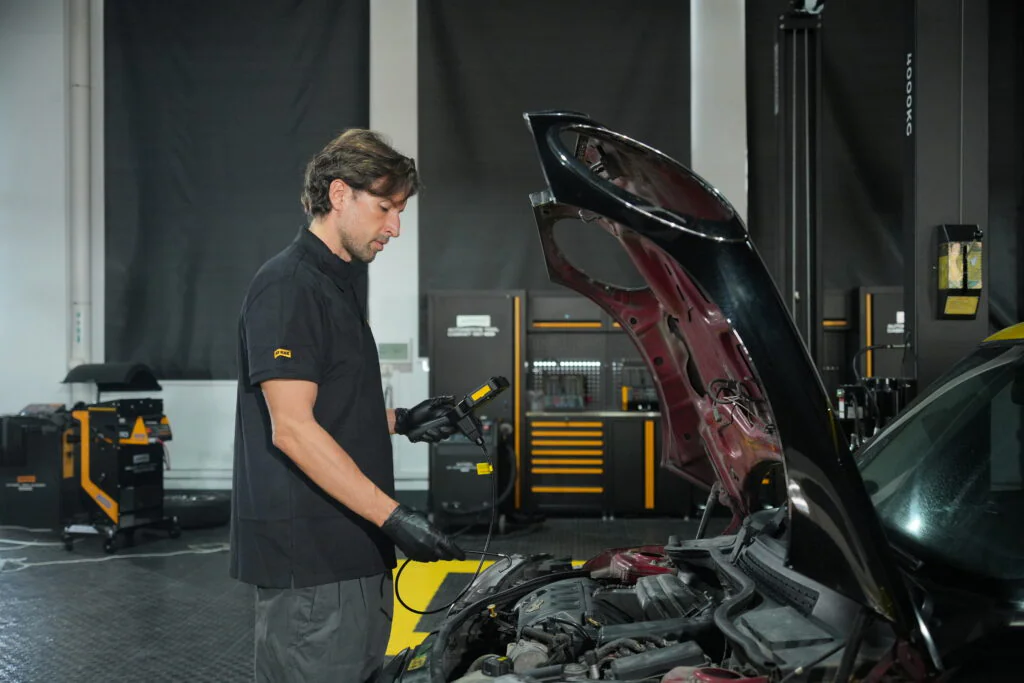
Many workshops have invested in low-cost straight-probe borescopes or flexible snake cameras, but these often fail completely when diagnosing valve issues.
Lorem ipsum dolor sit amet, consectetur adipiscing elit. Ut elit tellus, luctus nec ullamcorper mattis, pulvinar dapibus leo.
Restricted Forward-Facing View
A straight-probe borescope has a forward-facing lens. Once inserted through the spark plug hole into the cylinder, the field of view can only point straight down at the piston crown. The intake and exhaust valves sit on the inner side of the cylinder head, angled above and to the sides of the spark plug hole. The probe cannot turn inside the tight cylinder space, leaving the valve backs and seat rings in a 100% visual blind spot.
Focusing Disaster with Side-View Mirrors
Some products attempt to add a 90° reflective side-view mirror. But this optical attachment is easily contaminated and fogged by residual oil inside the cylinder. Due to its fixed focal length, the image becomes dim and blurry once inside the cylinder, making it impossible to identify hairline cylinder scoring.
Flexible Hoses Kink and Jam
Turning a standard flexible hose by hand easily causes it to curl and deform inside the narrow combustion chamber. Not only does it fail to reach the target angle, but forced dragging can also damage the sensor or drop it into the cylinder.
To clearly see valve burning, the probe must have the mechanical flexibility to “turn around and look up” within a confined space after entering the spark plug hole.
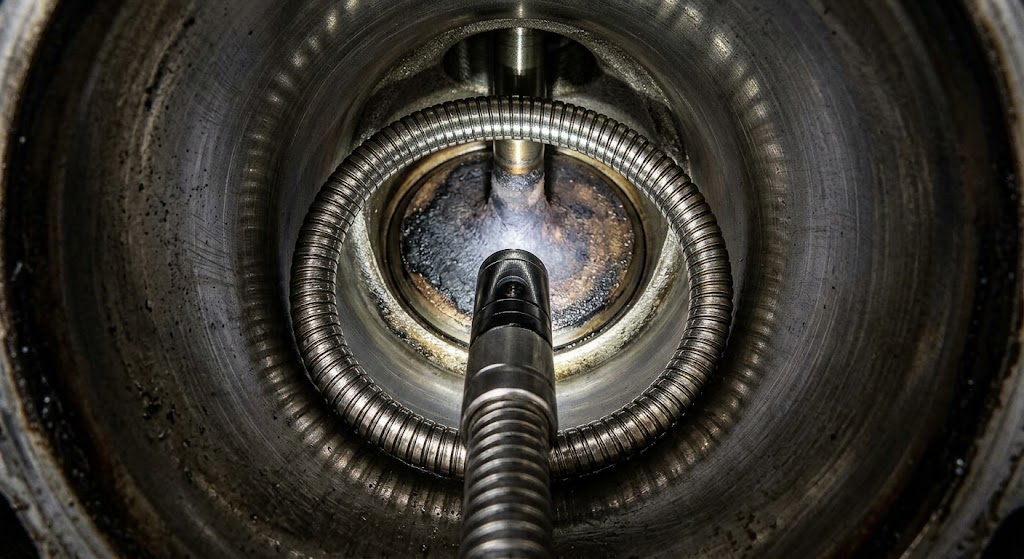
210° Extreme Bidirectional Mechanical Damped Articulation
The AUTOOL SVB series (including flagship models SVB305 and SVB308) features a precision mechanical articulation joint at the front end, driven by a mechanical roller beneath the handle. The probe diameter is as small as 6.2mm, easily passing through various strict-diameter spark plug holes or diesel injector holes. Once the probe reaches the combustion chamber and hovers above the piston, turning the roller enables 210° extreme bidirectional articulation. The lens flips directly from “looking down at the piston” to “looking up at the valves,” providing a full panoramic view of the intake valve seat ring and exhaust valve edges.
1-Megapixel Macro Depth of Field with Multi-Level High-Brightness Illumination
Designed for the narrow cylinder environment, the macro optical design optimizes depth of field within the 15mm–100mm golden imaging range, maintaining sharp clarity even when close to the cylinder wall or valve seat ring. A ring of multiple industrial-grade high-brightness LEDs illuminates the dark, enclosed metal cavity. Combined with digital smooth zoom, even stress cracks as narrow as 0.05mm on the metal substrate can be rendered in fine detail.
Burnt Valve Edges and Carbon-Sealed Combustion Chambers
When combustion is incomplete over a long period, the exhaust valve overheats under high-temperature exhaust gas scouring. The valve edge metal oxidizes and flakes off, causing the valve to close improperly and the cylinder to leak severely. By controlling the SVB probe to bend upward inside the cylinder, the contact ring between the valve head and seat ring can be directly observed. If the valve edge shows jagged flaking or red-hot discoloration with oxidation pits, a diagnosis of burnt valve or sealing failure can be confirmed immediately.
Vertical Cylinder Wall Scoring
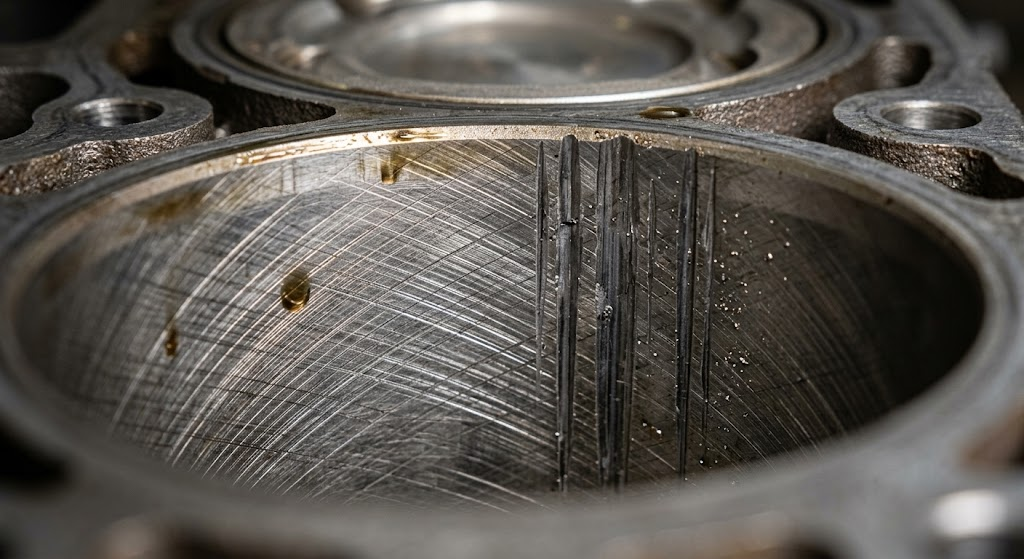
Piston ring carbon sticking, injector drip diluting the oil film, or cold-start debris scratching the cylinder wall can break cylinder sealing, causing oil consumption, blue smoke, and power loss. Bend the probe to 90° against the cylinder bore surface and slowly rotate the probe tube to scan the cylinder wall. If bright vertical grooves parallel to the piston travel direction appear, or even deep grooves, rather than the original cross-hatch honing pattern, this indicates irreversible cylinder scoring and requires immediate major overhaul.
Injector Leakage and Wet Piston Crown
When the high-pressure direct injection injector needle valve wears and fails to close properly, residual fuel drips onto the piston crown after shutdown, causing black smoke on cold start. After shutting off the engine, quickly insert the probe into the combustion chamber to observe whether there are unevaporated wet reflective fuel droplets on the piston crown edge, or an “abnormal cleaning zone” where local carbon has been washed away by injected fuel. This quickly pinpoints the faulty injector location.
Engine bays in repair shops are often filled with oil, gasoline, and coolant. Vehicles that have just arrived for inspection may have extremely hot engine blocks, and ordinary electronic products are easily damaged.
Smart High-Temperature Warning and Power-Off Protection System
For technicians inspecting cylinders while the engine is still hot, AUTOOL SVB features a built-in sensitive temperature detection probe. When the probe’s ambient temperature exceeds 80°C, a yellow high-temperature warning automatically pops up on the display. If the temperature continues to rise above 90°C, the system automatically triggers a power-off protection mechanism to shut down the camera, preventing precision chips from burning out.
IP67-Rated Corrosion-Resistant Protection Standard
The probe and gooseneck tube use a wear-resistant metal braided armor layer with extremely high tensile strength and oil contamination resistance. Even when directly immersed in brake fluid, engine oil, or antifreeze, it can be wiped clean immediately, preventing liquid seepage from corroding the probe circuitry.
A borescope is not just a diagnostic hardware tool. It’s also a marketing and communication tool that helps modern repair shops improve service acceptance rates and eliminate customer complaints.
Rebuilding Customer Trust
Relying on verbal descriptions from technicians, vehicle owners often suspect exaggerated faults. With the AUTOOL SVB handheld large-screen real-time display, owners can see scratches and carbon deposits with their own eyes, multiplying trust instantly.
Zero Time for Repair Decisions
In the past, vehicles had to be kept overnight or even disassembled before a repair plan could be given. Now, high-definition inspection images can be produced within 5 minutes of arrival, allowing owners to make decisions on the spot and naturally leading to deep repair services.
Complete Prevention of After-Sales Disputes
In the past, lacking pre-service evidence made it easy for owners to argue that “the cylinder scored after the repair.” Now, one-touch photo and video recording saves pre-service files, making responsibility boundaries clear and unambiguous.
Precise visual inspection is the technical foundation for repair shops to eliminate misjudgment and win long-term customer trust. Say goodbye to blind major disassembly and experience-based guesswork. Using a flexible articulating HD probe to reach deep into engine blind spots ensures every diagnosis has evidence and every work order is transparent and efficient.
[Image Upgrade · Professional Workshop Standard] AUTOOL SVB308 Smart Articulating Video Borescope]:
https://autoolstore.com/product/autool-svb308-articulating-borescope/
[Flexible Bidirectional · Best Value Choice] AUTOOL SVB305 Smart Articulating Automotive Industrial Borescope]: