LANGUAGE & CURRENCY
Uncategorized
Brake Fluid Problems Hiding in Plain Sight: Is Your Brake Fluid Tester the Right One?

September 2, 2026
Share:
 autoolstore.com
Repair testing / 8 sub-categories
Diagnostic tools for leak tracing, visual inspection, battery health, circuits, pressure, spark, oil, and electrical readings.
Repair maintenance / 6 sub-categories
Service equipment for fluid exchange, A/C diagnostics, refrigerant recovery, oil handling, and cooling-system work.
Carbon cleaning / 3 sub-categories
Carbon-removal equipment for injectors, intake valves, components, and workshop cleaning jobs.
Wheel tire / 3 sub-categories
Equipment for alignment, lifting, tire repair, tire mounting, and service-bay workflows.
Tool storage / 1 sub-category
Storage products for keeping workshop tools, test equipment, and accessories organized.
EV charging / 1 sub-category
EV charging products for new-energy vehicle service, workshop use, and installation scenarios.
OBD diagnosis / 5 sub-categories
OBD-related testers, ECU programming power supplies, cable products, used-car inspection tools, and key frequency diagnostics.
Accessories / 8 sub-categories
Replacement parts, adapters, consumables, cables, and add-ons for major diagnostic and service equipment.
The braking system is the core of driving safety. Most car owners pay attention to brake pads and rotors — but overlook the condition of the brake fluid itself. Brake fluid absorbs moisture and accumulates contaminants without triggering any warning lights. Yet it directly leads to brake failure — a hidden safety hazard. Regular testing of brake fluid moisture content and boiling point is an essential step in every professional maintenance routine.
Brake fluid is highly hygroscopic – it absorbs moisture from the air over time. At the same time, normal wear introduces metal particles into the fluid.
When brakes are applied heavily, temperatures rise rapidly. Moisture in the fluid vaporizes, forming compressible gas bubbles. This directly causes a spongy pedal and brake failure – especially dangerous on long descents or during aggressive driving.
Metal particles and debris wear down the master cylinder, wheel cylinders, and ABS valve bodies – causing valve sticking that damages ABS and ESP systems. They also clog lines, leading to poor fluid return and brake drag.
Contaminated fluid corrodes brake lines and rubber seals, leading to leaks.
The entire braking system wears out faster, driving up repair costs significantly.
There are two main testing technologies on the market:
Principle: Measures the electrical conductivity of brake fluid to calculate moisture content. Fast operation – results in 10 seconds. Ideal for quick screening to determine moisture absorption levels. Perfect for rapid pre-checks on high volumes of vehicles.
Principle: Heats a sample of brake fluid to measure its actual boiling point, displaying the result in °C or °F. Compares against DOT standard reference values. Direct boiling point measurement is the most authoritative indicator of brake fluid performance. Ideal for in-depth diagnostics and generating professional reports.
AUTOOL offers three professional brake fluid testers, covering quick screening, advanced diagnostics, and professional boiling point testing – matching the needs of different workshops and automotive enthusiasts.
Technology: Conductivity testing – moisture content measurement
Screen: 1.8-inch backlit display
Response Time: Results in 10 seconds
Probe: 26cm iron oxide probe
Power: 3V
Modes: Standard mode; supports 6 fluid types: ENV-4, ENV-6, DOT3, DOT4, DOT5, DOT5.1
Best For: Small repair shops, quick-service bays, DIY users – anyone seeking low-cost, fast moisture screening on high volumes of vehicles.
Not Supported: Temperature unit switching, direct boiling point measurement.
Technology: Conductivity testing – moisture content measurement
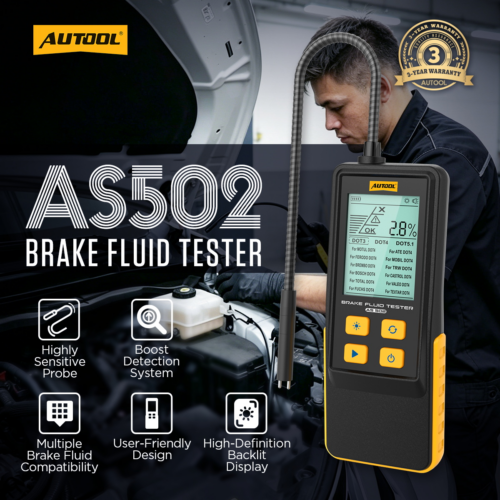
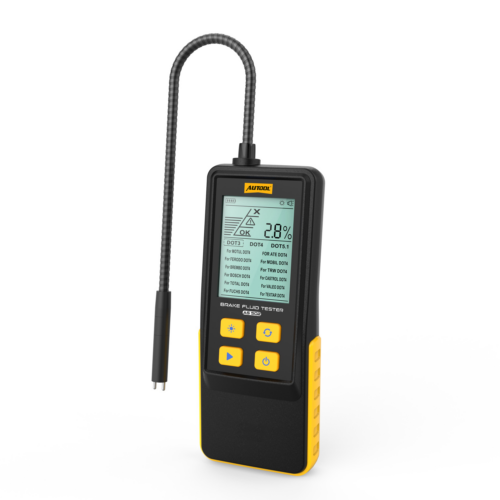
Screen: 2.8-inch larger display – shows more information
Response Time: Results in 10 seconds
Probe: 26cm 304 stainless steel probe – corrosion-resistant and longer-lasting
Power: 6V
Modes: Standard mode + Expert mode; supports 3 fluid types: DOT3, DOT4, DOT5.1
Best For: Mid-sized repair shops wanting a larger screen, durable stainless steel probe, and Expert mode for more data – perfect for fast moisture screening.
Not Supported: Direct boiling point measurement.
AS501 vs AS502: Both measure moisture content. AS502 has a larger screen, upgraded stainless steel probe, and adds Expert mode.
Technology: Flash point heating – directly measures brake fluid boiling point
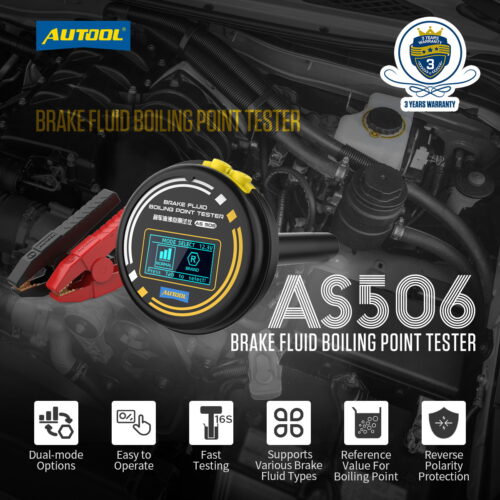
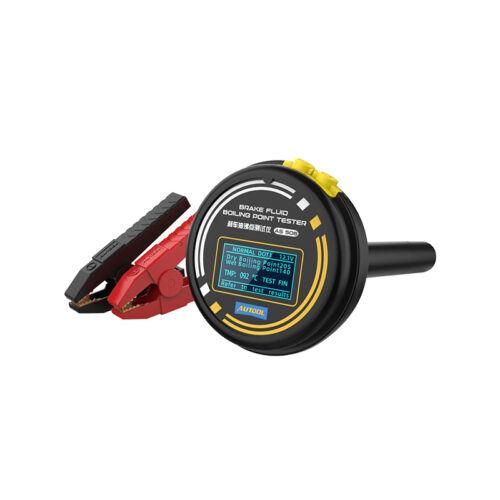
Screen: 1.54-inch display – supports °C/°F switching
Response Time: Results in 16 seconds
Power: 12V
Temperature Range: 0-320°C / 0-608°F
Modes: Standard mode + Brand mode; built-in reference values for 9 fluid standards: DOT3, DOT4, DOT4+, DOT4ESP, DOT5, DOT5.1, DOT5.1ESP, ENV4, ENV6
Comes with boiling point reference values for direct comparison – delivers professional diagnostic reports.
Best For: Large repair shops, transmission/brake specialists, testing facilities – anywhere that needs real boiling point data and professional test reports for customers.
Brake fluid is an invisible safety component – you cannot judge its condition by sight or by mileage alone. Using professional testers to assess the real condition of brake fluid helps avoid unnecessary early replacement while also detecting degraded fluid before it leads to brake failure. Choose the AUTOOL brake fluid tester that fits your shop’s needs – and elevate your professionalism with a more scientific maintenance approach.