LANGUAGE & CURRENCY
Uncategorized
How often should you change or top off your car’s coolant?

September 11, 2026
Share:
 autoolstore.com
Repair testing / 8 sub-categories
Diagnostic tools for leak tracing, visual inspection, battery health, circuits, pressure, spark, oil, and electrical readings.
Repair maintenance / 6 sub-categories
Service equipment for fluid exchange, A/C diagnostics, refrigerant recovery, oil handling, and cooling-system work.
Carbon cleaning / 3 sub-categories
Carbon-removal equipment for injectors, intake valves, components, and workshop cleaning jobs.
Wheel tire / 3 sub-categories
Equipment for alignment, lifting, tire repair, tire mounting, and service-bay workflows.
Tool storage / 1 sub-category
Storage products for keeping workshop tools, test equipment, and accessories organized.
EV charging / 1 sub-category
EV charging products for new-energy vehicle service, workshop use, and installation scenarios.
OBD diagnosis / 5 sub-categories
OBD-related testers, ECU programming power supplies, cable products, used-car inspection tools, and key frequency diagnostics.
Accessories / 8 sub-categories
Replacement parts, adapters, consumables, cables, and add-ons for major diagnostic and service equipment.
Car coolant may seem like just a liquid in the radiator, but it plays a crucial role in ensuring the engine runs stably at the proper temperature. Failing to change the coolant for an extended period, using the wrong type, or not properly bleeding the air after refilling can all lead to engine overheating, corrosion of the cooling system, and even costly repairs.
So, how often should car coolant be changed? And if the level drops, can you simply top it off? We’ll explain everything clearly below.
Automotive coolant, often referred to as “antifreeze,” typically consists of a base fluid, deionized water, and additives that provide corrosion protection, rust prevention, and anti-foaming properties. It circulates between the engine, radiator, water pump, and cooling lines, primarily serving the following functions:
• Dissipates heat generated during engine operation to prevent overheating;
• Reduces the risk of freezing in cold environments;
• Raising the boiling point to reduce boiling and evaporation at high temperatures;
• Protecting the radiator, water pump, and metal cooling lines by reducing the risk of corrosion and scale buildup;
• Providing lubrication and protection for the water pump and seals.
Therefore, coolant must not only “prevent freezing” but also provide heat dissipation, boil-over protection, corrosion protection, and system protection. Even if a vehicle is driven primarily in warm climates, tap water should never be used as a substitute for coolant.
Coolant does not last forever. As a vehicle accumulates operating time and mileage, the coolant is repeatedly exposed to high and low temperatures as well as pressure fluctuations. The additives in the coolant—such as those that provide corrosion protection and anti-foaming properties—gradually deplete, and the fluid may become contaminated with rust, deposits, or other impurities.
Even if the coolant level appears normal, this does not mean its protective properties are still adequate. Once the coolant has exceeded its service life, the following changes may occur:
1. Reduced corrosion and rust protection;
2. Changes in freezing point, boiling point, and pH;
3. Discoloration, cloudiness, or sediment formation in the coolant;
4. Compatibility issues when mixing different formulations;
5. Reduced cooling efficiency and system protection.
Regularly changing the coolant is actually a way to maintain the entire engine cooling system—not just replacing a consumable.
Aged coolant does not necessarily lead to immediate vehicle failure, but continuing to use it may increase the following risks.
Aged, low, or poorly circulating coolant may fail to dissipate heat in a timely manner, causing the coolant temperature to rise abnormally. In severe cases, this can damage the cylinder head gasket, cylinder head, or even the engine block.
As corrosion inhibitors gradually lose their effectiveness, corrosion may occur in the radiator, engine coolant passages, and metal fittings, leading to leaks or damage to the cooling lines.
Impurities, sediment, and reduced lubrication properties may accelerate wear on water pump seals and related components, affecting the normal circulation of coolant.
Long-term accumulation of rust and deposits can block narrow water passages, leading to reduced cooling performance and insufficient cabin heating.
When the coolant mixture ratio or performance does not meet specifications, its antifreeze and anti-boil capabilities are compromised. In extreme cases, freezing and subsequent expansion can damage the radiator, hoses, or engine components.
There is no one-size-fits-all answer; the correct interval should be based on your vehicle’s owner’s manual, the type of coolant, and the actual condition of your vehicle.
As a general guideline:
• Standard coolant should be replaced every 2 years or approximately 40,000 kilometers;
• Extended-life coolant usually lasts 5 years or more than 100,000 kilometers;
• Some new models come equipped with factory-installed ultra-extended-life coolant, which may last up to 10 years or nearly 200,000 kilometers before the first replacement, after which the replacement intervals will shorten.
Differences between vehicle models can be significant. For example, Toyota officially recommends that owners determine the interval based on the maintenance manual, noting that some standard-formula coolants are typically replaced every 2 years or 30,000 miles, while extended-life products may last up to 5 years or 100,000 miles; in the official maintenance schedules for some Hyundai models, the first replacement interval for OEM coolant can reach 120 months or approximately 200,000 kilometers. Therefore, one cannot assume that all vehicles follow a “replace every 2 years” rule. Toyota Coolant Replacement Guidelines; Hyundai Maintenance Interval Examples
In addition to time and mileage, you should also inspect or replace the coolant early if any of the following conditions occur:
• The coolant has noticeably changed color, become cloudy, is foaming, or has developed sediment;
• The coolant needs to be refilled after repairs to the cooling system;
• The vehicle frequently experiences abnormally high coolant temperatures;
• The coolant type is unknown, or products of different specifications have been mixed;
• Testing reveals that the freezing point, boiling point, or other performance characteristics do not meet specifications.
It is important to note that “topping off” and “replacing” are not the same thing. Topping off merely restores the fluid level; it cannot restore the performance of coolant that has already deteriorated. If the fluid level drops frequently, you should not simply keep topping it off; instead, check the reservoir, hoses, water pump, fittings, and the interior of the engine for leaks
Changing coolant involves high temperatures, high pressure, exhaust fumes, and waste fluid disposal. If you lack maintenance experience, it is recommended that you have a professional mechanic perform the task.
When the engine is hot, there may still be pressure inside the cooling system. Opening the radiator cap or expansion tank cap at this time could cause hot coolant to spray out and result in severe burns. You must wait until the engine has cooled completely before proceeding.
Consult your vehicle’s owner’s manual to confirm the coolant’s technical specifications, capacity, and mixing ratio. Do not select a product based solely on color, as identical colors do not necessarily indicate the same formulation or specifications.
Unless the product is explicitly labeled as a premixed coolant, you should dilute it with deionized or distilled water according to the manufacturer’s instructions. Do not use tap water, and do not mix coolants from different technical systems.
Before draining and refilling, inspect the radiator, water pump, hoses, clamps, expansion tank, and fittings. If the system itself has a leak, simply adding new coolant will not resolve the issue.
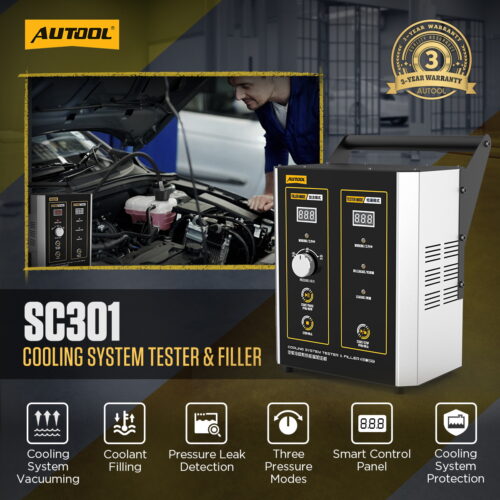
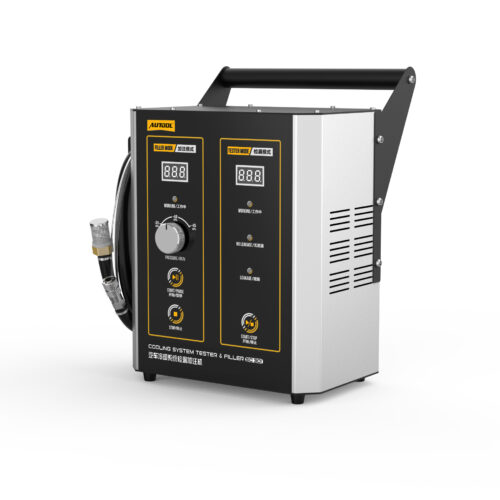
For repair shops or technicians looking to improve workflow efficiency, the AUTOOL SC301 Automotive Cooling System Leak Detection and Refill Machine can assist with the process. This device integrates cooling system leak detection and automatic coolant filling into a single unit. It assesses the system’s condition through vacuum and pressure-holding processes and displays the test results via red and green indicator lights.
Drain the old coolant into a dedicated recycling container. If the old coolant is severely cloudy, contains sediment, or if you need to switch to a different type of coolant, flush the system according to the vehicle manufacturer’s specifications.
Used coolant is hazardous to humans, animals, and the environment. It must not be poured directly into drains, soil, or regular trash; instead, it should be recycled by an authorized facility equipped to handle it.
During traditional manual filling, residual air in the system can create air locks, leading to poor coolant circulation, fluctuating engine temperatures, or abnormal heater performance. Consequently, bleeding the system after filling often takes a significant amount of time.
The AUTOOL SC301 uses vacuum technology to assist in extracting air from the system and then automatically draws in new coolant, thereby helping to reduce air residue and shorten the filling time. The device offers three vacuum pressure settings and comes with connectors of various sizes to accommodate most common vehicle models, allowing a single person to complete both leak testing and fluid filling. During actual use, select the appropriate setting based on the vehicle model and strictly follow the product manual and vehicle service manual.
After refilling is complete, perform bleed and operational checks in accordance with the vehicle manufacturer’s specifications to confirm that:
• The coolant level is within the specified range;
• The engine temperature remains normal;
• The heater system is functioning properly;
• There are no leaks in the hoses or fittings;
• The fluid level remains within the required range after the engine has completely cooled down.
If the coolant level drops rapidly again, immediately investigate the cause of the leak rather than continuing to top it off blindly.
The replacement interval for automotive coolant varies depending on the vehicle model and product type. For standard coolant, a general guideline is every 2 years or approximately 40,000 kilometers; for long-life coolant, the interval may extend to 5 years, 100,000 kilometers, or even longer. However, you must always follow the specifications outlined in your vehicle’s owner’s manual.
During daily use, the coolant level and condition should be checked regularly. If the level is low, top up with a product that meets the original equipment manufacturer’s specifications; if the coolant has aged, become contaminated, or reached the specified replacement interval, it should be completely replaced. Never mix coolants of unknown specifications, and never open the cooling system while the engine is hot.
For auto repair shops, fleets, and professional technicians, standardized leak detection, vacuuming, and refilling procedures can reduce the risk of rework. The AUTOOL SC301 combines cooling system leak detection with automatic refilling, enabling a single technician to perform coolant maintenance more efficiently and making the replacement process more standardized and faster.