LANGUAGE & CURRENCY
Uncategorized
Why is the cost of refrigerant charging so high?

August 24, 2026
Share:
 autoolstore.com
Repair testing / 8 sub-categories
Diagnostic tools for leak tracing, visual inspection, battery health, circuits, pressure, spark, oil, and electrical readings.
Repair maintenance / 6 sub-categories
Service equipment for fluid exchange, A/C diagnostics, refrigerant recovery, oil handling, and cooling-system work.
Carbon cleaning / 3 sub-categories
Carbon-removal equipment for injectors, intake valves, components, and workshop cleaning jobs.
Wheel tire / 3 sub-categories
Equipment for alignment, lifting, tire repair, tire mounting, and service-bay workflows.
Tool storage / 1 sub-category
Storage products for keeping workshop tools, test equipment, and accessories organized.
EV charging / 1 sub-category
EV charging products for new-energy vehicle service, workshop use, and installation scenarios.
OBD diagnosis / 5 sub-categories
OBD-related testers, ECU programming power supplies, cable products, used-car inspection tools, and key frequency diagnostics.
Accessories / 8 sub-categories
Replacement parts, adapters, consumables, cables, and add-ons for major diagnostic and service equipment.
Many car owners head to a repair shop to have refrigerant topped up after discovering their car’s air conditioning is no longer cooling effectively. However, upon seeing the bill, many ask the same question: “Why does adding just a little refrigerant cost so much?”
In reality, the cost of automotive A/C repair involves more than just the price of the refrigerant itself. Factors such as the type of refrigerant, the maintenance equipment used, labor costs, and environmental regulations all directly influence the final price.
Costs have risen significantly compared to the past, particularly as R1234yf has increasingly become the standard refrigerant for new vehicles.
So, is refrigerant really that expensive? How often does a car’s refrigerant need to be replaced? Can the use of automated refrigerant charging equipment at repair shops help lower costs?
Currently, there are two main types of refrigerants commonly used in the automotive market:
R134a has long served as the standard refrigerant for automotive air conditioning systems.
Its advantages include:
• Mature technology
• Plentiful supply
• Relatively low cost
• Widespread availability of service equipment
For most conventional internal combustion engine vehicles, a full charge typically requires only about 500g to 800g.
Consequently, the material cost of R134a itself is not particularly high.
As environmental regulations become increasingly stringent, more new vehicle models are adopting R1234yf.
Compared to R134a, R1234yf offers:
• A lower Global Warming Potential (GWP)
• Better compliance with European and American environmental standards
• A more eco-friendly profile
However, its price is typically several times higher than that of R134a.
For an air conditioning system of the same capacity, the cost of R1234yf refrigerant can be several times higher—or even more—than that of R134a.
This is a key reason why many car owners find that:
Air conditioning repair costs for new energy vehicles or newer models are significantly higher than those for older models.
In reality, the fees charged by repair shops typically cover:
• Refrigerant costs
• Vacuuming process
• System diagnostics
• Equipment depreciation
• Technician labor
• Refrigerant recovery and disposal
Therefore, the amount paid by the car owner covers far more than just the purchase of the refrigerant itself.
Especially when old refrigerant recovery, leak detection, and recharging are required, the entire repair process can take anywhere from 30 minutes to over an hour.
Many car owners believe that A/C refrigerant, like engine oil, requires periodic replacement.
In reality, this is not the case.
Automotive air conditioning is a sealed system.
Theoretically:
• Refrigerant is not consumed.
• It does not degrade like engine oil.
• There is no fixed replacement interval.
If the system remains completely sealed, it can function properly for years—or even over a decade.
As a vehicle ages:
• Seals age and deteriorate.
• Pipe connections loosen.
• The condenser corrodes.
• Compressor seals wear out.
Any of these factors can lead to a slow refrigerant leak.
When refrigerant levels are low, the following symptoms typically occur:
• Reduced cooling performance.
• Air output is not cold enough.
• Frequent compressor cycling (starting and stopping).
• The A/C stops cooling entirely.
In this situation, the priority is not simply to top up the refrigerant, but to first check the system for leaks.
If the leak is not repaired, the same problem is likely to recur within a few months, even after refilling the refrigerant.
The answer is: Yes, they save money in the long run.
In the past, many repair shops relied on manual pressure gauges for operations:
• Manual recovery
• Manual vacuuming
• Manual charging
• Manual weighing
This approach is not only time-consuming but also prone to charging errors.
How does automatic refrigerant charging equipment reduce costs?
Modern refrigerant recovery and charging machines can automatically perform:
• Refrigerant recovery
• Refrigerant purification
• Vacuuming
• Leak detection
• Precision charging
The entire process becomes more standardized.
This offers several advantages for repair shops:
Reduced refrigerant waste
Refrigerant prices are constantly rising, especially for R1234yf.
Automatic recovery systems can recover and purify used refrigerant, minimizing direct emissions and waste.
Increased work efficiency
Traditional manual operations can take over 40 minutes.
Automatic equipment shortens operation times, allowing for a higher volume of vehicles serviced daily.
Improved charging precision
Overcharging or undercharging affects air conditioning performance.
Automatic weighing systems ensure precise charging according to manufacturer specifications, enhancing repair quality.
Lower labor costs
The equipment automates most of the process, allowing technicians to handle other repair tasks simultaneously.
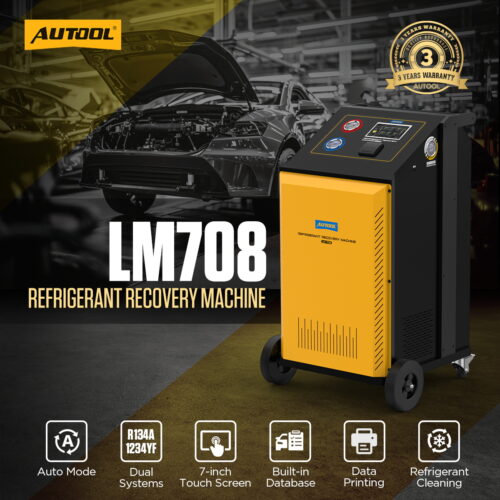
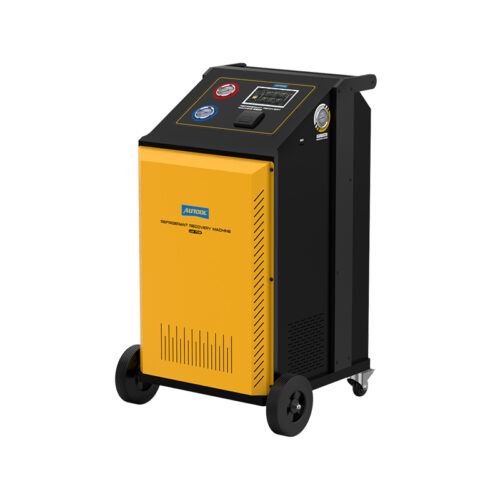
How does the AUTOOL LM708 help repair shops boost profitability?
For professional repair shops, the AUTOOL LM708 refrigerant recovery and charging machine enables:
• Fully automatic refrigerant recovery
• Automatic vacuuming
• Automatic charging
• High-precision electronic weighing
• Refrigerant purification and reuse
Especially as R1234yf becomes increasingly common, the cost savings from reduced refrigerant waste will become more significant.
For shops with a high volume of A/C repair business, an automatic refrigerant recovery and charging machine can often pay for itself within a short period.
The high cost of automotive A/C refrigerant recharging is not solely due to the price of the refrigerant itself.
From the shift from R134a to the more expensive R1234yf, and through processes ranging from refrigerant recovery and system diagnostics to the use of specialized equipment and professional labor, every step influences the final repair cost.
For vehicle owners, the A/C system does not require periodic refrigerant replacement; refrigerant only needs to be topped up or fully recharged following a leak or system repair.
For repair shops, adopting automated refrigerant recovery and recharging equipment has become a key strategy to boost efficiency, minimize refrigerant loss, and increase profits. Fully automatic units like the AUTOOL LM708 not only enhance repair quality but also help shops achieve greater operational efficiency in an increasingly competitive market.