ภาษาและสกุลเงิน
GAP
How to Choose an Automotive Smoke Leak Detector? AUTOOL คู่มือการเลือกรุ่น

September 21, 2026
แบ่งปัน:
 ออโต้ลสโตร์.com
การทดสอบการซ่อมแซม / 8 หมวดหมู่ย่อย
เครื่องมือวินิจฉัยสำหรับตรวจสอบการรั่วไหล การตรวจสอบด้วยสายตา สุขภาพแบตเตอรี่ วงจร แรงดัน ประกายไฟ น้ำมัน และการวัดค่าทางไฟฟ้า
งานซ่อมบำรุง / 6 หมวดหมู่ย่อย
อุปกรณ์บริการสำหรับเปลี่ยนถ่ายของเหลว การวินิจฉัยปัญหาเครื่องปรับอากาศ การกู้คืนสารทำความเย็น การจัดการน้ำมัน และงานเกี่ยวกับระบบทำความเย็น
การทำความสะอาดคาร์บอน / 3 หมวดหมู่ย่อย
อุปกรณ์กำจัดคาร์บอนสำหรับหัวฉีด วาล์วไอดี ชิ้นส่วนต่างๆ และงานทำความสะอาดในโรงงานซ่อมรถยนต์
ยางล้อ / 3 หมวดหมู่ย่อย
อุปกรณ์สำหรับงานตั้งศูนย์ล้อ งานยก งานซ่อมยาง งานติดตั้งยาง และขั้นตอนการทำงานในศูนย์บริการ
ที่เก็บเครื่องมือ / 1 หมวดหมู่ย่อย
ผลิตภัณฑ์สำหรับจัดเก็บเครื่องมือช่าง อุปกรณ์ทดสอบ และอุปกรณ์เสริมต่างๆ ให้เป็นระเบียบ
การชาร์จรถยนต์ไฟฟ้า / 1 หมวดหมู่ย่อย
ผลิตภัณฑ์สำหรับการชาร์จรถยนต์ไฟฟ้า สำหรับการใช้งานในศูนย์บริการ อู่ซ่อมรถ และการติดตั้งรถยนต์พลังงานใหม่
การวินิจฉัย OBD / 5 หมวดหมู่ย่อย
อุปกรณ์ทดสอบที่เกี่ยวข้องกับ OBD, แหล่งจ่ายไฟสำหรับตั้งโปรแกรม ECU, ผลิตภัณฑ์สายเคเบิล, เครื่องมือตรวจสอบรถยนต์มือสอง และเครื่องมือวินิจฉัยความถี่กุญแจ
อุปกรณ์เสริม / 8 หมวดหมู่ย่อย
ชิ้นส่วนอะไหล่ อะแดปเตอร์ วัสดุสิ้นเปลือง สายเคเบิล และอุปกรณ์เสริมสำหรับอุปกรณ์วินิจฉัยและซ่อมบำรุงหลักๆ
When a vehicle develops rough idling, reduced power, increased fuel consumption, or EVAP-related trouble codes, the leak may be hidden in a hose, connector, O-ring, or fuel tank vent line. A smoke leak detector turns an invisible air leak into a visible smoke trail, making the leak easier to locate. However, different models vary significantly in their air supply, output pressure, monitoring capabilities, and applications. Comparing models based only on price can result in choosing a unit that does not fit the actual job. A better approach is to consider the systems being tested, the working environment, and how frequently the equipment will be used.
If EVAP leak testing is the main application, low-pressure control should be a priority. EVAP lines and components are relatively sensitive, so the test pressure must comply with the vehicle manufacturer’s service information. Pressure should never be increased simply to make smoke appear faster. A fixed low-pressure model is straightforward to operate and is suitable for leak detection in fuel tanks and vapor lines, as well as around related valves.
If the equipment is also used regularly to check intake manifolds, vacuum hoses, exhaust connections, crankcases, vehicle seals, or low-pressure turbocharger piping, a wider range of applications is more useful. Professional repair shops can also choose a model with a pressure gauge, flow meter, and flow control. This allows technicians to check whether the system can build pressure before introducing smoke, then use the smoke to pinpoint the exact leak location.
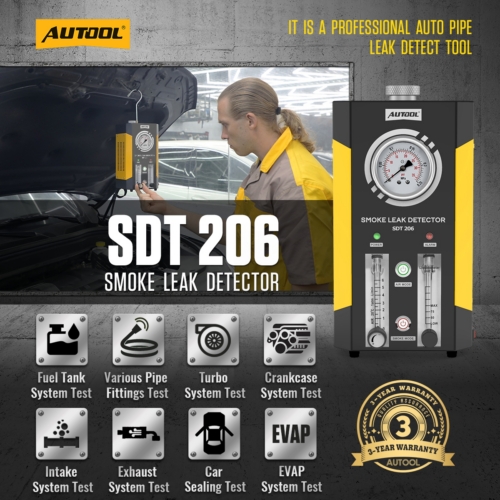
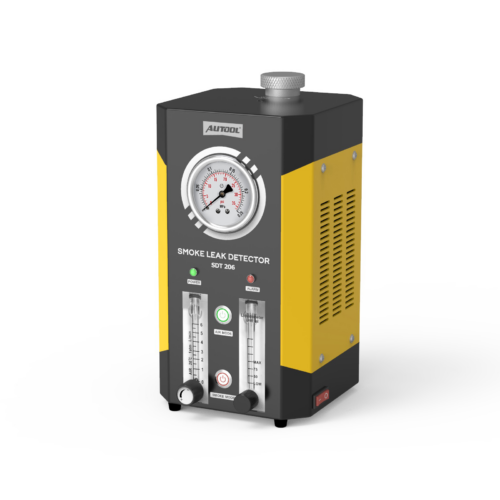
Models with a built-in air pump do not require a shop air compressor. They can generate airflow once connected to the vehicle’s power supply, making them suitable for home garages, mobile repairs, and workstations where the equipment needs to be moved frequently. The AUTOOL SDT206 uses a built-in air pump and a portable design for low-pressure testing of permitted EVAP systems, intake and exhaust systems, fuel tanks, and common lines. For first-time buyers of an automotive smoke leak tester, this type of equipment requires fewer preparation steps and can be put into operation more quickly.
Models that use an external air supply are more suitable for repair shops that already have a compressed-air system. The AUTOOL SDT101 uses an external air supply and controls the test-end output pressure to a fixed 0.46 PSI, making it suitable for working environments where low-pressure testing such as EVAP testing is the main requirement and a built-in air pump is not necessary. The input pressure from the air compressor is not the same as the pressure delivered by the equipment to the vehicle system. The equipment’s pressure-regulating structure should not be bypassed during use.
A basic smoke leak machine mainly relies on smoke to locate leaks, while pressure and airflow feedback can help technicians determine system conditions more quickly. After the system is properly sealed, if pressure cannot be established or continues to drop, there may be a leak, an improperly sealed connection, or an incorrectly positioned valve. A consistently high flow rate also indicates that air is still escaping from the system.
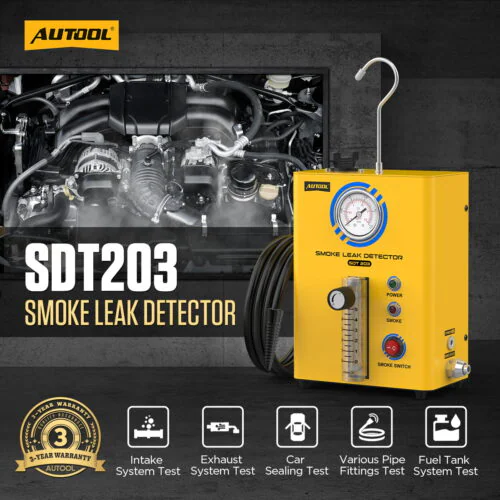
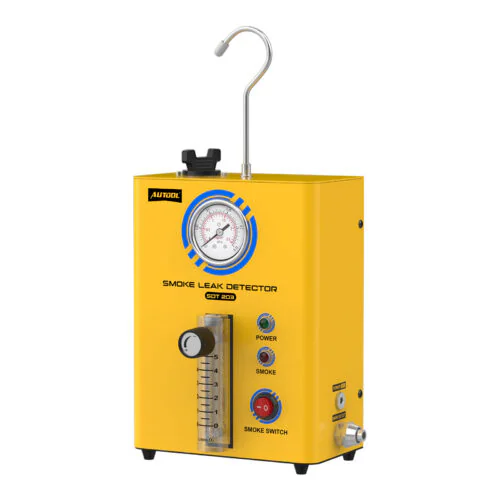
การขอ AUTOOL SDT203 integrates a built-in air pump, pressure gauge, flow meter, and flow control knob. Technicians can check pressure and airflow before introducing smoke to locate the leak, making it suitable for DIY users and repair technicians who want clearer test feedback. Flow adjustment also helps match the airflow to systems with different volumes instead of testing every system at the same output.
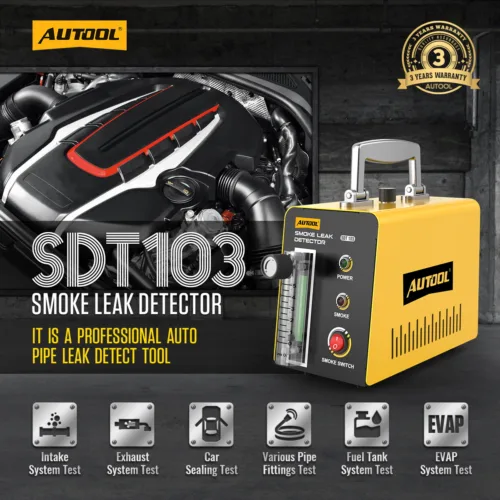
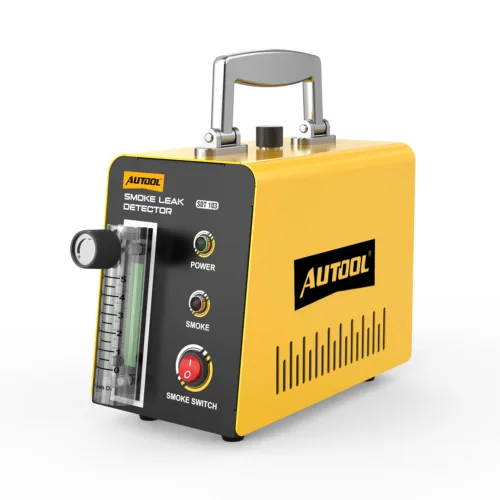
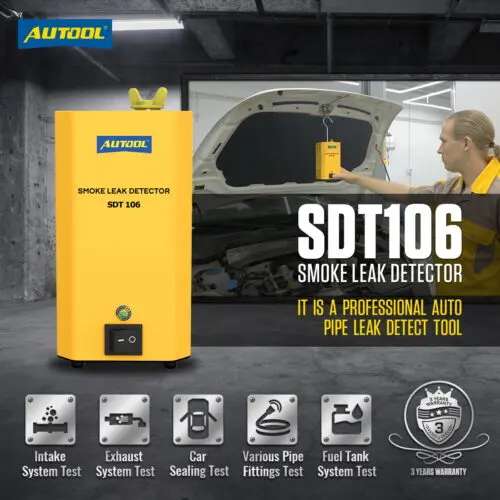
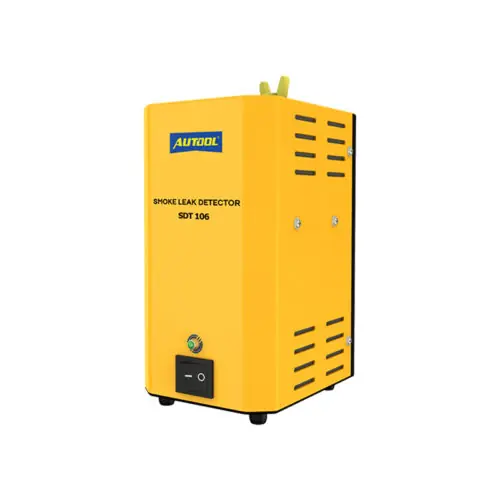
For users who only occasionally service their own vehicles, portability, easy connection, and no need for an additional air supply are often more important. A built-in-pump model such as the SDT106 is a suitable option. If EVAP testing is the primary application and a shop already has an air supply, the fixed low-pressure SDT101 can be considered. If airflow monitoring and adjustment are also needed, the SDT103 adds a flow meter and flow control, making changes in airflow easier to monitor.
General repair shops that work with different vehicle models and a variety of low-pressure systems can choose the SDT203 for more comprehensive functionality. It balances portability, pressure monitoring, and flow adjustment, making it suitable for routine intake, exhaust, EVAP, fuel tank, and seal testing.
For high-frequency professional testing, the AUTOOL SDT206 uses dual built-in air pumps and provides independent air and smoke modes, along with pressure and flow feedback, oil-level monitoring, and an oil-drain design. Technicians can first use air mode to check the system condition, then switch to smoke mode to locate the leak. This also makes routine maintenance more straightforward.
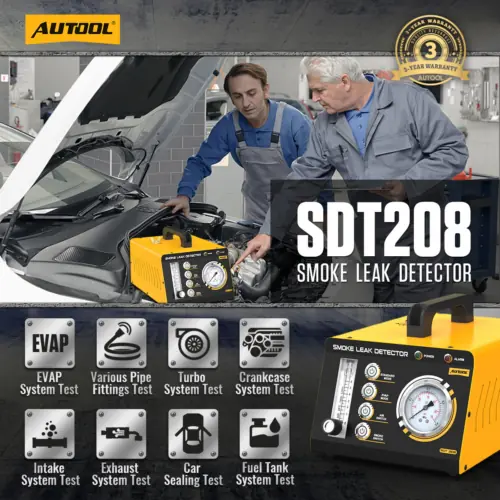
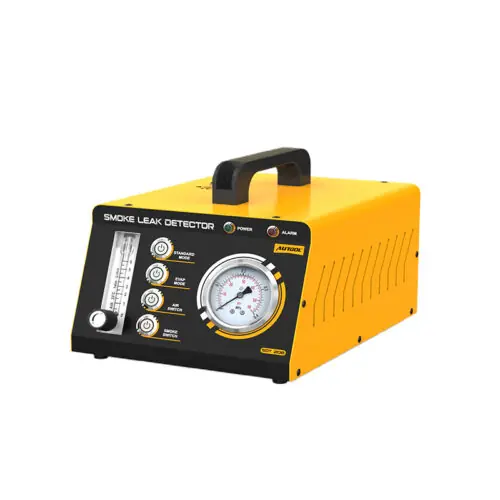
If different pressure levels or 24V vehicles are also involved, the SDT208 provides EVAP and standard-pressure modes, 12V/24V power supply, and pressure and flow monitoring. Multiple modes do not mean that the pressure can be increased arbitrarily. The allowable test pressure for the vehicle or component should always be confirmed before selecting a mode.
When the main functions of different models are similar, the included accessories can have a significant impact on actual use. Before purchasing, the package contents should be checked to confirm whether a smoke hose, cone adapters, EVAP connectors, inflatable sealing bladders, power cables, and commonly used adapters are included. The right connectors can reduce setup time and prevent false results caused by poorly sealed test ports. For applications involving a wide range of vehicle models, broader accessory coverage is often more practical than simply choosing a unit with higher output.
Test oil requirements, single continuous working time, overheat protection, consumable supply, and warranty policy should also be understood. The more frequently the device is used, the more important clear oil level checks, oil drain design, and reliable after-sales support become.
AUTOOL after-sales guarantee: We provide a three-year warranty. If any non-human-caused accessory damage occurs within three years, we will replace the accessory free of charge. A dedicated after-sales technical team is also available to handle service needs at any time.
Finally, maximum pressure and smoke output should not be the only factors considered. Higher output is not necessarily better for delicate lines. What matters is whether the equipment can operate steadily within the allowable range of the system being tested. A list of regularly serviced vehicle types, daily test volume, and available air supply can provide a more practical basis for model selection than specifications alone.
The key to choosing a smoke leak detector is not to select the product with the highest specifications, but to match the equipment to the testing task: individual users can prioritize portability and a built-in air pump; dedicated EVAP testing requires stable low-pressure control; general repair shops can benefit from pressure and flow feedback; and high-frequency professional workshops need more comprehensive control and maintenance features.
เรียกดู AUTOOL Smoke Leak Detector series and compare based on vehicle type, test system, air supply conditions, and usage frequency. That’s how to find the model that truly fits the workflow—and makes every leak check more efficient and more reliable.