Engine Basics
The automobile engine is often described as the heart or soul of the car because it determines power, fuel economy, stability, emissions, reliability, and service life. Although an engine is a complex system, its basic principles are consistent: it converts fuel energy into mechanical power that moves the vehicle. This article explains the role of the automobile engine, common engine classifications, the four-stroke and two-stroke work cycles, the crank connecting rod mechanism, and the gas distribution mechanism. Understanding these basics helps car owners better understand how an engine works and why regular maintenance matters.
Engine Role

What does the automobile engine do?

1. The Engine Converts Fuel Energy Into Mechanical Power

An automobile engine converts the heat energy of gasoline combustion into mechanical energy. Expanding combustion gas pushes the piston, and the engine then transfers that movement into rotating power for the vehicle. Automobile engines can be classified in several ways:
  • Intake systemCommon types include naturally aspirated, turbocharged, mechanically supercharged, and double supercharged engines.
  • Piston movementEngines may use reciprocating pistons or rotary pistons.
  • Number of cylindersEngines may be single-cylinder or multi-cylinder designs.
  • Cooling methodCommon cooling designs include water-cooled and air-cooled systems.
  • Number of strokesInternal combustion engines may use a four-stroke or two-stroke cycle.
Beyond providing power, the engine helps control acceleration, deceleration, and stopping behavior through the vehicle’s drivetrain systems. It also affects acceleration, top speed, fuel economy, carbon dioxide emissions, nitrogen oxides, particulate matter, reliability, and durability.
Work Cycle

What are the principles and processes of an automobile engine?

2. Gasoline Engines Use Mechanisms and Systems to Complete the Work Cycle

A gasoline engine typically includes the crank linkage mechanism, gas distribution mechanism, and five main systems: fuel supply, lubrication, cooling, ignition, and starting. A diesel engine also has two main mechanisms, but it usually has four systems because it does not use a gasoline-style ignition system. The working principle of an automobile engine involves converting thermal energy into mechanical energy through four processes:

  • IntakeThe air-fuel mixture enters the cylinder.
  • CompressionThe mixture is compressed inside the cylinder.
  • Power strokeThe mixture ignites, combustion gas expands, and the piston is pushed downward.
  • ExhaustCombustion gas is expelled from the cylinder.
These four processes make up one work cycle in a four-stroke engine. In a four-stroke engine, the crankshaft rotates twice and the piston moves four times to complete one cycle. In a two-stroke engine, the crankshaft rotates once and the piston moves twice to complete one cycle. Today, most automobiles use four-stroke engines because they offer better fuel efficiency, reliability, and durability. Four-stroke, water-cooled, in-line or V-type reciprocating engines are common in modern vehicles.
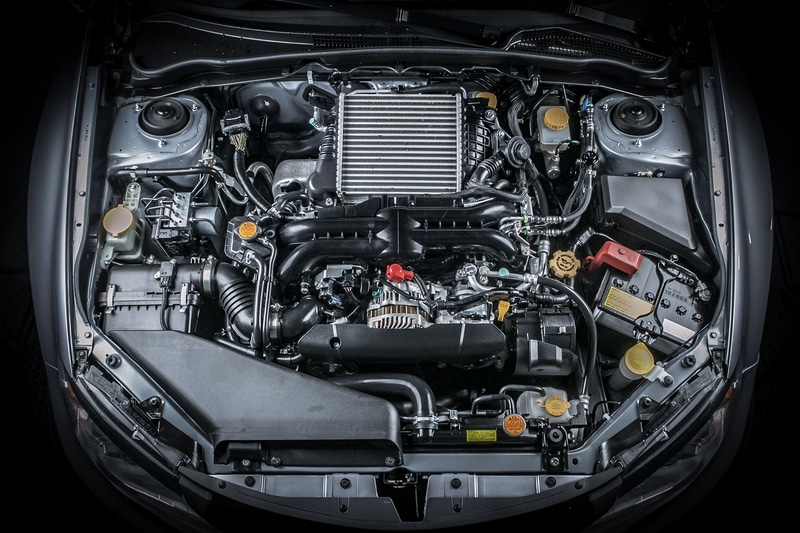
Automobile engine structure and work cycle illustration
Image source: Animagraffs / Facebook video
Two-Stroke Cycle

How does a two-stroke gasoline engine work?

3. A Two-Stroke Gasoline Engine Works Through Two Strokes and Gas Exchange

The operation of a two-stroke gasoline engine can be summarized in three stages: the first stroke, the second stroke, and the gas exchange process.
  • First strokeThe piston moves upward from the lower stop. The engine closes the three air holes, opens the intake ports, and lets the combustible mixture enter the crankcase. As the piston moves upward, it compresses the mixture for the next combustion process.
  • Second strokeThe spark plug ignites the mixture, gas expands, and the piston is pushed downward. At the same time, the intake port closes and the mixture in the crankcase is compressed for the next gas exchange.
  • Gas exchangeAs the piston approaches the lower stop, the exhaust port opens and exhaust gas leaves the cylinder. The gas change opening then allows the pre-compressed combustible mixture to rush into the cylinder and help discharge remaining exhaust gas.
The gas exchange process is central to two-stroke engine work because it provides the next power base for combustion.
Crank Linkage

What is the crank connecting rod mechanism?

4. The Crank Connecting Rod Mechanism Turns Piston Force Into Torque

The crankshaft connecting rod set is a key engine component. It converts the gas force acting on the piston and connecting rod into torque, then drives the transmission, gas distribution mechanism, and other auxiliary devices. During operation, the crankshaft experiences bending and torsional alternating loads caused by gas forces, inertia, and moment changes. Its main functions include:
  • Complete the work cycleThe mechanism supports the engine’s energy conversion process by turning thermal energy from fuel combustion into mechanical movement.
  • Transmit powerThe crank linkage transfers engine output to the vehicle’s transmission system so the vehicle can move.
  • Affect performance and efficiencyThe structure and manufacturing quality of the crank connecting rod mechanism directly affect engine performance, efficiency, durability, and reliability.
Gas Distribution

How does the gas distribution mechanism work?

5. The Gas Distribution Mechanism Controls Intake and Exhaust Valves

The gas distribution mechanism opens and closes the intake and exhaust valves at the correct time. This allows the air-fuel mixture to enter the cylinder and lets exhaust gases leave after combustion. The crankshaft drives the camshaft through timing gears. The camshaft then moves rocker arms through tappets and push rods. When the cam apex passes the tappet, the valve closes under spring pressure. The gas distribution mechanism includes valve transmission parts and valve groups, such as timing gears, tappets, push rods, rocker arms, valves, valve guides, springs, oil seals, and valve seats. Its timing is determined by the engine’s work cycle and cylinder ignition sequence. During compression and power strokes, closed valves keep the combustion chamber sealed. Correctly timed valve opening and closing ensures normal engine operation.
Conclusion

6. Understanding Engine Structure Helps With Better Maintenance

There are many engine types on the market, but their basic principles are similar. Understanding the engine’s role, work cycle, crank connecting rod mechanism, and gas distribution mechanism helps car owners better understand the vehicle’s powertrain. The original article also notes that future articles will continue to explain engine knowledge. If you have ideas or questions, you can discuss them in the comment section.

Related Products

Rendered through WooCommerce product shortcode so the cards inherit the global product-card structure and Blocksy/WooCommerce styles.

Leave a Reply

Vaše e-mailová adresa nebude zveřejněna. Vyžadované informace jsou označeny *